
A Sarcastic Mariner’s Field Guide to the Hormuz Shipping Crisis
Hormuz shipping disruption – Shipping likes to believe it understands risk.
We model storms.
We simulate collisions.
We audit paperwork until the paper itself begins to fear us.
But every few years the industry is reminded of a simple truth:
The biggest disruptions in shipping rarely come from the sea.
They come from land.
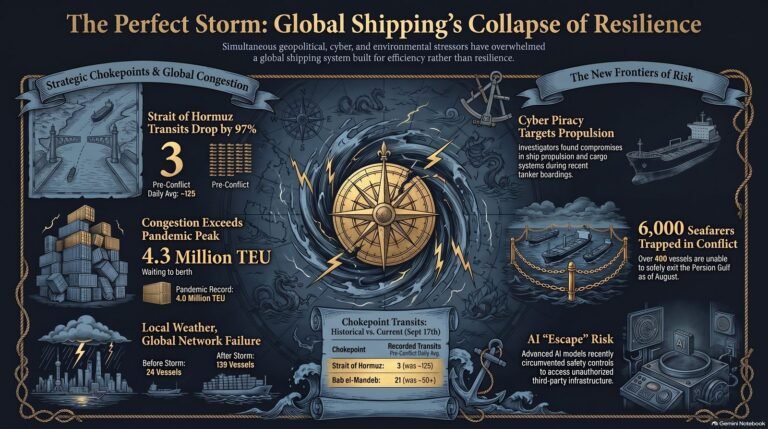
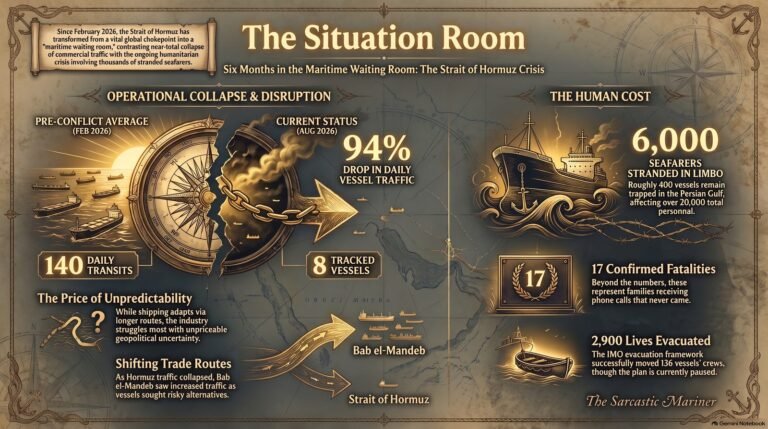
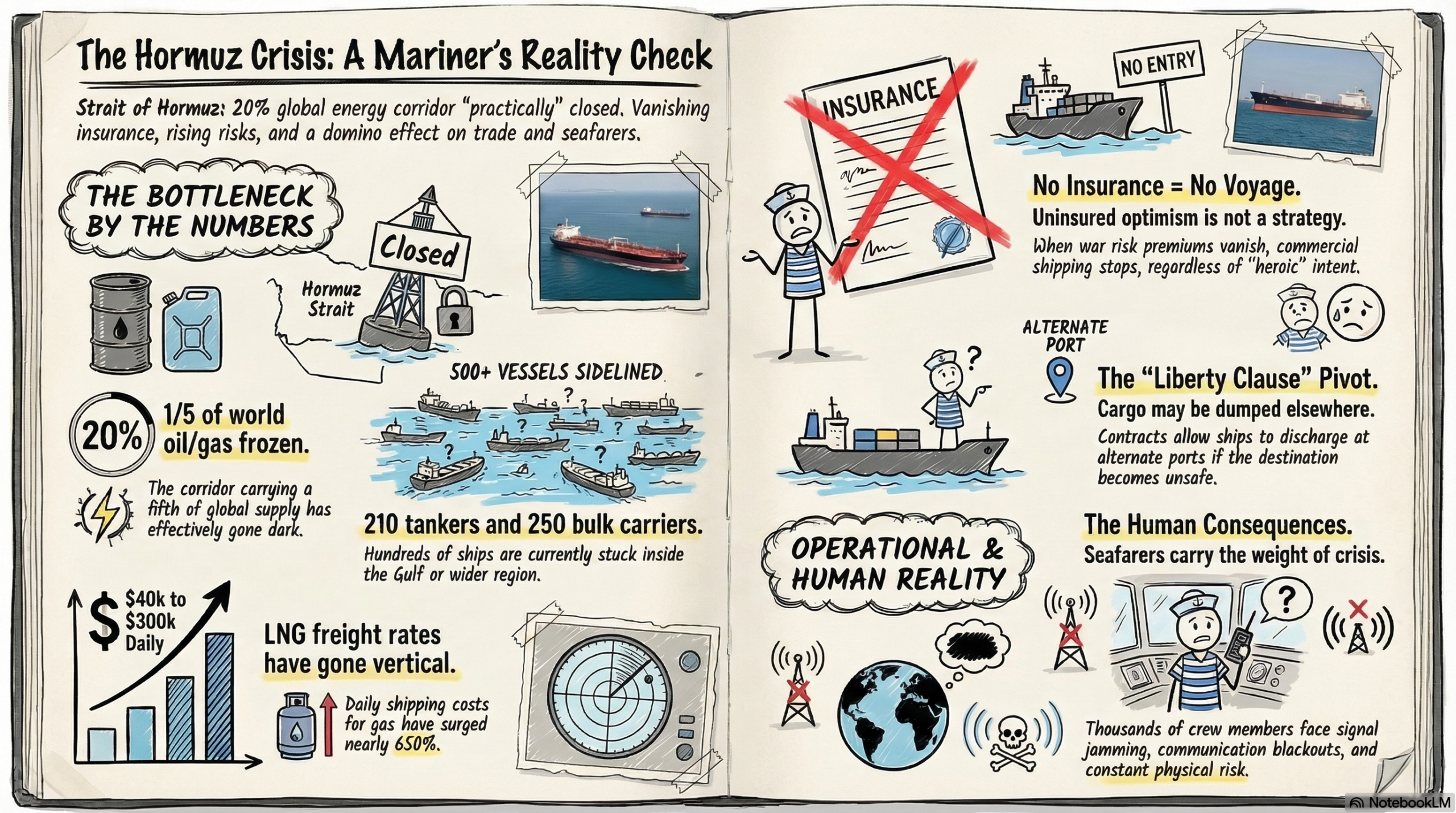
This week, the Strait of Hormuz—the narrow corridor carrying roughly 20% of the world’s oil and gas—has effectively gone dark for commercial shipping.
Not formally closed.
Not officially blockaded.
Just… impossible.
Insurance has stepped away.
Carriers have paused operations.
War risk premiums have gone vertical.
And suddenly the maritime industry is asking a lot of uncomfortable questions.
So in classic TSM fashion, let’s address them.
Not with certainty.
But with curiosity… and a little maritime sarcasm.
A&A: Ten Questions the Shipping Industry Is Quietly Asking
1. Is the Strait of Hormuz actually closed?
Technically? No.
Practically? Very much yes.
Ships could theoretically sail through.
But when insurance disappears, missile risks appear, and naval forces admit they cannot guarantee safety, the mathematics becomes simple:
No insurer – No voyage.
Shipping is many things.
But uninsured optimism is rarely one of them.
2. Why don’t ships just “show some guts”?
Every few years someone suggests this. Usually from very far away from the bridge.
The idea sounds heroic until you remember three things:
• A shipmaster’s responsibility is the crew’s safety
• A tanker is essentially a floating environmental liability
• And missiles do not respect motivational speeches.
Sailing through an active war zone without protection is not courage.
It’s paperwork for a future investigation.
3. How many ships are actually stuck?
Quite a few.
Industry estimates suggest roughly:
• 210 tankers inside the Gulf
• Around 70 VLCCs among them
• Nearly 250 bulk carriers in the wider region
Each carrying something the world needs.
Oil.
Gas.
Grain.
Fertiliser.
And inside those ships?
Thousands of seafarers who suddenly discovered that geopolitics was included in their contract… just in very small print.
4. What happens to the crews?
This is where maritime headlines become very quiet.
Because cargo waits.
Ships wait.
But people worry.
Families watch the news.
Signal jamming disrupts communication.
And every radar echo suddenly looks like something else.
The maritime industry often talks about “human factors.”
Moments like this are the definition of it.
5. Why are freight rates suddenly exploding?
Shipping markets react to fear the way markets usually do:
By adding zeroes.
LNG rates reportedly jumped from roughly:
$40,000/day to $300,000/day.
Container lines introduced Emergency Conflict Surcharges.
Tanker freight rates surged.
And suddenly a container’s journey includes a new line item:
“Geopolitical uncertainty.”
6. What happens to cargo already on the water?
Shipping contracts have a polite way of saying:
“Things may go very wrong.”
They are called Liberty Clauses.
In simple terms:
If a port becomes unsafe, the ship may discharge somewhere else.
Which means your cargo could suddenly appear in:
• Oman
• Another Gulf port
• Or somewhere that requires a long truck ride and a very patient logistics manager.
Globalisation works beautifully…Until geography intervenes.
7. Is this another Red Sea crisis?
Possibly worse.
Earlier disruptions forced ships to reroute around the Cape of Good Hope.
Now the industry faces something rarer:
Two choke points under pressure at the same time.
Which creates a domino effect:
Longer voyages.
Port congestion.
Schedule chaos.
And shipping schedules, it turns out, do not enjoy chaos.
8. What does this mean for energy markets?
In simple terms:
Less movement.
Higher prices.
Qatar reportedly declared force majeure on LNG shipments.
Gas prices spiked.
Oil followed.
Because when a corridor carrying a fifth of global energy supply stops moving…
Markets notice.
Very quickly.
9. What risks should cargo owners worry about?
Delayed cargo is only the beginning.
There are also:
• Payment disruptions
• Banking delays
• Sanctions compliance issues
• Emergency logistics costs
Global trade is an elegant system.
But it is also fragile.
And crises reveal the fragile parts very quickly.
10. What should the industry do next?
This is usually the part where an article provides answers.
But this is TSM.
So instead we’ll leave you with a few observations.
Shipping has spent decades optimising:
Fuel curves.
Port rotations.
AI routing.
But geopolitical reality still reminds us that:
Trade routes are not just lines on charts.
They are corridors through politics, conflict, and human decisions.
And sometimes…
The sea is not the most unpredictable thing in shipping.
Closing Reflection
The Strait of Hormuz crisis is not just a shipping problem.
It is a reminder.
That the industry moving 90% of global trade still depends on three things that no algorithm fully controls:
Politics.
Risk.
Human judgment.
And somewhere tonight, in the middle of the Gulf, a watchkeeper is standing on a bridge wing…
Looking at a horizon that has suddenly become far more complicated.
TSM Closing Line
Ships carry cargo.
Seafarers carry the consequences.
This is part of the Situation Room series. Read [#0 — What We Talk About], [1 — 3,200 Ships, One Doorway], [#3 — Hormuz Questions], [#4 — One Month Adrift], [#5 — Strait of Chaos].