
Seafarer mental health at sea is the industry’s most carefully avoided subject. We measure everything aboard a vessel — except the person running it.
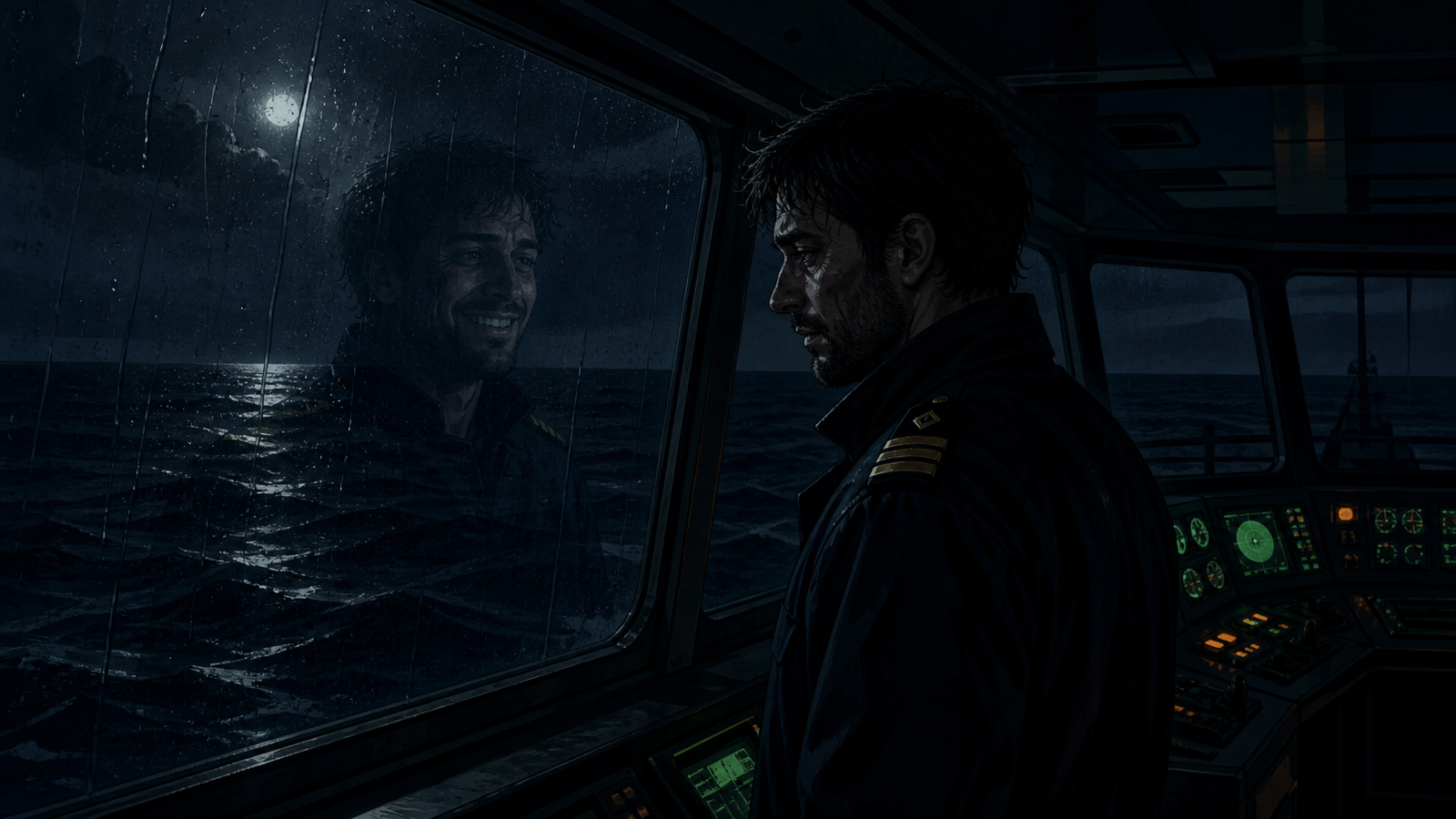
Here’s a seafarer you probably know. They’ve been at sea for seven months.
They smile in every video call home.
They tell the office “all good.”
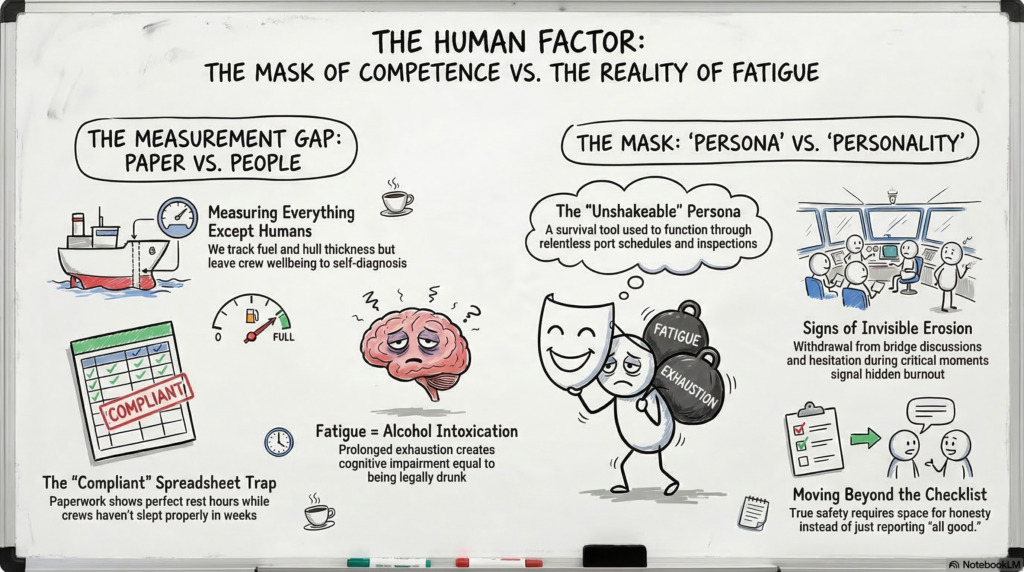
Rest hours? Signed compliant.
Paperwork? Perfect.
KPIs? All green.
They haven’t slept properly in weeks.
But the ship is moving. The cargo is flowing.
So technically…nothing is wrong.
Shipping Measures Everything. Except This.
In shipping, we love numbers.
Hull thickness? Measured to the millimetre.
Cargo temperature? Tracked to the decimal.
Fuel consumption? Graphs within graphs.
ISM checklists can run longer than a Tolstoy novel.
But when it comes to the people actually running the vessel, the metrics suddenly become… optimistic.
A landmark study by IOSH and Cardiff University’s Seafarers International Research Centre found that the majority of shipping companies had not identified seafarer mental health as a priority — in the preceding decade
“Rest hours? All compliant.”
The spreadsheet says so.
If fatigue could be managed as neatly as ballast water, the industry would have solved it years ago.
The Persona at Sea
Over time, shipping doesn’t just shape careers….It shapes personas.
The unshakeable master.
The always-available chief engineer.
The officer who never drops the ball.
These personas aren’t fake. They’re survival tools. They allow people to function through emergencies, inspections, night watches, and relentless port schedules.
But personas are designed for performance. Not for recovery. And when worn long enough, they quietly push something else into the background:
Personality – Curiosity – Doubt – Vulnerability. This is the quiet erosion at the heart of seafarer mental health at sea.
Instead of saying: “I’m struggling.” We say: “It’s manageable.”
Fatigue: Shipping’s Quiet Default Setting
Fatigue in shipping is rarely dramatic….It’s structural.
Long contracts.
6-on / 6-off rotations.
Short manning labelled “efficiency.”
Port schedules that allow zero recovery time.
The science is clear. Cognitive impairment from prolonged fatigue can rival alcohol intoxication.
The line between fatigue and burnout is shorter than the industry acknowledges — and we’ve looked at where that line breaks.
But fatigue doesn’t trigger breathalysers….It triggers compliant rest-hour spreadsheets.
Until something goes wrong.
Then suddenly everyone asks why nobody noticed.
Seafarer Mental Health at Sea: The Taboo the Industry Built
Seafaring is one of the most demanding professions on earth.
Isolation- Pressure – Responsibility measured in millions of dollars of cargo.
Yet the industry’s monitoring systems are strangely selective.
The ITF Seafarers’ Trust and Yale University found that 20% of surveyed seafarers had experienced suicidal ideation in the preceding two weeks — figures that rarely surface in any company welfare report
We install satellite-linked sensors to monitor an engine bearing. But the human bearing running the ship is left to self-diagnose.
When mental strain builds, it rarely looks dramatic. It looks like:
• Small errors
• Hesitation during critical moments
• Withdrawal from bridge discussions
• The persona working harder to hide the cracks
Nothing catastrophic…..Just slow erosion.
The Gap Nobody Measures
This is where the real risk lives. In the gap between:
Who someone is
and
Who they present.
It shows up as:
Burnout that “appears suddenly.”
Irritability without explanation.
Detachment from work that once mattered.
Fatigue that sleep no longer fixes.
But because the persona still performs…the system assumes everything is fine.
This is where seafarer mental health at sea actually lives — not in the incident report, but in the silence before it.
Enter SIRE 2.0: Humans Finally on the Checklist
For the first time, frameworks like SIRE 2.0 place serious attention on seafarer mental health at sea as an operational risk factor, not just a soft issue.
Fatigue management.
Competence.
Crew welfare.
Psychological wellbeing.
Not as soft issues….But as operational risk factors.
Because a tired crew doesn’t just affect morale.
It affects navigation decisions.
Maintenance judgment.
Crisis response.
In other words: It affects safety.
But Frameworks Don’t Remove Personas
A new inspection system cannot undo decades of culture. Personas don’t disappear because a checklist changed. They disappear when people feel safe enough to put them down.
That safety — psychological safety — is the missing foundation of any genuine maritime safety culture.
When a chief officer can say:
“I’m exhausted”…..Without the office quietly writing “performance concern.”
When a master reports a near-miss honestly…without wondering if it becomes a career footnote.
A Small but Radical Shift
Shipping still needs competence.
Calm under pressure – Professionalism – Discipline.
But it also needs something else:
Space – Space where personality can breathe – A conversation that lasts eight honest minutes.
Leaders asking “how are you holding up?” instead of just “when is ETA?”
Crew welfare has to mean more than a helpline number posted in the mess room.
Fatigue systems that predict problems instead of recording them afterwards.
Because personas keep ships moving….But personalities keep people whole.
The Uncomfortable Truth
Ships don’t run on checklists….They run on humans.
Tired.
Stressed.
Resilient.
Resourceful humans who have learned to say, “I’m fine”, in seven languages.
Until our industry starts measuring what actually matters — and takes seafarer mental health at sea as seriously as fuel consumption — we’ll keep managing 21st-century ships with 19th-century assumptions.
And hoping the crew survives the audit. Not just the voyage.
For those at sea
When was the last time you said “I’m fine” when you weren’t?
For those ashore: When was the last time you asked a different question?
For the other side of this conversation — what shore life actually demands of the people asking that question — read The Human Factor #3.
Fiction from the same sea: The Measurable Horizon, Book 1: A Year in the Life of a Modern Master →
Related reading: The Quiet Defiance of Staying Afloat