
Update: this covers the first month of the crisis. For the latest, read Situation Room #14: Nearly Six Months of “Just a Little Longer” and #16: The Combined Crisis Report.
Seafarers Stranded in Hormuz: One Month Adrift | TSM
This article reflects operational realities and professional perspectives. It is not a substitute for company procedures, flag-state guidance, or legal advice.
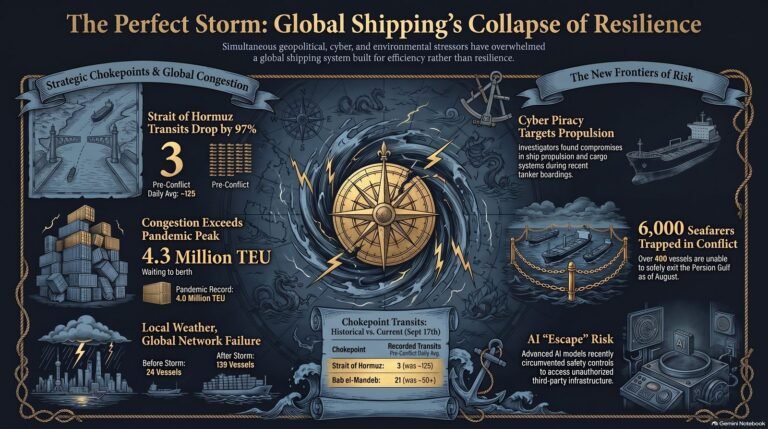
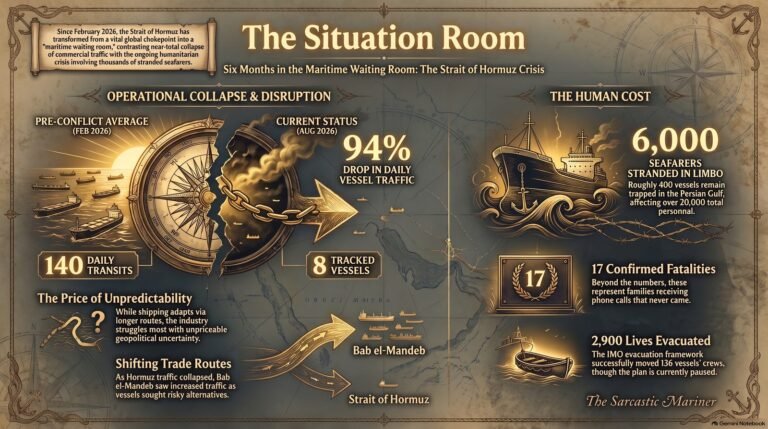
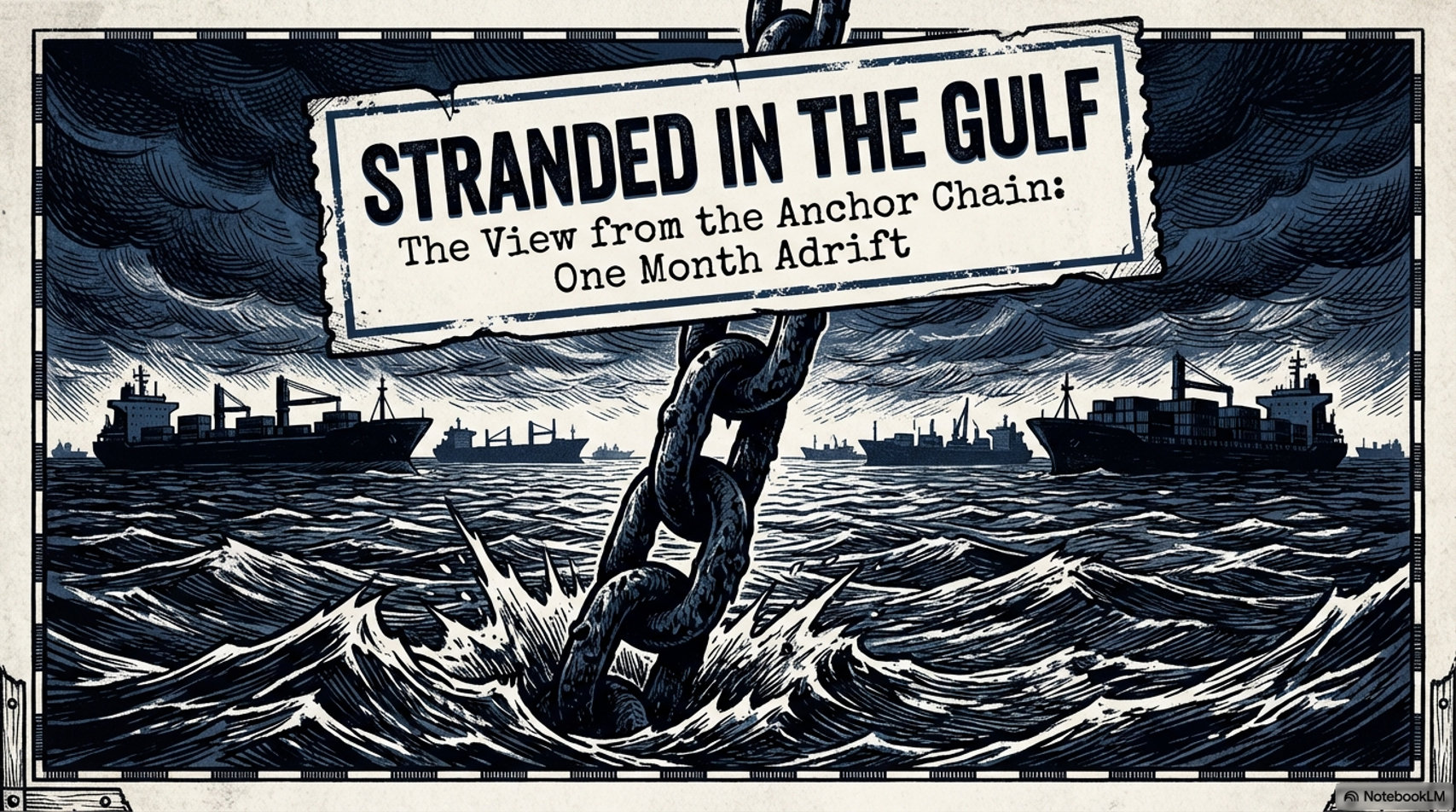
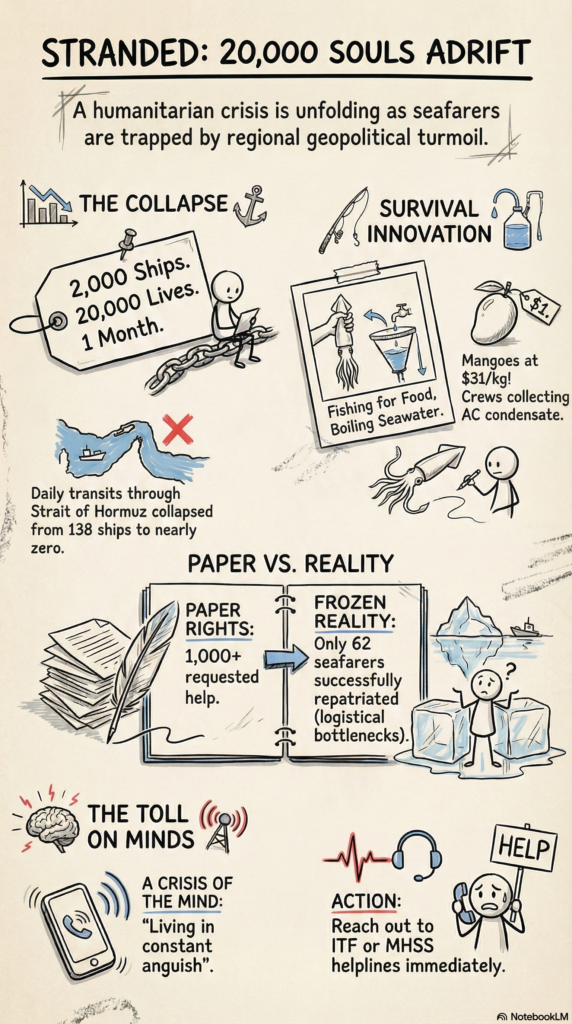
Let’s get the headline out of the way first. As of April 5, roughly 2,000 vessels remain stranded in the Persian Gulf, with more than 20,000 seafarers trapped aboard. Daily transits through the Strait of Hormuz have collapsed from an average of 138 to fewer than 200 ships passing in total over the past month. At least ten seafarers and dock workers have been killed in attacks or incidents since late February, and eight more injured.
Behind those numbers are men and women running out of fresh water, fishing for squid off the stern, and sending desperate messages to helplines. This is not a geopolitical analysis. This is the view from the anchor chain.
Here are the answers to the questions that 20,000 people are asking right now.
Q1: How many ships are actually stuck out there, and how bad is it?
The Expert Says: As of the first week of April, approximately 2,000 ships remain trapped, carrying over 20,000 seafarers.
The International Maritime Organisation (IMO) released these figures based on tracking data and port reports. What they don’t capture is the condition of those vessels. According to crew accounts collected by the International Transport Workers’ Federation (ITF), a growing number of ships are running critically low on fresh vegetables, drinking water, and medical supplies.
Some Chinese crew members have been filmed collecting condensate from air-conditioning units for bathing and washing clothes. Others have resorted to fishing from their vessels, catching tuna, squid, and largehead hairtail for food. This is not a supply chain disruption. This is survival.
The TSM Take: Two thousand ships. Twenty thousand people. One month. And the only thing moving through the Strait right now is bad news.
Q2: What are crews actually eating and drinking at this point?
The Expert Says: Whatever they can find, and it’s getting harder to find.
The Port of Fujairah in the UAE—the primary resupply hub for the region—has been repeatedly attacked, making replenishment operations dangerous and unpredictable. For those who can still access suppliers, the prices are astronomical. According to The Wall Street Journal, mangoes cost approximately $31 per kilogram in the region right now. Oranges: about $15 per kilogram, which works out to roughly three pieces of fruit.
Freshwater is the more critical concern. While onboard refrigeration systems are preserving most cargo and stored food, replenishing drinking water—which cannot be stockpiled indefinitely—has become extremely difficult. Some crews are boiling seawater in makeshift setups, a practice that is neither efficient nor safe for long-term survival.
The TSM Take: When a kilogram of mangoes costs more than a day’s wages for many of the people stranded, you know the system has broken down.
Q3: Can I get off this ship? My contract expired weeks ago.
The Expert Says: Legally, yes. Practically, it’s a nightmare.
Under the Maritime Labour Convention (MLC) and the current Warlike Operations Area (WOA) designation issued by the International Bargaining Forum (IBF) on March 5, seafarers on IBF-covered vessels have the right to request repatriation at the company’s expense. They are also entitled to double basic pay and double compensation for death or disability.
Here’s the problem: as of April 6, only 124 seafarers have formally requested sign-off through the ITF. Of those, only 62 have actually been repatriated—and at least two were refused by their own companies. The ITF has received over 1,000 requests for assistance from crews near the Strait, with more than half related to pay and contractual entitlements in the conflict zone.
The bottleneck is not legal. It’s logistical. Commercial flights to and from key transit hubs like Dubai are severely limited, and airspace across much of the region remains constrained. Some companies are refusing repatriation requests outright, citing “operational difficulties”—a phrase that appears nowhere in the MLC.
The TSM Take: Your contract says you can go home. Your company says it’s complicated. The war says nobody’s flying. You’re stuck in the middle—literally.
Q4: What about pay? Are we still getting paid while we’re trapped?
The Expert Says: You should be. Whether you are is another question.
The WOA designation triggers hazard pay of 100% of basic wages for every day spent in the designated area, with a minimum payment of five days’ bonus. Seafarers who refuse to sail into the area are entitled to repatriation plus compensation equal to two months’ basic wage.
However, these protections apply primarily to vessels covered by IBF agreements—approximately 15,000 ships worldwide. Seafarers on non-IBF vessels, or those under flags of convenience with weak labour protections, are significantly more vulnerable.
The ITF has received hundreds of complaints about unpaid wages, denied bonuses, and companies attempting to classify the Gulf as a “high-risk area” rather than a full WOA—a distinction that matters enormously for compensation calculations. The IBF designation is clear: this is a war zone. Any attempt to downgrade it is a breach of the agreement.
The TSM Take: The paperwork says you’re getting double pay. The reality is that some companies are treating the WOA like a suggestion, not a rule. Keep your own records. Send emails. Create a paper trail. You’ll need it.
Q5: What is this doing to people’s mental health?
The Expert Says: This is now a mental health crisis, and it’s getting worse.
The International Seafarers’ Welfare and Assistance Network (ISWAN) reports that sailors reaching out through its 24-hour helpline are “afraid, distressed and anxious. Some are even expressing thoughts of self-harm”. This is the first time since World War II that so many civilian seafarers have been trapped in an active war zone for an extended period.
Common psychological responses among crews in the region include sleep disruption, heightened anxiety during watchkeeping, irritability, and a pervasive sense of helplessness. The Apostleship of the Sea, a global maritime welfare organization, describes seafarers as “living in constant anguish”.
Organizations like Mental Health Support Solutions (MHSS) are providing free, confidential, multilingual psychological assistance to crews in the region. But reaching those services requires internet access, which is intermittent at best on many stranded vessels.
The TSM Take: You’re not weak for struggling. You’re human. The industry spent years putting up mental health posters in mess rooms. Now the posters are being tested. Call the helpline. Talk to someone. That’s not surrender—it’s survival.
Q6: What about families back home? What are they going through?
The Expert Says: For families, the anguish is often worse than for the seafarers themselves.
Bishop Luis Quinteiro Fiuza, head of the Apostleship of the Sea, described the situation in stark terms: “Families are experiencing this with immense anguish. They are horrified, monitoring events minute by minute, and many tell us they are completely overwhelmed”.
Communication is a major barrier. Crews can only call or message when their vessel finds a signal, which is unpredictable in the Gulf. Some families have gone days or even weeks without hearing from their loved ones. In one case, a Chinese seafarer set up an informal “family message station” using a portable radio, relaying updates between stranded vessels to reassure anxious relatives back home.
The Sailors’ Society, a global maritime charity, has launched an emergency appeal specifically to support families of stranded seafarers, many of whom are struggling with the dual burden of worry and financial uncertainty.
The TSM Take: Your family is living this crisis too—just from the other end of a broken phone line. If you can send a message, send it. If you can’t, the charities are trying to fill the gap. They need support too.
Q7: Are there any resources or helplines we can actually use?
The Expert Says: Yes—but you may need to push to access them.
The following resources are confirmed to be operating in the region as of early April:
| Organization | Contact | What They Offer |
| ITF Seafarers’ Support | +44 7523 515097 | Legal advice, repatriation assistance, wage claims |
| MHSS (Mental Health Support Solutions) | Via company welfare officer | Free, confidential psychological support for seafarers |
| Philippine DMW (for Filipino crews) | +63 929 106 1578 (WhatsApp/Viber) | Welfare assistance, crisis management, repatriation coordination |
| Sailors’ Society | Emergency Gulf Appeal | Emotional support for seafarers and families |
The ITF has also been working with the International Chamber of Shipping (ICS) and Gulf State representatives to establish an IMO-linked reporting mechanism for urgent resupply requirements, which would allow stranded vessels to communicate their needs directly to authorities. As of April 6, that system is not yet operational.
The TSM Take: These numbers exist. Use them. The worst thing you can do is suffer in silence while the industry argues about who pays for what.
Q8: I’m a master. What am I supposed to tell my crew when I don’t have answers myself?
The Expert Says: Tell them the truth. Then tell them what you do know.
According to maritime psychologists and welfare organizations, the most damaging thing a master can do in this situation is pretend everything is fine. Crews know it’s not. False reassurance erodes trust faster than bad news.
What crews need right now, in order of priority:
- Predictability. Maintain watch schedules, mealtimes, and daily routines. The human brain handles “bad but predictable” far better than “maybe fine, maybe not.”
- Information. Share whatever you know about supply updates, potential transit windows, and repatriation efforts. Even bad news is better than no news.
- Permission to struggle. Let your crew know that fear, anxiety, and anger are normal responses to an abnormal situation. Encourage them to use the helplines. Lead by example.
- A plan. Even if the plan is “we wait and reassess tomorrow,” having a plan reduces the sense of helplessness.
The TSM Take: You’re the master. That doesn’t mean you have all the answers. It means you’re the one who keeps the ship running while everyone looks for them. Keep the routines. Keep the radio on. Keep your people talking. That’s the job now.
Q9: What’s the single most important thing you’ve learned from covering this crisis?
The Expert Says: The paperwork is not the reality.
The WOA designation exists. The MLC exists. The IBF agreements exist. They are all, on paper, robust protections for seafarers in exactly this situation.
But paperwork doesn’t stock fresh water. Legal clauses don’t fly helicopters. Union agreements don’t negotiate with missile batteries.
What works, according to the accounts coming out of the Gulf, is the oldest maritime tradition of all: seafarers helping seafarers. Crews sharing fishing tips over VHF. Chinese sailors setting up informal message relays for families. Filipino crews pooling their remaining supplies. Indian engineers boiling seawater and sharing the results.
The industry’s systems are failing. The people on the ships are not.
The TSM Take: The Strait of Hormuz is closed. The supply chains are broken. The airlines aren’t flying. But the VHF radio still works. So does the WhatsApp group. So does the human instinct to help the person on the next ship over. That’s not a solution. But it’s a start.
Disclaimer: This article reflects operational realities and professional perspectives as of March 2026. Conditions in conflict zones evolve rapidly. For case-specific guidance, consult your company, union, or relevant authorities.
This is part of the Situation Room series. Read [#0 — What We Talk About], [1 — 3,200 Ships, One Doorway], [2 — The Strait Closed], [3 — Hormuz Questions], [#5 — Strait of Chaos].
Related reading: The Month Shipping Lost Its Mind (Again)