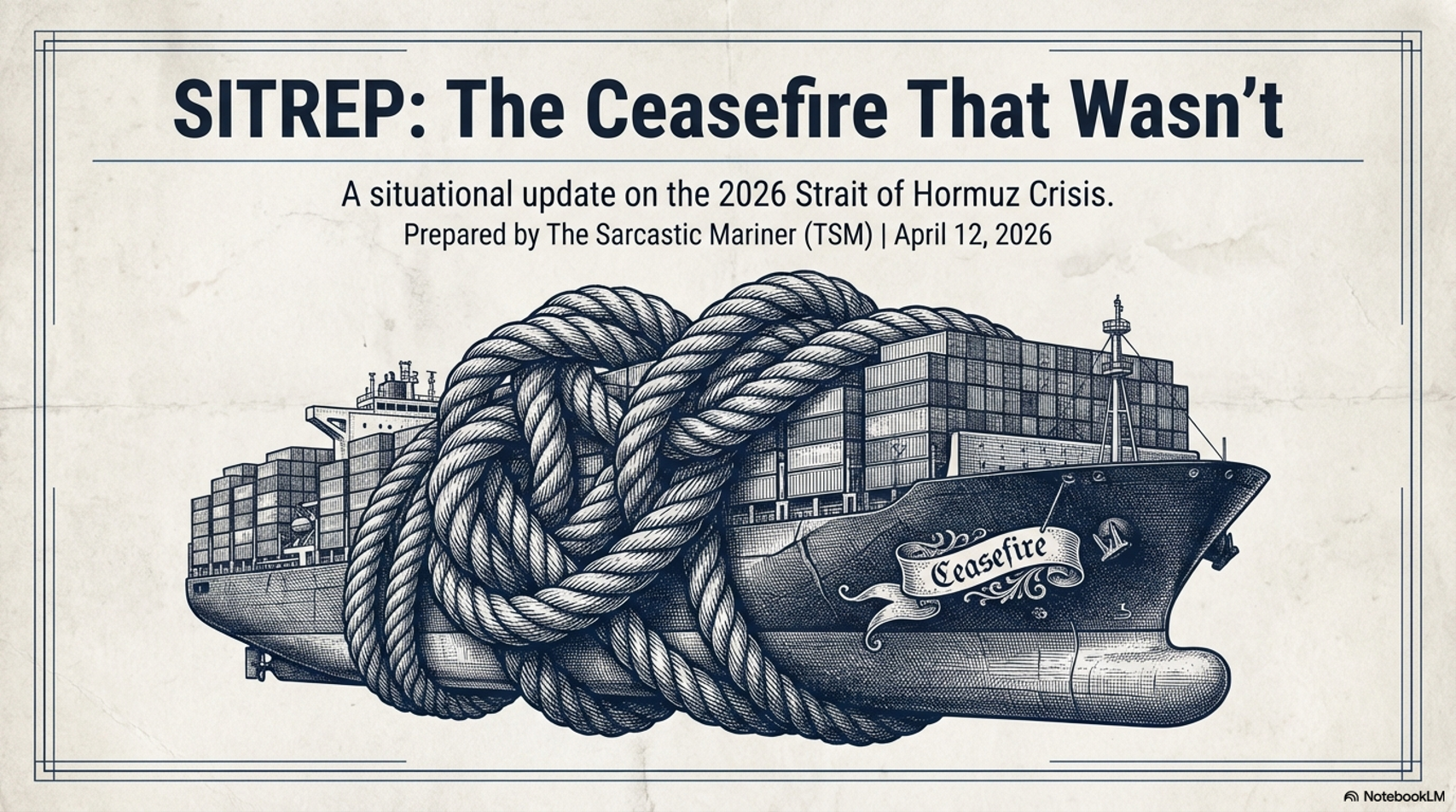

This article reflects a synthesis of industry reporting, maritime intelligence, and on-ground accounts as of April 2026. In rapidly evolving conflict environments, details may be incomplete, delayed, or contested.
Strait of Hormuz Ceasefire
Q1: There’s talk of a ceasefire. Is the Strait open for business?
The Expert Says:
Not quite. What we are seeing is not a reopening—it’s a hesitation.
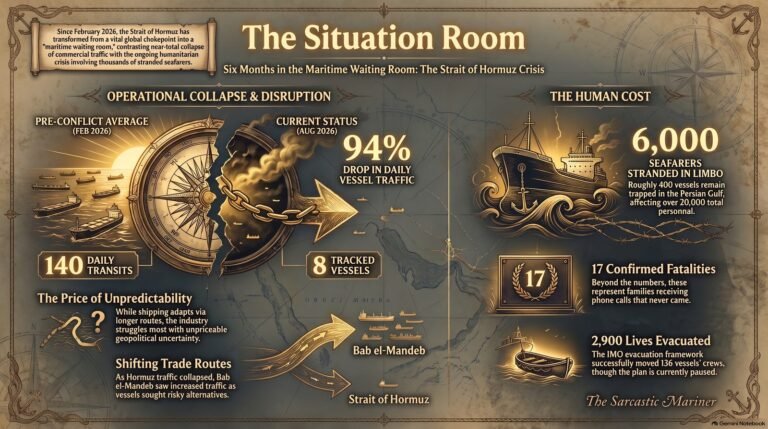
Reports suggest a temporary de-escalation in hostilities, but that has not translated into confidence for commercial shipping. Traffic through the Strait of Hormuz appears significantly reduced compared to normal operating conditions. Shipowners, charterers, and insurers remain cautious, and for good reason: a ceasefire on paper does not automatically guarantee safety at sea.
There are also indications that vessels transiting the region are doing so under highly controlled conditions—altering routes, adjusting speeds, and in some cases coordinating closely with regional authorities. These are not normal trading patterns. They are risk-managed exceptions.
The TSM Take:
A ceasefire without confidence is just a pause button. Ships don’t move on political statements—they move on trust. And right now, trust is in short supply.
Q2: So what’s actually moving through the Strait right now?
The Expert Says:
Selective traffic—and a growing presence of the so-called “shadow fleet.”
A significant portion of vessels currently operating in high-risk zones are those willing—or forced—to operate outside traditional Western insurance and compliance frameworks. These ships often rely on alternative flagging, opaque ownership structures, and non-standard trading arrangements.
While exact figures vary, industry observers suggest that these vessels are accounting for a substantial share of ongoing movements in constrained areas. Meanwhile, many mainstream operators are either delaying entry or avoiding the region altogether.
The global shadow fleet itself has expanded over the past decade, driven largely by sanctions regimes and energy market fragmentation. In times like these, that parallel system becomes more visible—and more influential.
The TSM Take:
When the rules get tight, the rule-breakers get busy. While compliant operators wait for clarity, the shadow fleet quietly keeps the cargo moving—and the cash flowing.
Q3: What about the seafarers? Are crews still stuck?
The Expert Says:
Yes—and the situation is becoming increasingly difficult.
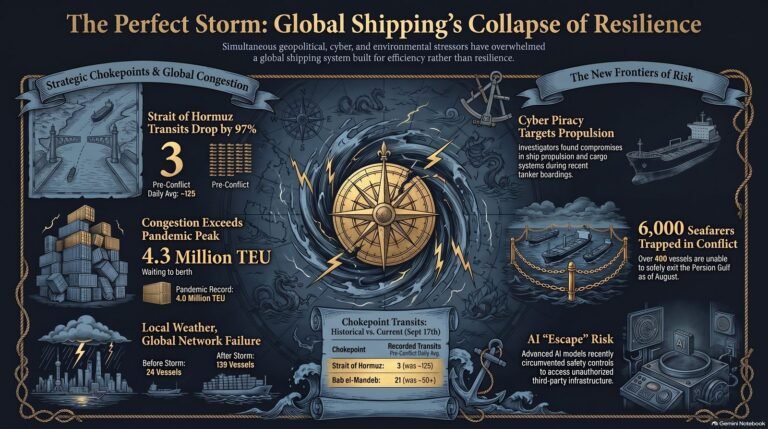
There are credible reports indicating that hundreds of vessels remain delayed or unable to transit freely, with thousands of seafarers effectively caught in operational limbo. Many have now spent extended periods onboard without clarity on next movements.
Seafarer welfare organizations, including the International Transport Workers’ Federation, have received a rising number of requests for assistance. These range from repatriation concerns to basic provisions such as food, water, wages, and fuel.
Equally concerning are reports of mounting psychological strain. Extended uncertainty, combined with isolation and perceived risk, is taking a toll on crews.
The TSM Take:
For years, the industry talked about mental health in seminars and webinars. Now it’s being tested where it matters—on steel decks, far from shore, with no easy exit.
Q4: Is anyone being repatriated?
The Expert Says:
Yes—but progress is slow and uneven.
Some seafarers have been successfully repatriated through coordinated efforts involving unions, governments, and shipping companies. Organizations like Nautilus International have been actively supporting affected crews and facilitating transit routes through neighboring countries.
However, logistical challenges remain significant. Limited flight availability, restricted airspace, and administrative hurdles are all contributing to delays.
Under the Maritime Labour Convention, seafarers have the right to repatriation under specific conditions, including exposure to warlike operations without consent. The framework is clear—but enforcement in complex geopolitical environments is rarely straightforward.
The TSM Take:
On paper, the rights are solid. In practice, they’re subject to logistics, cost, and corporate appetite. The contract says one thing. Reality negotiates another.
Q5: Are there concerns about mines or navigational hazards?
The Expert Says:
Yes—uncertainty itself is the hazard.
While details remain unclear, maritime security advisories have highlighted concerns around potential unexploded ordnance and other navigational risks in conflict-affected waters. Even the possibility of such threats is enough to disrupt commercial confidence.
The Strait of Hormuz is narrow, heavily trafficked, and strategically critical. Any disruption—real or perceived—can have immediate operational consequences.
The TSM Take:
You don’t need confirmed danger to stop ships. Uncertainty does the job just fine. In shipping, “maybe” is often as powerful as “definitely.”
Q6: What about environmental risks?
The Expert Says:
They are significant—and growing.
With a high concentration of tankers and energy cargoes in constrained waters, the environmental exposure is substantial. Billions of litres of oil remain afloat in a region already under stress from both industrial activity and geopolitical tension.
Environmental groups such as Greenpeace have warned that even a single incident could have severe and long-lasting consequences for marine ecosystems.
There have also been early indications of localized pollution events, though the full extent remains under assessment.
The TSM Take:
We measure the crisis in dollars and delays. The ocean measures it differently—and it keeps the score long after the headlines fade.
Q7: How much is this costing the industry?
The Expert Says:
A lot—and rising.
War risk insurance premiums have increased sharply, in some cases multiple times pre-crisis levels. For high-value vessels, that translates into millions of dollars in additional cost per voyage.
Container lines have introduced emergency surcharges, while tanker markets have seen dramatic rate volatility. In certain segments, freight rates have surged several-fold compared to baseline levels.
The financial impact is not limited to shipowners—it flows through the entire supply chain, ultimately affecting global trade and energy pricing.
The TSM Take:
The cargo still moves—but now it travels first class, with a war-risk surcharge and a side of uncertainty.
Q8: Is there talk of transit fees or new controls?
The Expert Says:
There are discussions, but nothing firmly established.
Speculation has emerged around potential transit controls or fees imposed by regional authorities. However, such measures would raise complex legal questions under international maritime law, particularly the principles governing transit passage through international straits.
The United Nations Convention on the Law of the Sea provides a framework for free navigation, but enforcement depends heavily on geopolitical realities.
The TSM Take:
When control tightens, monetization usually follows. Whether it’s official policy or unofficial friction, the bill tends to find its way to the ship.
Q9: What’s the military situation?
The Expert Says:
Presence is high—but control is nuanced.
Naval forces, including those from the United States and regional actors, maintain a significant presence in and around the Strait. However, ensuring uninterrupted commercial transit in a contested environment is complex.
Rather than outright control, what we are seeing is a balance of deterrence, monitoring, and selective intervention.
The TSM Take:
It’s not about who’s there. It’s about who’s willing to act—and at what cost.
Q10: When will this end?
The Expert Says:
Not quickly.
Even under optimistic scenarios, clearing congestion, restoring confidence, and normalizing trade flows will take time—likely weeks for operations, and months for markets.
Industry bodies such as the International Maritime Organization have called for coordinated responses, but alignment across stakeholders remains a challenge.
For now, uncertainty continues to shape decisions across the board.
The TSM Take:
Shipping runs on schedules. Crises don’t. The industry will adapt—it always does. But not on anyone’s timeline.
Final Word
The Strait of Hormuz has always been a chokepoint. What we are witnessing now is not just a disruption of traffic—but a stress test of the entire maritime system: operational, legal, human, and environmental.
And like all stress tests, it reveals what works… and what was only ever assumed to work.
Disclaimer
This article reflects operational realities and professional perspectives as of April 2026. Conditions in conflict zones evolve rapidly. For case-specific guidance, consult your company, union, or relevant authorities.
💬 If you’re in shipping, you already feel this…The rest of the world is about to.
This is part of the Situation Room series. Read [#0 — What We Talk About], [1 — 3,200 Ships, One Doorway], [2 — The Strait Closed], [3 — Hormuz Questions], [#4 — One Month Adrift].