
Dr. Kumud R. Jha · Singapore · Doctorate in AI · US Patent Holder View LinkedIn Profile
The Skills That AI Makes More Valuable — Not Less
Yesterday we talked about how AI literacy shows up in practice. Today I want to talk about what it is worth.
Today I want to talk about the emerging AI skills and roles that will actually matter over the next five years — and what they’re worth.
Because the skills conversation around AI has been dominated by two unhelpful narratives. The first is the panic narrative: AI is coming for your job, retrain immediately, learn to code. The second is the dismissal narrative: human skills will always matter, don’t worry, be yourself.
Both are too simple. And both leave you without a map. So here is an attempt at a more honest one.
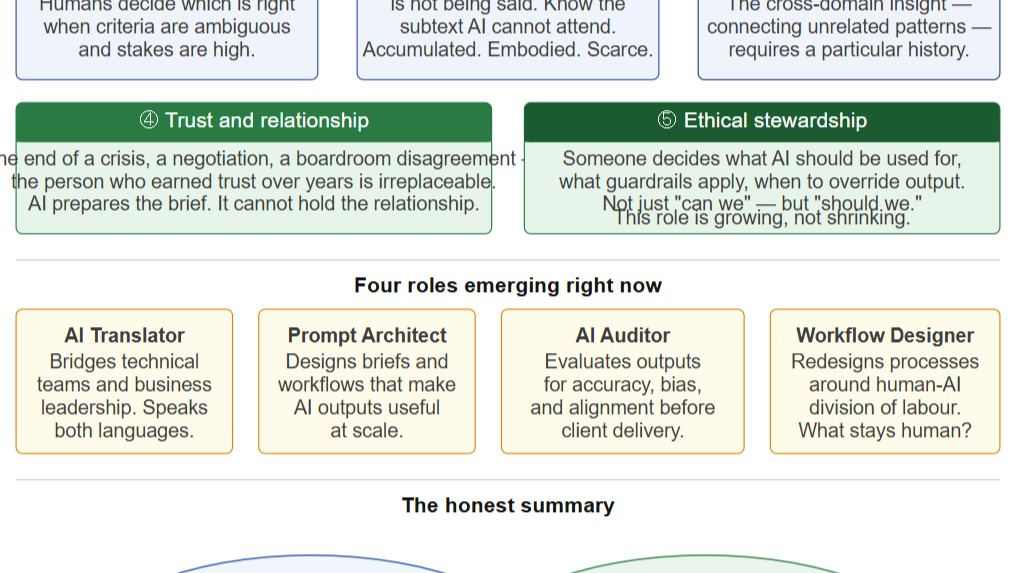
One — Judgment under uncertainty. AI is extraordinarily good at processing information and generating options. It is not good at deciding which option is right when the criteria are ambiguous, the stakes are high, and reasonable people disagree. That decision still requires a human — and as AI handles more information processing, the humans who can decide well under uncertainty become more valuable, not less.
Two — Contextual intelligence. The ability to read a room. To understand what is not being said. To know that the CFO’s real concern is not the number on slide seven but the conversation she had with the board chair last Tuesday. AI cannot attend that conversation. Contextual intelligence — the accumulated, embodied understanding of how a specific organisation or relationship actually works — is deeply human and increasingly scarce.
Three — Synthesis across domains. AI is very good within domains. What it struggles with is genuinely cross-domain insight: the energy consultant who spots the regulatory pattern because she also understands the political economy, and connects it to a technology trend from a completely different sector. Synthesis is not retrieval. It requires a self with a particular history of attention.
Four — Trust and relationship. At the end of a difficult negotiation, a boardroom disagreement, or a crisis, the person who has earned trust over years is irreplaceable. AI can prepare the brief. It cannot hold the relationship.
Five — Ethical stewardship. Someone has to decide what AI should be used for, what guardrails are appropriate, and when to override the output. That role isn’t going away — it’s growing. Every organisation deploying AI needs people who ask not just can we but should we.
The Roles That Are Emerging
AI translators — people who bridge technical teams and business leadership, fluent in both languages.
Prompt architects — people who design the briefs, workflows, and frameworks that make AI outputs consistently useful at scale.
AI auditors — people who evaluate AI outputs for accuracy, bias, and alignment with organisational values before they reach clients or the public.
Human-AI workflow designers — people who redesign processes around the new human-AI division of labour, deciding what gets automated, what stays human, and what becomes a collaboration.
The Honest Summary
The next five years will not reward the people who know the most. They will reward the people who can do the most with what they know — combining human judgment, contextual intelligence, and AI capability into something neither could produce alone.
That is not a threat. That is an invitation to build the emerging AI skills this shift actually rewards.