
Dr. Kumud R. Jha · Singapore · Doctorate in AI · US Patent Holder View LinkedIn Profile
The Case for AI Abundance
AI abundance is the possibility that AI, deployed well, represents the most significant opportunity to reduce human suffering in the history of our species.
I do not say that lightly. And I am not saying it naively. For twenty-seven days this series has talked about risks, governance, displacement, bias, trust, and the conditions under which AI can go wrong. But the responsible position — the one that takes both the risks and the opportunities seriously — requires sitting with this possibility honestly. Not as hype. As a genuine, examined claim.
Here is the case.
The binding constraints on human welfare, for most of human history, have not been values or intentions. They have been scarcity and complexity. We have not cured most diseases because the biology is extraordinarily complex and the research cycles are decades long. We have not educated every child well because skilled teaching is scarce and expensive. We have not given everyone access to expert legal, medical, and financial guidance because expertise cannot scale. We have not solved climate change because the systems involved are too complex to model and optimise at the speed the problem requires.
AI does not change human values. But it attacks scarcity and complexity directly.
AlphaFold solved the protein folding problem — a fifty-year grand challenge in biology — and made the results freely available. Researchers are now using it to design drugs for diseases that have resisted treatment for generations. This is not a promise. It happened.
AI tutoring systems in controlled trials have produced learning gains equivalent to one-on-one human tutoring — the most effective educational intervention ever studied — at a cost approaching zero. For children with no access to quality teaching, this is not a marginal improvement. It is transformative.
AI-assisted legal tools are giving people in jurisdictions with inadequate public defence the ability to understand their rights, contest wrongful decisions, and navigate systems that were previously impenetrable without expensive representation.
AI diagnostic tools are catching cancers earlier, identifying rare diseases that took years to diagnose, and extending the reach of specialist expertise to communities where specialists do not exist.
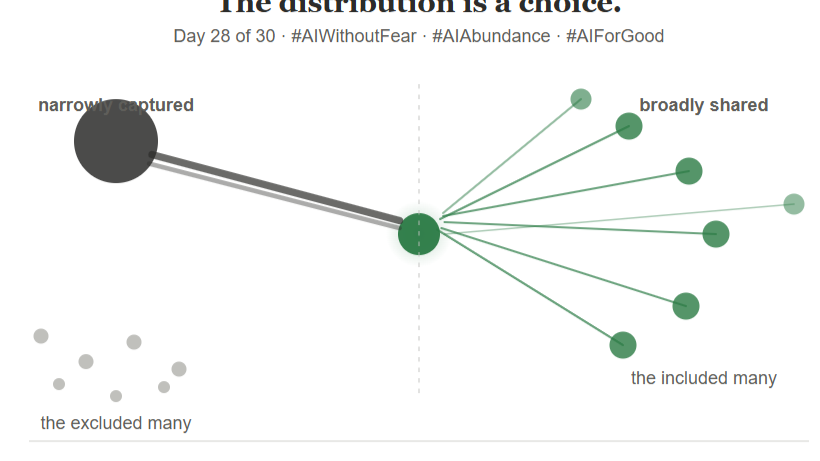
None of these are guaranteed futures. All of them are happening now, at varying scales, with varying quality. The question is not whether the capability exists. The question is whether we will make the choices — political, economic, and institutional — to deploy it in the service of the many rather than the convenience of the few.
Why AI Abundance Is a Distribution Question, Not a Technology One
Every technology that has ever promised abundance has delivered it unevenly. The industrial revolution created extraordinary wealth and extraordinary misery, often in the same places at the same time. The green revolution fed billions and devastated agricultural ecosystems. The internet connected the world and concentrated power in a handful of companies.
AI will not be different in its tendency to distribute benefits unevenly. But it could be different in the degree to which we anticipate and design against that tendency — if we choose to.
The choices being made right now — about who owns the models, who accesses the compute, who governs the deployment, whose problems get prioritised in the research agenda — will determine whether AI abundance is broadly shared or narrowly captured.
These are not technical choices. They are political ones. And they are being made, largely, without broad democratic participation.
The question worth asking in every room where AI decisions are made: who benefits from this — and who does not? And what would it take to change that ratio?
That question does not slow down AI development. It redirects it. Toward the problems that actually matter. Toward the people who actually need it most.
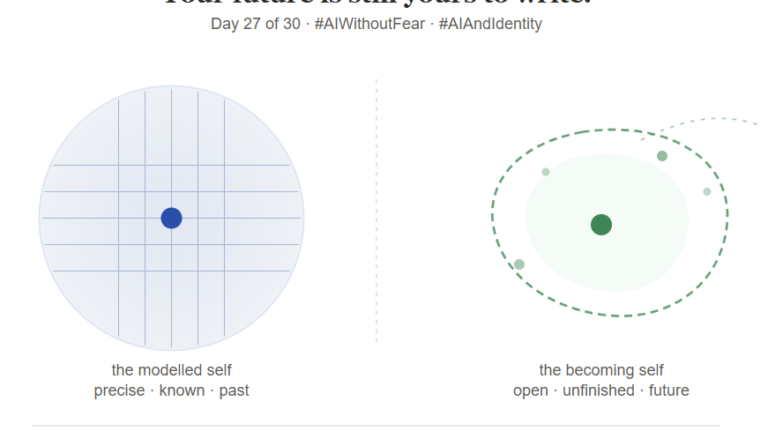
As we covered in Day 27, the machine’s precision cuts both ways — the same is true here. AI abundance is possible. The distribution is a choice.