
Dr. Kumud R. Jha · Singapore · Doctorate in AI · US Patent Holder View LinkedIn Profile
Why the Future of AI Is a Human Choice, Not a Technical One
The future of AI is not being written by the technology. It is being written by the choices we make about the technology. Choices about governance and deployment, about distribution and access, about what we optimise for and what we refuse to sacrifice. Choices being made right now, in boardrooms and legislatures and research labs and — more than most people realise — in the everyday decisions of ordinary people about how they engage with these systems.
The narrative that AI has its own momentum — that it is an unstoppable force that will do what it will do regardless of human intervention — is not a neutral observation. It is a political position. And it serves, conveniently, the interests of the people who benefit most from the absence of meaningful constraint.
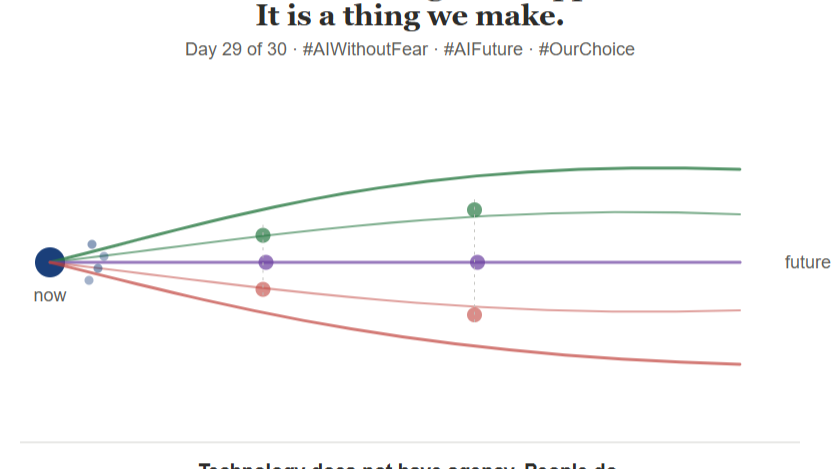
Technology does not have agency. People do.
Here is what twenty-nine days of honest examination has taught me.
AI is not good or evil. It is a mirror, an amplifier, and a lever. It reflects the values and incentive structures of the people who build and deploy it. It amplifies whatever it is pointed at — efficiency, creativity, surveillance, care, manipulation, healing. And it is a lever of extraordinary power, capable of shifting outcomes at a scale and speed that no previous technology has matched.
Which makes the question of who holds the lever, and what they are trying to move, the most important question of our time.
What Gives Me Hope About the Future of AI
The people working on AI safety are serious, rigorous, and growing in number. The regulatory frameworks being built — imperfect, slow, contested — are being built. The public conversation about AI is maturing: less breathless, more precise, more willing to sit with complexity.
The technology itself is producing genuine wonders. Not the wonders of science fiction — not superintelligence, not sentient machines — but the quieter, more profound wonders of diseases diagnosed earlier, knowledge made accessible, barriers lowered for people who were previously locked out.
And ordinary people — people like the ones who have read this series for twenty-nine days — are more capable of informed, nuanced engagement with these questions than the loudest voices in the room give them credit for.
What Still Worries Me
The speed of deployment is outpacing the speed of governance — not because governance is impossible, but because the incentive to move fast is concentrated and the incentive to govern carefully is diffuse.
The benefits are accruing unevenly, along lines that map with uncomfortable precision onto existing inequalities of wealth, language, geography, and power.
The epistemic environment — the shared informational ground on which democratic deliberation depends — is under genuine and serious pressure.
And the people most affected by AI — workers whose jobs are being restructured, communities whose data is being harvested, citizens whose information environment is being shaped — are largely not in the rooms where the consequential decisions are being made.
What I Want to Leave You With, One Day Before the End
The future is not a thing that happens to us. It is a thing we make — through our choices, our demands, our participation, and our refusal to accept that the most important decisions of our time are someone else’s responsibility.
You do not need to be a researcher or a regulator or a technologist to have a stake in this. You are already in it. Every platform you use, every tool you engage with, every conversation you have about these questions — these are acts of participation in shaping what comes next.
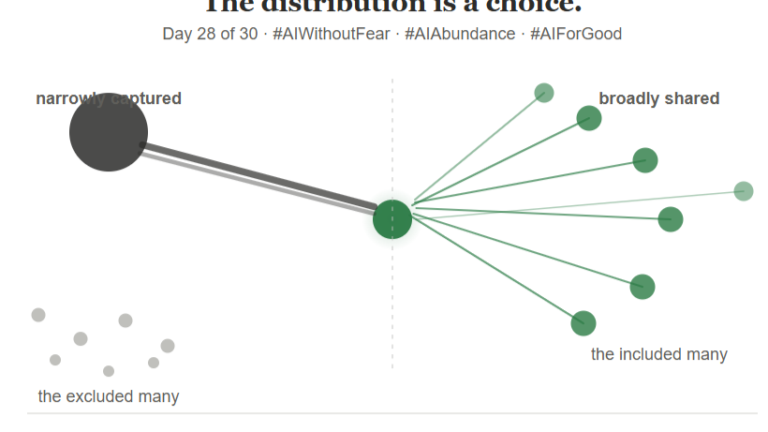
As we covered in Day 28, the distribution of AI’s benefits is a choice, not an inevitability. The future of AI follows the same logic: it already changed the world. The question is what kind of world we are choosing to build with it.