
While the world debates oil prices, geopolitics, and which politician said what on television… the maritime industry is dealing with slightly more practical questions.
Questions like:
- Are we legally allowed to refuse sailing into a war zone?
- Is war risk insurance actually gone, or just painfully expensive?
- If a charterer orders a transit and the master refuses — who pays the bill?
- And perhaps the most honest question of all: how much is a human life worth in freight terms?
Because while analysts argue about Brent crude and LNG supply curves, thousands of seafarers are sitting on steel boxes in the Gulf wondering whether their next voyage is a commercial operation… or a military gamble.
So we spoke with Industry Experts to answer the questions currently being searched across shipping offices, bridge computers, and late-night WhatsApp groups.
Here’s the uncomfortable reality.
Q1
Can a Master legally refuse to sail into the Strait of Hormuz right now?
The Expert Says
In many cases, yes.
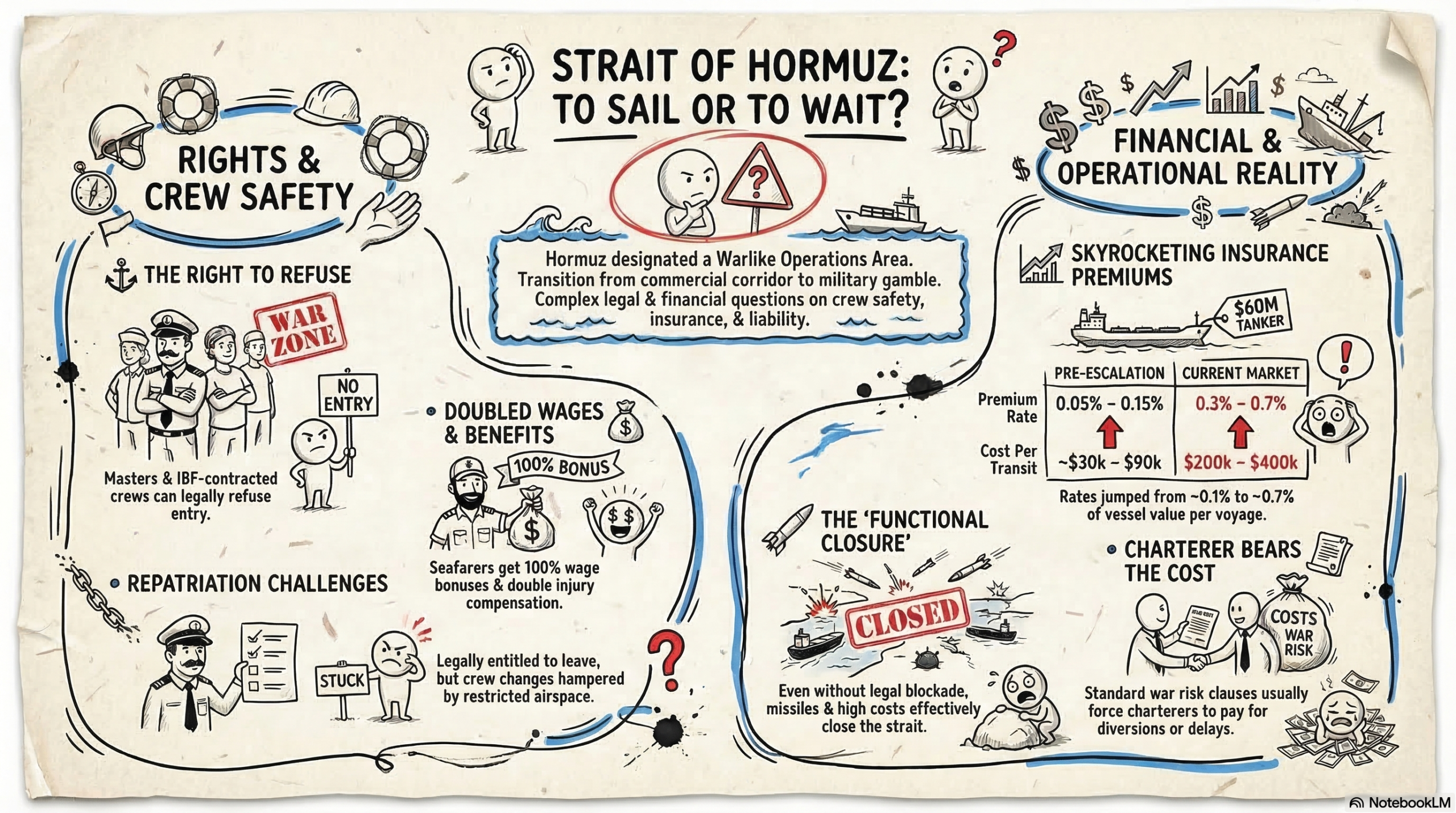
The Strait of Hormuz and surrounding waters have now been designated a Warlike Operations Area (WOA) under International Bargaining Forum agreements. This means seafarers working under IBF contracts have the right to refuse entry into the zone and request repatriation at the employer’s expense.
Even outside IBF agreements, maritime law gives the Master overriding authority for vessel safety.
Under the “reasonable judgement” doctrine, if a master believes the vessel faces unacceptable war risk, they may legally refuse orders that would expose the ship and crew to danger.
The key word is reasonable — and given missile strikes, drone attacks, and naval warnings in the region, the threshold for “reasonable” has become extremely low.
TSM Translation
You’re the captain of a ship, not the commander of a disposable drone.
If the situation looks like a war zone, smells like a war zone, and insurers are running away from it like a cat from a vacuum cleaner… the law tends to agree it might actually be a war zone.
Q2
Has war risk insurance actually disappeared?
The Expert Says
Not entirely — but it has dramatically changed.
Many P&I clubs and marine insurers issued 7-day cancellation notices for existing war risk coverage in the region once the conflict escalated.
This doesn’t mean insurance is impossible.
It means coverage must now be negotiated per voyage, with significantly higher premiums.
Before the escalation, war risk premiums for Hormuz transits were typically around:
0.05% – 0.15% of vessel value
Recent market estimates suggest premiums now ranging between:
0.3% – 0.7% per voyage
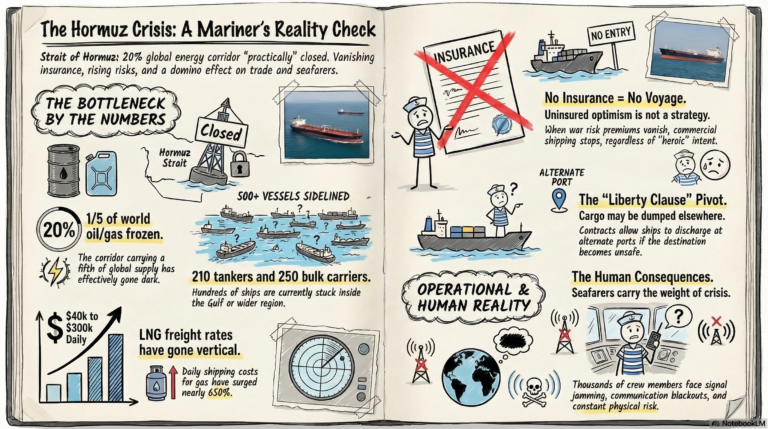
For a $60 million tanker, that can mean $200,000–$400,000 just to pass through the Strait once.
TSM Translation
Insurance still exists. It just now costs roughly the same as buying a small apartment in London.
Q3
Are crews entitled to extra money for sailing through the conflict zone?
The Expert Says
Yes.
Under the Warlike Operations Area designation, seafarers are entitled to:
• 100% bonus on basic wages while in the zone
• Minimum five days additional pay even for short transits
• Double compensation in case of injury or death linked to hostilities
These provisions are negotiated through maritime labour agreements designed specifically for war-risk areas.
TSM Translation
Yes, the pay doubles. That’s not because the job suddenly became glamorous.
It’s because the industry quietly acknowledges the risk just doubled too.
Q4
If the charterer orders the ship through Hormuz and the Master refuses, who pays?
The Expert Says
This is governed by standard war risk clauses in charterparties.
Most modern charter agreements include clauses such as:
- CONWARTIME
- VOYWAR
These allow the vessel to refuse entering areas where war risk is deemed unacceptable. If the Master/Owners refuse based on reasonable risk assessment, the Charterer may redirect the vessel to another safe port.
In most cases, the charterer bears the cost of diversion, delay, or discharge.
TSM Translation
If someone insists on playing geopolitical roulette with your ship…They usually get to pay for the chips.
Q5
If the Strait is technically international waters, how can anyone “close” it?
The Expert Says
Legally, the Strait of Hormuz is governed by UNCLOS transit passage rights, meaning international shipping should not be blocked.
However, law and reality often diverge during conflicts.
When:
• missiles are flying
• naval forces are conducting operations
• insurance disappears
• and shipping companies suspend transits
the strait becomes “functionally closed” even without a legal blockade.
TSM Translation
The law says the road is open. Reality says someone parked a tank in the middle of it.
Q6
What is the biggest risk to commercial ships right now?
The Expert Says
Naval analysts consistently identify mines as the most serious threat.
Unlike missiles or drones, mines:
• are cheap
• difficult to detect
• capable of blocking narrow waterways
The Hormuz shipping lane narrows to roughly two kilometres in places.
One disabled tanker could halt traffic completely…. Remember Evergiven?.
TSM Translation
A mine costs a few thousand dollars. The damage it can cause runs comfortably into hundreds of millions.
Welcome to asymmetric warfare.
Q7
What happens to cargo stuck on ships trapped inside the Gulf?
The Expert Says
Cargo may be discharged at an alternative safe port under liberty clauses if the destination becomes unsafe.
However, this typically occurs at the cargo owner’s cost and risk. Owners/Carriers still retain a duty to care for the cargo but they can generally seek recovery of these charges based on the contractual provisions or as may be implied by law.
This means:
• new transport arrangements
• additional storage costs
• possible contract disputes
Supply chains don’t stop during wars.
They simply become more expensive arguments.
TSM Translation
Your cargo will probably still arrive. It just might take a different route, three extra invoices, and several lawyers.
Q8
If my contract ends while I’m stuck in the Gulf, can I leave the ship?
The Expert Says
Under the Maritime Labour Convention, seafarers are entitled to repatriation when contracts expire.
However, the current complication is logistics.
Airspace closures and security risks make crew changes extremely difficult.
Employers must attempt repatriation — but success depends heavily on regional access and aviation availability.
TSM Translation
Yes, you’re entitled to go home. Getting there right now may require more creativity than the average crew change planner signed up for.
The Question Nobody Likes Asking
The maritime industry loves to discuss technology, efficiency, and optimisation.
But crises like this remind us of something less comfortable.
Shipping may run on algorithms, sensors, and satellite navigation. But when a vessel approaches a war zone, that human being carries the responsibility for:
• the crew
• the cargo
• the ship
• and the headlines that follow.
Technology can optimise routes.
It cannot decide how much risk is acceptable.
TSM Closing Thought
The Strait of Hormuz crisis isn’t just a geopolitical event.
It’s a reminder of a truth the shipping industry occasionally forgets:
Global trade ultimately depends on individual human judgement.
And sometimes that judgement boils down to one brutally simple question:
“Do we sail… or do we wait?”
This article reflects publicly available information and expert commentary at the time of writing. It is intended for industry discussion and awareness, not as legal advice.
The Sarcastic Mariner(s)…Stirring the pot so the industry remembers how to think.