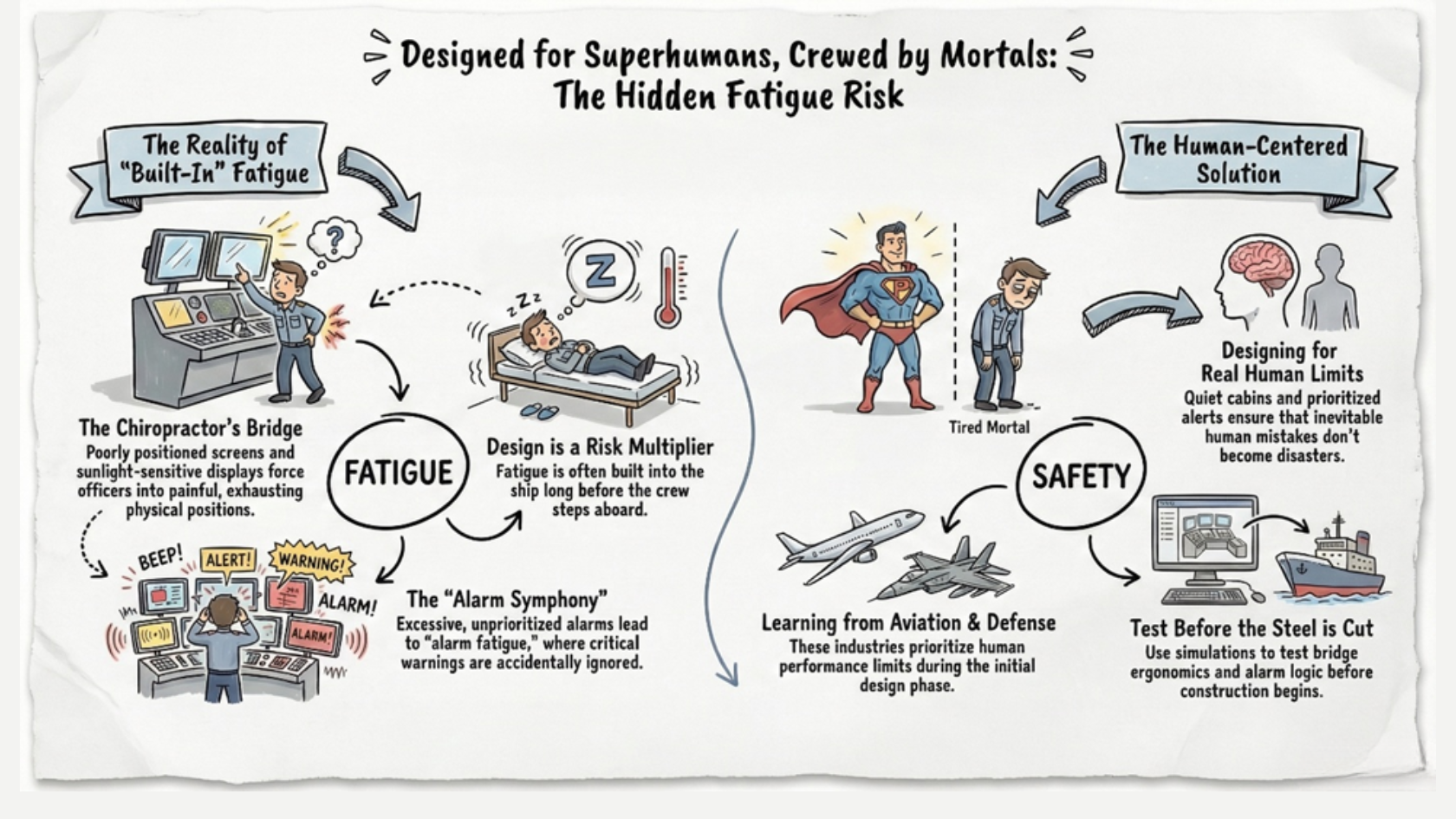

Designed for Superhumans, Crewed by Mortals: The Hidden Fatigue Risk in Modern shipping
Modern ships are technological marvels, but many are still designed as if crews were “superhuman.” Human-centered ship design focuses on building vessels around the real physical and cognitive limits of seafarers. Yet commercial ship design often prioritizes engineering efficiency and cost over ergonomics and crew usability. The result is bridge layouts, alarm systems, and accommodation spaces that increase fatigue, errors, and operational risk.
Why Human Factors and Fatigue Still Challenge Modern Shipping
Ever notice how many vessels seem designed for officers who don’t exist?
The mythical operator who never gets tired, never loses focus, and can somehow read a display panel positioned at ankle height while steering through a typhoon.
Unfortunately, those officers exist only in PowerPoint presentations — not on the bridge at 0300 hours after a 12-hour watch cycle.
This is the quiet but persistent problem of human factors and fatigue in modern shipping.
Ships are becoming more technologically advanced every year, yet many are still designed as if the humans operating them were superhuman machines rather than very mortal crew members.
The Illusion of “Rest Hours”
The shipping industry loves paperwork solutions.
When fatigue comes up, the standard response is simple: “Rest hours are regulated.”
Yes, they are.
But ticking a rest-hour box does not magically refresh the brain of a third officer who has just been jolted awake by a cascade of alarms.
Fatigue in maritime operations is rarely just about sleep duration.
It’s about:
- Where crews sleep (often next to noisy machinery)
- What they are asked to do (manual data entry across multiple incompatible systems)
- How ship systems are designed (complex bridge layouts and overwhelming alarm systems)
In many cases, fatigue is built into the ship itself, long before the crew ever steps aboard.
This is where human factors engineering becomes critical — and where shipping often falls behind.
Design Misalignment in Modern Ships
Examples of poor human-centered ship design are still surprisingly common.
The Chiropractor’s Bridge
Radar screens positioned perfectly — provided the officer happens to be 6’4” with exceptional neck flexibility.
For everyone else, the bridge becomes a slow introduction to chronic back pain
The Alarm Symphony
Modern ships generate an astonishing number of alarms.
Every minor system demands attention at the same volume.
After alarm number 27, the human brain naturally begins filtering them out — which unfortunately might be the moment when the one critical alarm actually appears.
This phenomenon, known as alarm fatigue, is well documented in aviation and healthcare.
Maritime operations are only beginning to acknowledge it.
The Shoebox Cabin
Crew cabins located directly next to machinery spaces.
Apparently, earplugs are still considered a fatigue management strategy
The Anti-Sunlight Display
Bridge displays that wash out the moment sunlight touches them.
Officers end up squinting at navigation data like characters in a spaghetti western duel at noon.
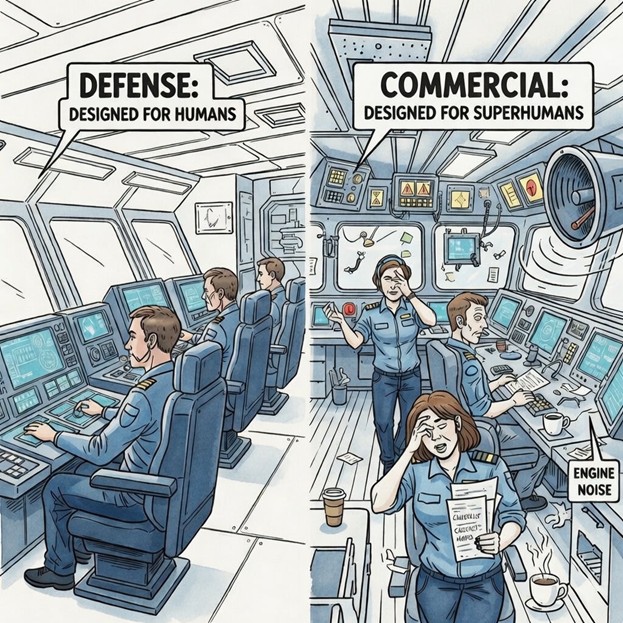
These design flaws are not minor inconveniences.
They are risk multipliers, quietly pushing tired humans closer to operational mistakes.
The Consequences the Industry Rarely Talks About
Look at almost any major maritime accident investigation.
Fatigue frequently appears somewhere in the background:
- groundings
- collisions
- navigation errors
- near misses
Yet fatigue rarely receives the same level of scrutiny as mechanical failures.
Why?
Because replacing a faulty pump is easier than redesigning a bridge.
And blaming the operator is often easier than blaming the design philosophy behind the system.
But here is the uncomfortable truth: If a system only works when the operator is fully rested, perfectly alert, and never distracted, then the system has already been designed for failure
The Elephant in the Room: Human-Centered Design
Other industries learned this lesson decades ago.
Aviation, for example, has long relied on human factors engineering.
Cockpits, instruments, and procedures are built around the limits of human performance.
The same is true in defense operations.
Warships, submarines, and military control rooms integrate human factors into their design from the beginning.
Why?
Because military planners know that fatigue destroys performance.
Meanwhile, commercial shipping still often treats human factors as an afterthought — something to be patched in once the steel is already cut.
The result?
Ships designed for superheroes.
Crewed by very tired mortals.
A Sarcastic Reality Check
The industry frequently claims that “safety comes first.”
But in practice, safety sometimes means:
- filling out another checklist
- accepting alarm overload as “normal”
- hoping fatigue disappears when another circular is issued
Because nothing says robust maritime safety culture quite like cabins where the bulkhead doubles as a subwoofer.
So What’s the Fix?
Improving human factors in ship design is not rocket science.
It simply requires acknowledging the limits of human performance.
Practical improvements include:
- designing bridges and consoles around realistic human ergonomics
- using simulation to test layouts before construction
- reducing alarm overload and improving alert prioritisation
- building sleeping spaces that actually allow crews to rest
Most importantly, the industry must accept a simple reality:
Tired people will make mistakes.
Good design ensures those mistakes do not become disasters.
Human-centered ship design should not be an optional extra.
It should be the foundation of maritime safety.
A Final Thought
Some parts of the maritime sector are finally beginning to take human factors engineering seriously.
The concept has long been central to defense and high-reliability industries.
Commercial shipping is slowly catching up.
Because if we continue designing ships for superheroes, we should not be surprised when ordinary humans occasionally send them somewhere they were never meant to go.

— The Sarcastic Mariner
Casualty Specialist | Part-Time Baggage Handler (Emotional & Otherwise) | Full-Time Crisis Juggler