
The Dashboard Never Sleeps: Why Shore Life Isn’t the Soft Option
Look, I get it. From the outside, shore-side shipping looks like the reward.
Air conditioning. Wi-Fi that actually loads a webpage before you finish reading the error message. No rolling decks. No six-month contracts. Just a desk, a screen, and the illusion of a normal life.
But here’s the thing about illusions: they’re usually covering something messier.
The Superintendent Who Knows Too Much
Let me tell you about the superintendent you won’t find in any safety poster.
Thirty-two years in the industry. Twelve at sea, twenty ashore. He can diagnose an engine fault from a cracked satellite call—that hesitation in the chief engineer’s voice tells him more than any telemetry. He’s survived three recessions, two regulatory overhauls, and one digital transformation that’s still, technically, “phase one.”
His phone hasn’t been on silent. When an alert pings at 22:47, he already knows the vessel. The master. The chief engineer. Their habits, their strengths, their blind spots. He’s sailed with half of them. The other half, he’s talked through enough crises to know how they’ll react before they do.
But now he also has to know the algorithm.
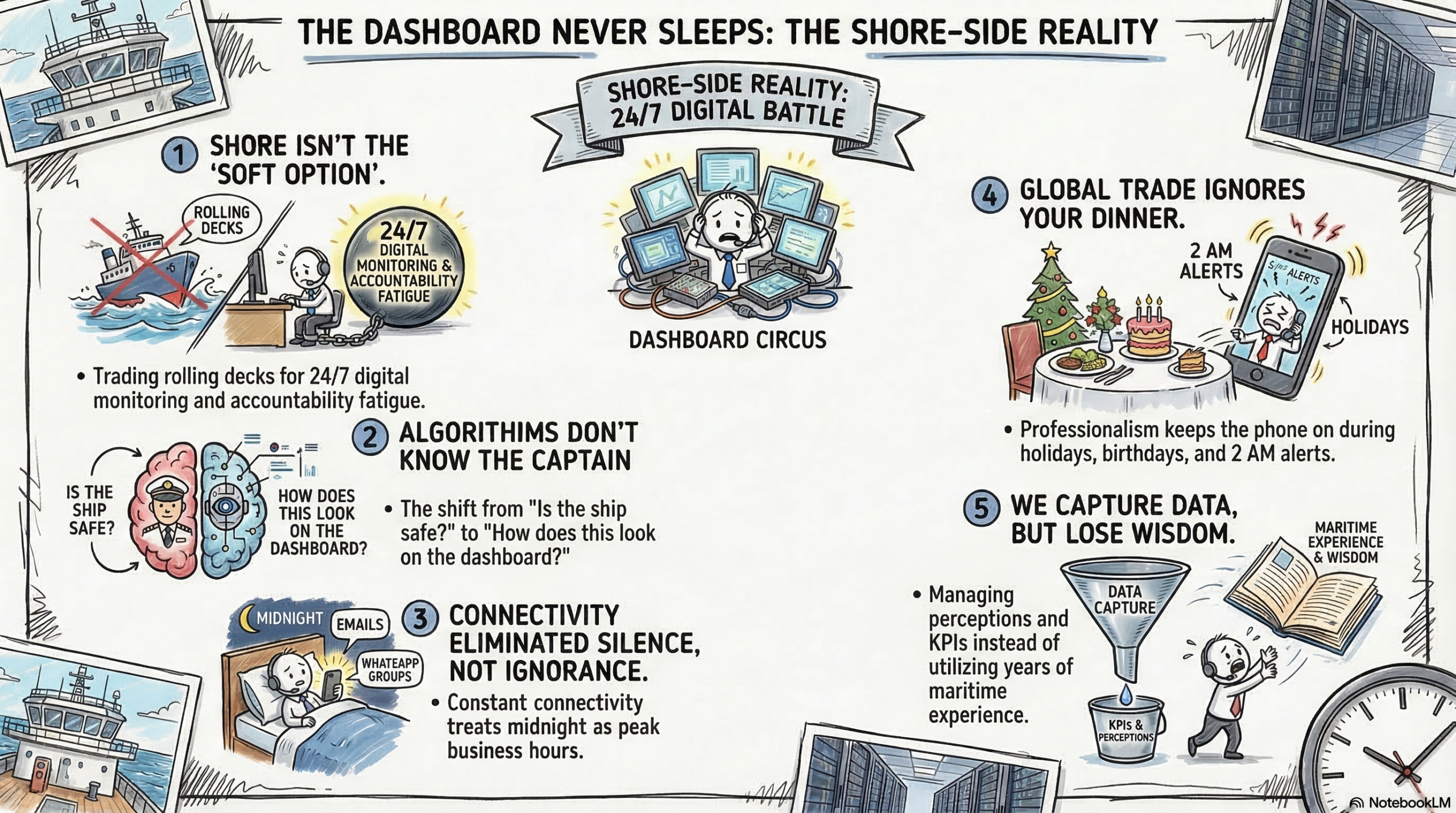
So his internal dialogue has expanded. It used to be simple: “Is the ship safe?” Now it’s a committee meeting in his head:
- Is this operationally significant?
- Is this commercially defensible?
- Is this insurable?
- Is this reportable?
- And—most dangerously—will this look bad on a dashboard?
That last question didn’t exist twenty years ago. Now it’s the first one.
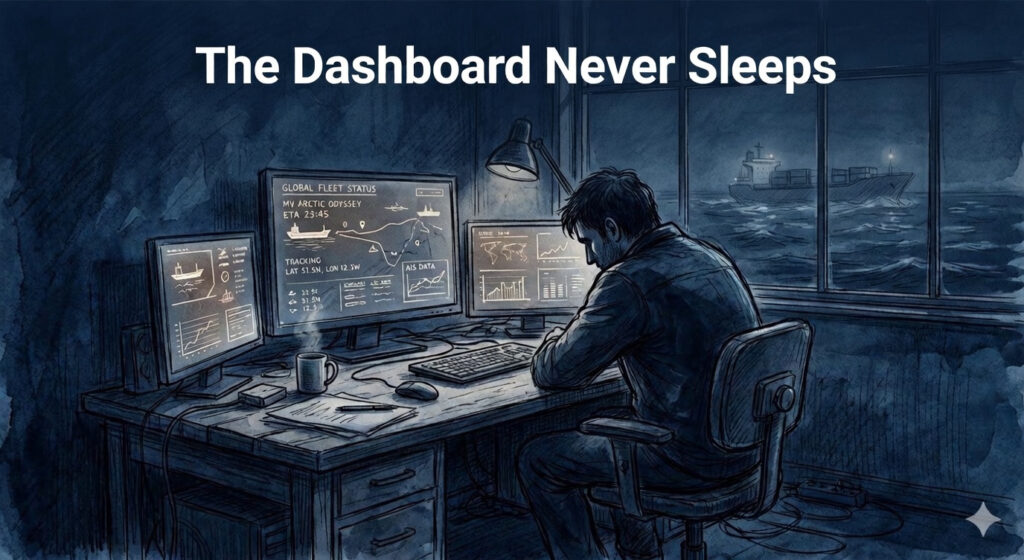
Welcome to the Dashboard Circus
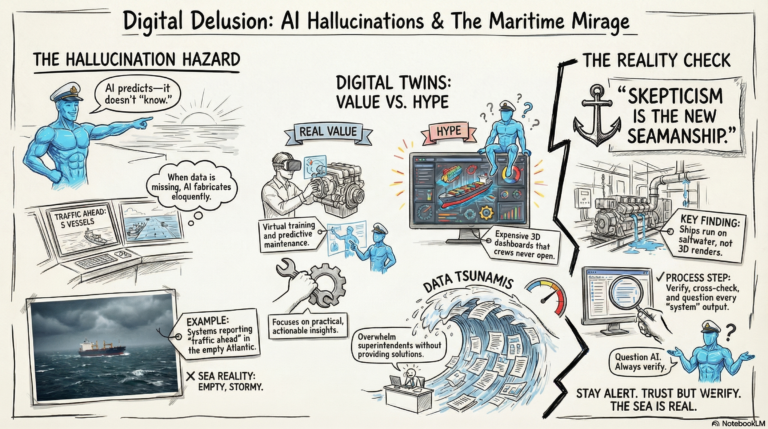
The shore team doesn’t sail vessels anymore. They monitor them. Continuously. Professionally. Exhaustively.
A superintendent used to worry about dry dock budgets and class items. Now he worries about whether a two-hour delay in the noon report submission is the first domino in a systemic collapse. Because if the data is late, the system flags it. And if the system flags it, someone asks. And if someone asks, he has to explain. And explaining takes time he doesn’t have, because three other vessels are also sending data he hasn’t looked at yet.
The irony? We have more information than ever. And less certainty than we’ve ever had.
The Email That Never Ends
Shore professionals don’t write logbooks. They write emails.
“Just checking.”
“Kindly clarify.”
“Please confirm.”
“Any update on this?”
“Following up on the below.”
Nobody types these because they enjoy them. They type them because the data exists. And when data exists, expectation exists. You can’t see a deviation and pretend you didn’t.
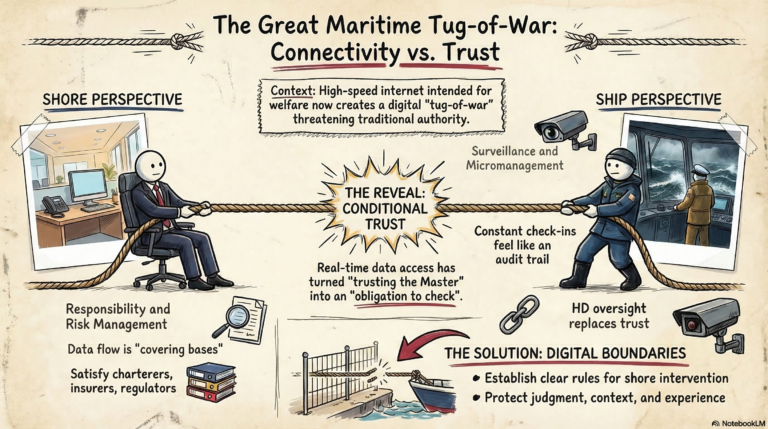
Connectivity was supposed to eliminate ignorance. Instead, it eliminated silence.
There was a time when a master made a decision and shore found out about it when the vessel berthed.
Now shore watches the decision unfold in real time. Which sounds empowering—until you realize you’re responsible in real time as well.
The Human Cost of Being Always Available
Shore life was marketed as stability. No more sailing. Predictable hours. Family time.
The brochure didn’t mention:
- 24-hour monitoring
- WhatsApp groups that treat 11pm as peak business hours
- Charterers who think email was invented specifically so they could ask questions at midnight
- KPIs that don’t care about time zones
- The polite, unspoken expectation that holidays are “reachable”
The job doesn’t end when you leave the office. It follows you. Persistently. Like a compliance reminder with good cell reception.
And you answer. Because you’re professional. Because you care.
Because somewhere out there is a vessel with twenty-two people on board, and you will not be the weak link in that chain.
Christmas Doesn’t Pause Global Trade
The holiday season arrives every year with the same promise: rest, family, reflection.
And every year, shipping politely ignores all of that.
While the rest of the world winds down, shipping does what it does best: keeps moving, keeps calling, keeps reminding us that global trade doesn’t observe public holidays.
For those ashore:
- “Just one quick question” emails sent at 11:58pm on December 31st
- Emergency calls that begin with “Sorry to disturb you…” and are never actually sorry
- Year-end reviews completed between airport queues and family dinners
For those at sea:
- Christmas in a different time zone, with a different menu, and the same alarms
- New Year’s Eve marked by a course change instead of fireworks
- Festive meals eaten between watches, because the cargo doesn’t care about tradition
Nothing says holiday spirit quite like a port state inspection on Christmas morning.
The pressure isn’t just operational—it’s emotional. Expectations rise. Tolerance drops. Fatigue accumulates. And yet professionalism stays intact, because shipping has always been very good at performing calm—even when everyone’s running on empty.
What the Shore Team Actually Absorbs
Here’s what doesn’t show up in any dashboard:
- Every delay they didn’t cause
- Every incident they didn’t witness
- Every decision they must justify after it’s already gone wrong
- Every amber flag that nobody knows how to resolve because the system that created it doesn’t speak to the system that could fix it
You don’t fight weather ashore. You fight timelines, emails, regulators, charterers, and hindsight. All at once. All the time.
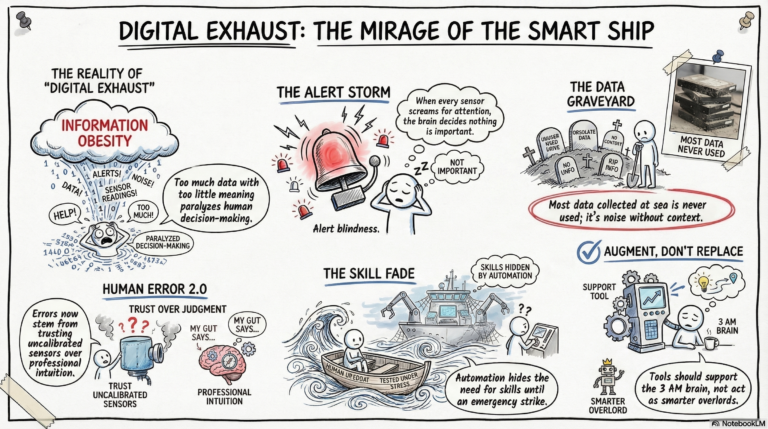
The risk isn’t just fatigue at sea. It’s fatigue ashore—decision fatigue, alert fatigue, accountability fatigue.
And when professionals spend more time managing perception than solving problems, the system becomes performative.
When everything is urgent, nothing is.
The Question Nobody Asks
When the superintendent with four decades of experience retires—who knows what he knows?
Who has asked him to write it down? Who has asked how he balances regulatory compliance with commercial reality? Who has asked which alerts actually matter and which can wait? Who has asked how crew welfare looks from the other end of the phone?
We built dashboards. We collected data. We generated reports.
We forgot to capture wisdom.
The Other End of the Same Line
Out at sea, a master stands on the bridge, making a decision with imperfect information.
Ashore, a superintendent sits under fluorescent lights, making a decision with too much information.
Both believe they’re protecting the vessel.
Both are right.
Both are tired.
Shipping doesn’t run on software. It runs on people who answer the phone—at 2am, on Christmas Day, during their daughter’s birthday dinner, in the middle of a crisis that started before they were born and will continue after they retire.
Maybe the next evolution of this industry isn’t better data. Maybe it’s better restraint. The courage to say: “This can wait.” “This is noise.” “This is not worth waking someone’s child for.”
Connectivity shrank the ocean. It didn’t shrink responsibility.
And somewhere between the bridge and the boardroom, we’re all holding the same line—just from different ends.