

Crew Welfare in Shipping: The Risk Nobody Wants to Audit
In the world of maritime human factors, we love numbers.
Hull thickness? Measured to the millimeter.
Cargo temperature? Tracked to the decimal.
ISM audit checklists? Longer than a Tolstoy novel.
Yet when it comes to the people actually running the vessel, our metrics suddenly become suspiciously vague.
“Rest hours? Oh yes, all in order. The spreadsheet says so.”
If only fatigue and mental health could be managed as neatly as ballast water.
Fatigue: The Silent Incident Generator
Crew fatigue is not a theoretical risk in maritime operations.
It is often the default condition.
• Long contracts
• 6-on / 6-off watch rotations
• Minimal shore leave
• Reduced manning justified as “efficiency”
• Port turnarounds that allow almost zero recovery time
The relationship between fatigue and maritime accidents is well established in human factors research.
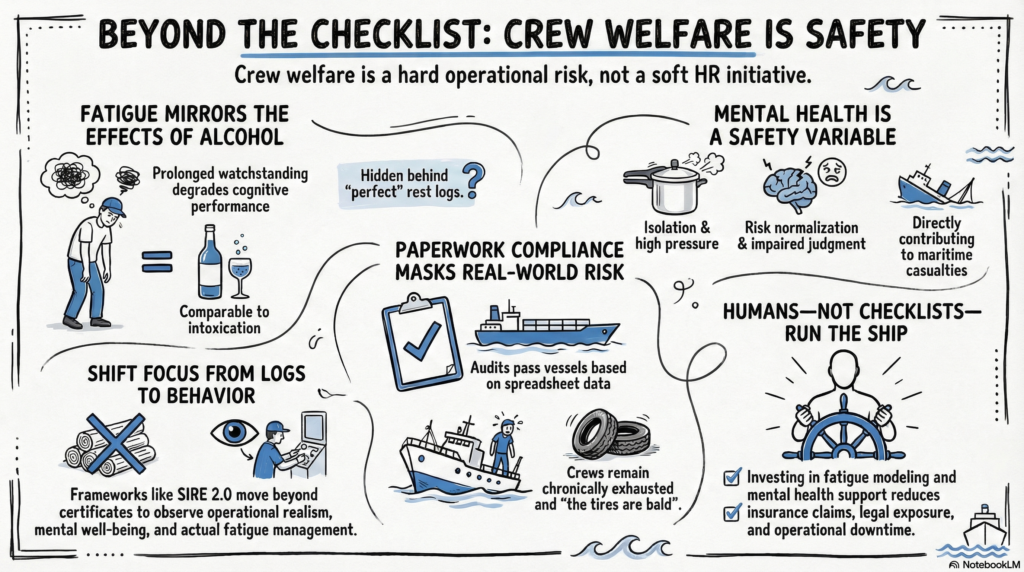
Prolonged watchstanding degrades cognitive performance — sometimes to levels comparable to alcohol impairment.
The difference?
Alcohol shows up in a test.
Fatigue shows up as a perfectly compliant hours-of-rest log.
Until it manifests as a grounding, collision, machinery failure, or cargo incident — we pretend it isn’t there

Mental Health: Shipping’s Quiet Taboo
Seafaring is isolating. High-pressure. Commercially unforgiving.
Mental health challenges are inevitable in such an environment — yet stigma, fear of career impact, and cultural norms keep discussions muted.
The irony is striking.
We install satellite-linked sensors to monitor an engine bearing in real time.
But the “human bearing” operating the vessel’s systems is left to self-diagnose.
Untreated mental health stressors can lead to:
• Reduced concentration
• Impaired judgment
• Conflict onboard
• Risk normalization
• Poor decision-making
In extreme cases, they contribute directly to maritime casualties.
Crew welfare is not a soft HR topic.
It is a safety variable.
The Human Blind Spot in Maritime Audits
Maritime audits were designed to be comprehensive.
Yet human factors frequently receive only surface-level treatment.
• Hours of rest? Spreadsheet-perfect.
• Fatigue indicators? Rarely measured.
• Mental health checks? Often treated as HR initiatives.
The result?
Crews may be chronically exhausted, but if the paperwork aligns, the audit passes.
It’s the maritime equivalent of passing your car’s inspection with bald tires because the inspector only checked the glovebox.
Compliance is documented.
Risk remains unmanaged.
The Shift Toward Human Factors
The updated inspection frameworks such as SIRE 2.0 represent a structural shift in how crew welfare is evaluated.
For the first time:
• Fatigue management is actively assessed
• Competence validation goes deeper than certificates
• Mental well-being is part of the operational conversation
• Inspectors observe behavior, not just paperwork
While initially tanker-focused, the influence is already spreading. Container, bulk, and LNG operators are integrating fatigue risk management systems and structured crew welfare policies into daily operations.
The signal is clear:
Human factors are no longer peripheral to maritime safety — they are central
Emerging Best Practices in Crew Welfare
Some operators are moving beyond minimum compliance:
Fatigue Risk Management Systems (FRMS)
Predictive modeling identifies unsafe work-rest patterns before incidents occur.
Digital Monitoring
Wearables and biometric tools assess sleep quality and alertness — implemented with strict privacy safeguards.
Mental Health Support
Confidential helplines, onboard training, peer support frameworks, and structured open dialogue.
Crew-Centric Audits
Direct crew interviews and qualitative welfare indicators complement traditional compliance checks.
The shift is gradual.
But it represents movement away from tick-box safety toward operational realism.
Crew welfare is not a “soft issue.”
It is a hard operational risk factor directly linked to:
- Casualties
- Insurance claims
- Operational downtime
- Legal exposure
- Reputational damage
Ships do not run on checklists.
They run on humans.
Tired, stressed, resilient, resourceful humans.
SIRE 2.0 may be just the beginning — but it signals recognition that maritime human factors finally matter.
Until that mindset spreads across the industry, we risk managing 21st-century shipping with 19th-century paperwork.
And hoping our crews survive the audit — not just the voyage
Ships do not run on checklists.
They run on humans.
Tired, stressed, resilient, resourceful humans.
— The Sarcastic Mariner
Casualty Specialist | Part-Time Baggage Handler (Emotional & Otherwise) | Full-Time Crisis Juggler