
The Bridge Perspective
Somewhere inside the Persian Gulf right now, a ship’s Master is looking at a chart that hasn’t changed — but a world that has.
The vessel is seaworthy.
The engines are ready.
The navigation plan still works.
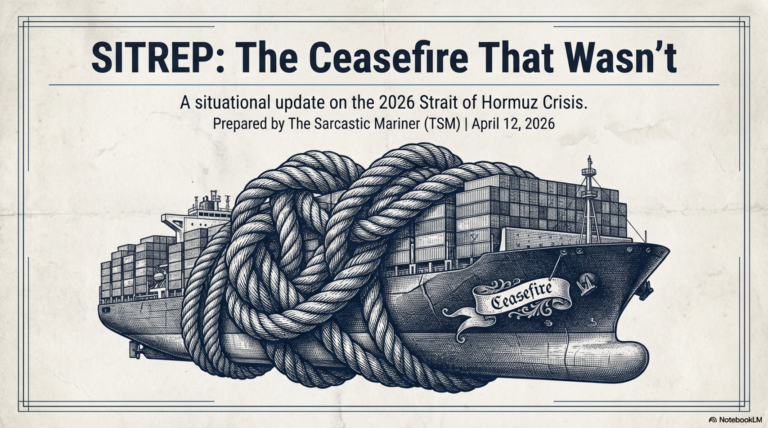
The problem is that the door has effectively closed.
The Strait of Hormuz, the narrow waterway every navigation cadet memorizes early in their training, has suddenly become the most fragile artery in global trade.
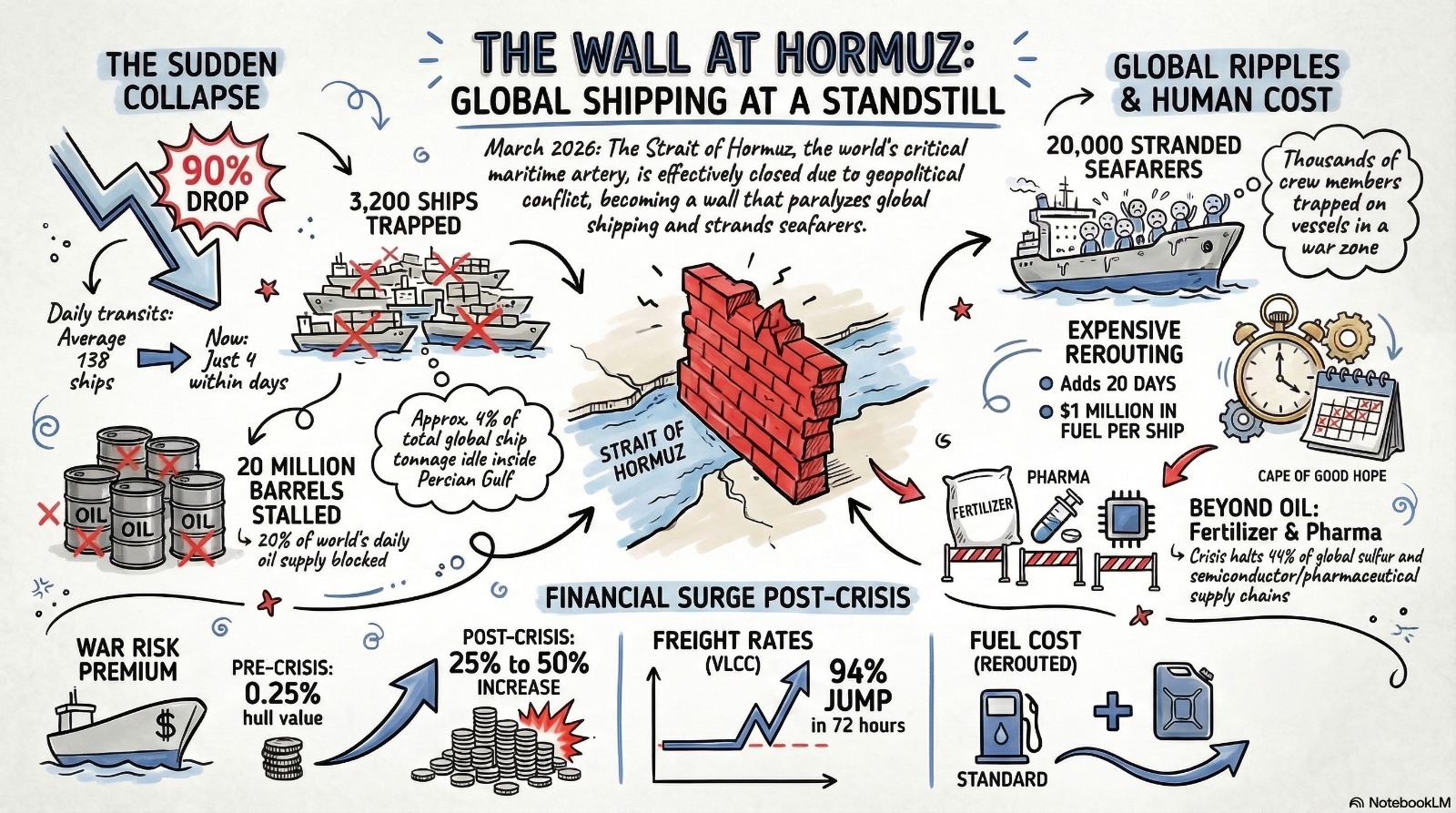
Following escalating conflict in early March 2026 — after joint U.S. and Israeli strikes on Iran and the reported death of Supreme Leader Ayatollah Ali Khamenei — Iran warned that vessels attempting to transit the strait would be targeted, sending immediate shockwaves through the maritime industry .
Commercial reality responded within hours.
Ships slowed.
Charterers paused.
Underwriters withdrew cover.
Traffic through the strait collapsed. By March 3, only four ships transited the waterway — a 90% drop from the previous seven-day average of 138 vessels per day .
The headlines call this a geopolitical crisis.
Inside the ships waiting in the Gulf, it feels different.
It feels like waiting.
Why the Strait of Hormuz Matters to Global Shipping
The Strait of Hormuz is the world’s most critical maritime chokepoint.
Each day in normal conditions:
- Roughly 20% of the world’s oil supply transits the strait .
- Around 20 million barrels of crude oil per day move through the corridor .
- Significant volumes of LNG, petrochemicals, fertilizers, and container cargo also pass through.
In other words:
When Hormuz slows, the world notices.
But the immediate impacts are not always the ones that make headlines.
The Ships That Cannot Move
According to Clarksons Research, approximately 3,200 ships — representing about 4% of global ship tonnage — are currently idle inside the Persian Gulf. Another 500 ships (1% of global tonnage) are “waiting” outside the Gulf in ports off the coast of the United Arab Emirates and Oman .
Major global shipping lines and operators have already adjusted operations dramatically:
- Maersk, MSC, Hapag-Lloyd, and CMA CGM have all suspended Gulf transits and are rerouting around the Cape of Good Hope .
- MSC suspended “all bookings for worldwide cargo to the Middle East region until further notice” .
- COSCO and others have issued similar stop-booking notices .
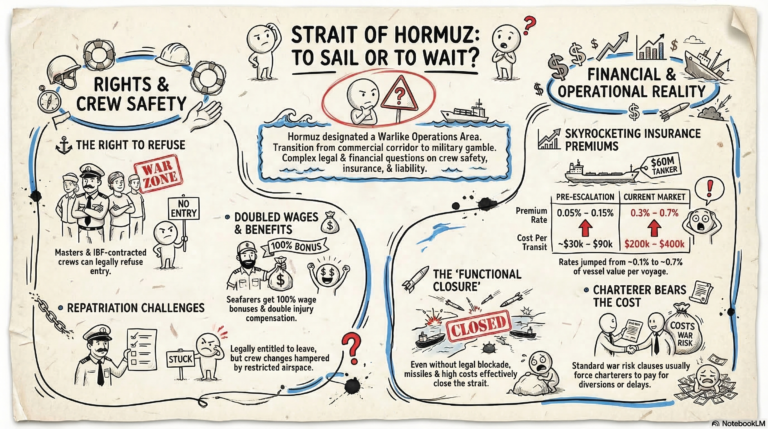
Meanwhile, maritime insurers have withdrawn or repriced war-risk cover, making many voyages economically impossible even if technically feasible .
Skuld and NorthStandard P&I issued formal 72-hour cancellation notices for coverage in the Middle East Gulf and the Gulf of Oman, effective March 5 .
War risk premiums, previously around 0.25% of a vessel’s hull value, are now expected to jump by 25% to 50% — potentially adding hundreds of thousands of dollars to a single voyage .
Shipping rarely stops because someone declares it closed.
Shipping stops because risk becomes uninsurable.
The Supply Chain Problem Nobody Likes to Talk About
Modern supply chains operate on a delicate assumption:
Critical maritime chokepoints will always remain open.
But geography does not provide redundancy.
Nearly every major Gulf export hub sits inside the Strait of Hormuz, including ports serving:
- Saudi Arabia
- Kuwait
- Qatar
- Bahrain
- the United Arab Emirates
When the strait becomes unsafe, there is no simple detour.
Yes, cargo can theoretically be diverted:
- through Red Sea ports (though the Suez Canal remains highly unstable)
- through Oman’s Arabian Sea ports
- or via land transport across the Arabian Peninsula
But these are not substitutes. They are expensive, limited workarounds .
Global shipping networks were built for efficiency — not for geopolitical stress tests.
The Quiet Cargoes at Risk
When analysts discuss the Strait of Hormuz, the conversation almost always revolves around oil.
But the disruption extends far beyond energy.
Delays through the Gulf can affect:
- Fertilizers: 44% of global sulfur, 31% of urea, 18% of ammonia, and 15% of phosphates transit the region .
- Pharmaceuticals from India shipped via Gulf hubs .
- Semiconductors and batteries from Asia routed through the region .
- Petrochemical feedstocks essential for global manufacturing.
- Temperature-sensitive food cargo in refrigerated containers.
Global trade moves in containers, tankers, and bulk carriers — not headlines.
And many of those cargoes do not tolerate delay.
The Human Cost: 20,000 Seafarers Stranded
This is the part that rarely appears in industry reports.
The UN’s International Maritime Organization (IMO) has confirmed that approximately 20,000 seafarers and around 15,000 cruise ship passengers are currently stranded aboard vessels in the Persian Gulf .
Arsenio Dominguez, IMO Secretary-General, told AFP:
“Besides the economic impact of these alarming attacks, this is a humanitarian issue. Any attack on innocent seafarers is unacceptable.”
The International Transport Workers’ Federation (ITF) described this as the worst situation its general secretary had seen in 32 years in the industry .
Greek seafarers have launched a 24-hour strike demanding the area be declared a war risk zone to enable crew repatriation .
One seafarer aboard a tanker in the region told The Guardian:
“We’re powerless… and hoping nothing hits us.”
Shipping statistics rarely include that metric.
The Ripple Effects Spreading Globally
The closure is not staying inside the Gulf.
- Freight rates for VLCCs loading in the Middle East Gulf jumped 94% from Friday to Monday .
- War risk surcharges of up to $800–$3,000 per container are being imposed .
- Cape of Good Hope diversions add 10–20 days and roughly $1 million in extra fuel per ship .
- QatarEnergy declared force majeure on LNG shipments after drone attacks halted production at Ras Laffan .
- Iraq’s Basra Port, with a normal capacity of 3.5 million barrels per day, handled zero crude oil on March 2 .
- European gas prices rose approximately 80% in the days following the outbreak .
JPMorgan analysts warn that if the Strait remains disrupted for 21 days, major regional oil producers will be forced to shut down facilities .
The Part That Rarely Appears in Industry Reports
Shipping analysis will eventually quantify the costs:
- oil price volatility
- freight rate spikes
- insurance premium increases
- rerouting delays
Those numbers will appear in reports and conference presentations.
But they rarely capture something else.
The people.
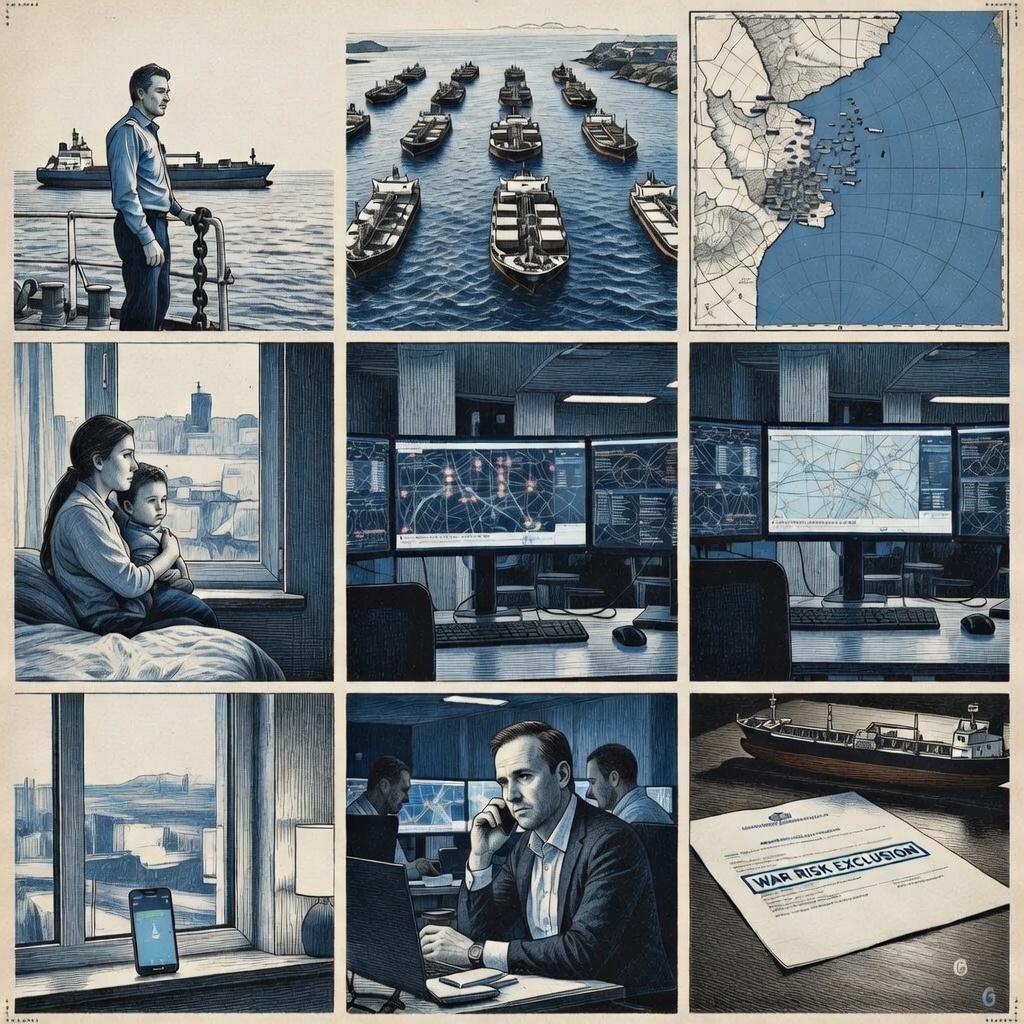
Inside every ship waiting offshore:
- someone is calculating provisions
- someone is delaying a crew change
- someone is explaining to their family why they cannot come home yet
And somewhere on a bridge in the Gulf, a Master is still doing what Masters always do:
Maintaining readiness.
Maintaining discipline.
Maintaining calm for the people who depend on him.
The anchor may be down.
But responsibility never is.
When a Chokepoint Becomes a Wall
For decades, analysts have described the Strait of Hormuz as a “strategic chokepoint”.
It always sounded theoretical.
Now it doesn’t.
Because when maritime geography turns into geopolitics, the system built for movement suddenly learns something uncomfortable:
Shipping is very good at moving.
It is far less comfortable standing still.
And right now, in the Gulf, a lot of it is doing exactly that.
Waiting.
Conclusion: The System vs The People Inside It
Global shipping moves around 90% of the world’s trade.
But it runs on a fragile network of narrow passages, political stability, and the quiet professionalism of the people at sea.
When one of those passages stops working, the numbers tell one story.
The ships tell another.
And somewhere in the Gulf tonight, a Master is still on the bridge — waiting for someone ashore to decide what happens next.

From a Fellow “Casualty Specialist | Part-Time Baggage Handler (Emotional & Otherwise) | Full-Time Crisis Juggler”