
The Unicorn of Shipping: Why ‘Just Culture’ Dies When Insurance Gets Involved”
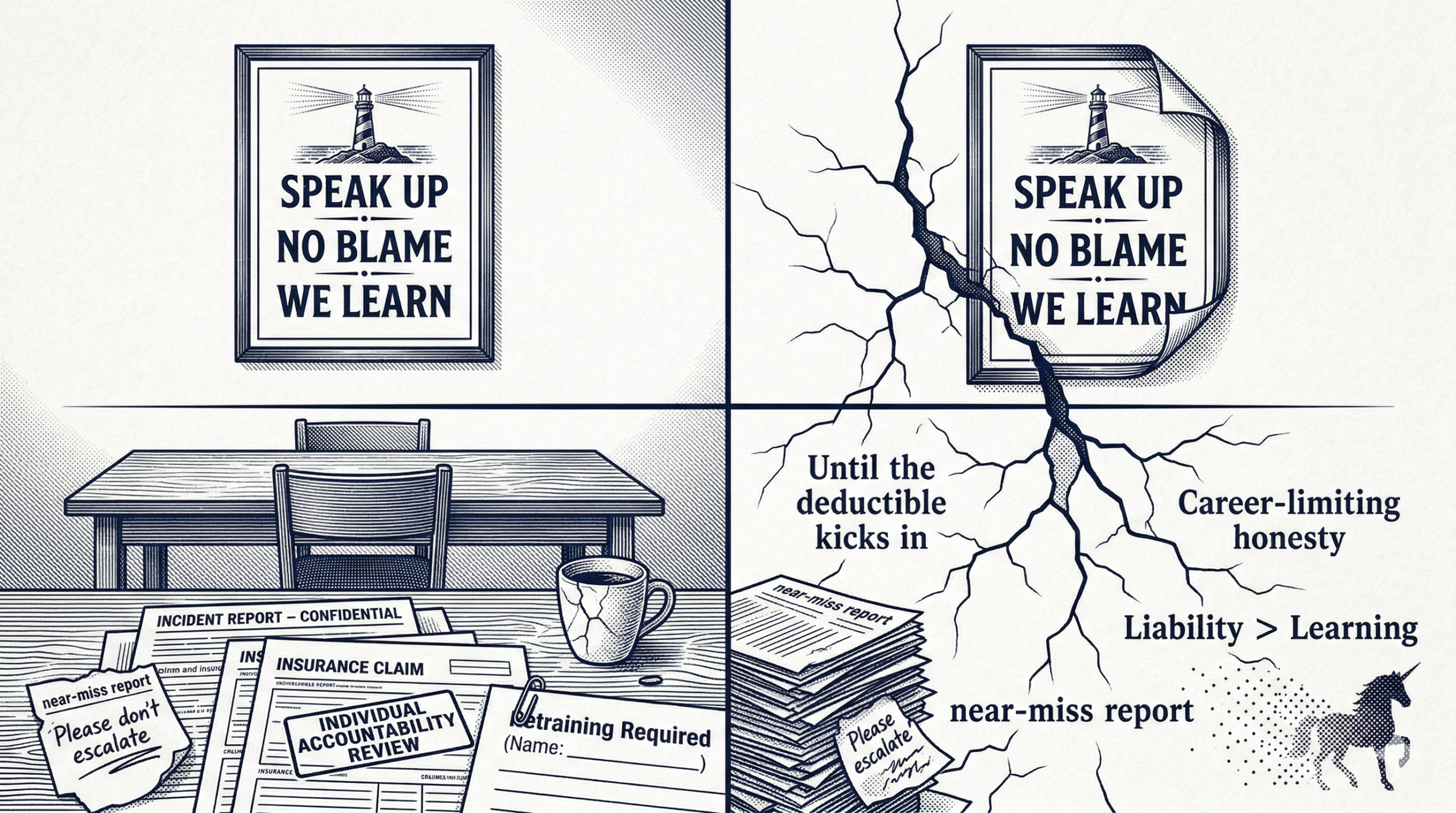
We’ve all seen the posters.
Beautiful fonts. Calming colours. Probably a lighthouse in the background.
“Speak Up.”
“No Blame Culture.”
“We Learn from Mistakes.”
“Safety is Everyone’s Responsibility.”
Now let me translate those into real shipping English.
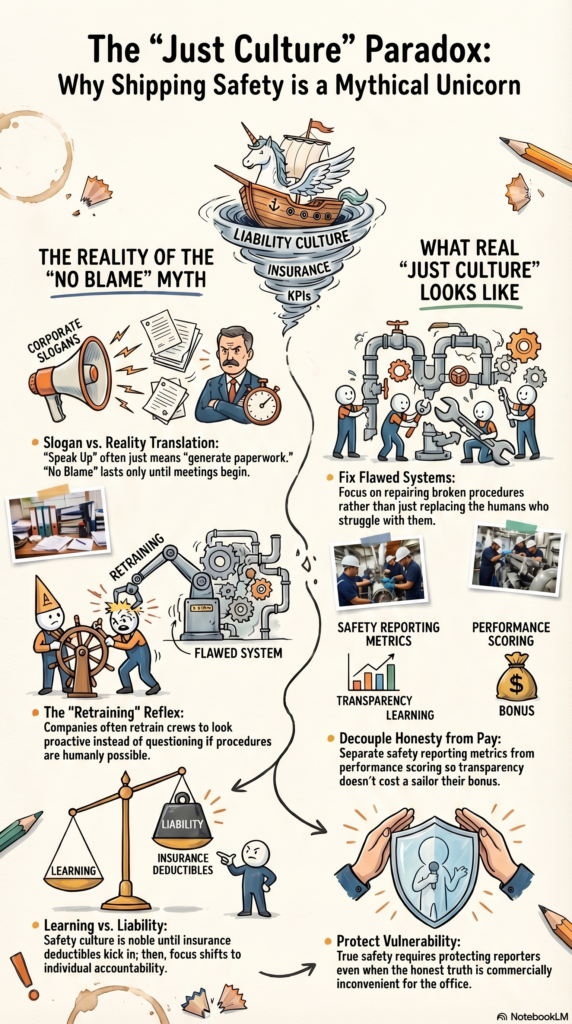
- “Speak Up” = Generate paperwork. Preferably in triplicate.
- “No Blame” = We won’t blame you immediately. We’ll wait until after the meeting.
- “We Learn” = After we identify who needs retraining. Spoiler: it’s you.
- “Safety is Everyone’s Responsibility” = Especially yours. Not ours. Yours.
Welcome to the Just Culture paradox.
Sounds great on paper. Works terribly in practice.
The Theory We Love to Frame
On paper, Just Culture is brilliant.
Encourage reporting. Remove fear. Focus on systems, not individual idiocy. Learn before things explode.
In theory, near‑miss reporting should be pure gold. Honest. Messy. Raw. Occasionally uncomfortable.
Because that’s how learning actually happens.
But theory meets reality somewhere between the bridge and the boardroom.
And reality, unfortunately, has KPIs.
The Fear of Reporting (Dressed Up as Professionalism)
Let’s be honest.
When a near‑miss happens, the first thought isn’t:
“How can we improve the system?”
It’s:
“Will this hit our statistics?”
So near‑miss reports become works of creative literature.
- “Minor deviation observed.”
- “No immediate risk identified.”
- “Corrective action taken promptly.”
Translation:
“We survived. Please don’t escalate. Also, can we go home now?”
Why?
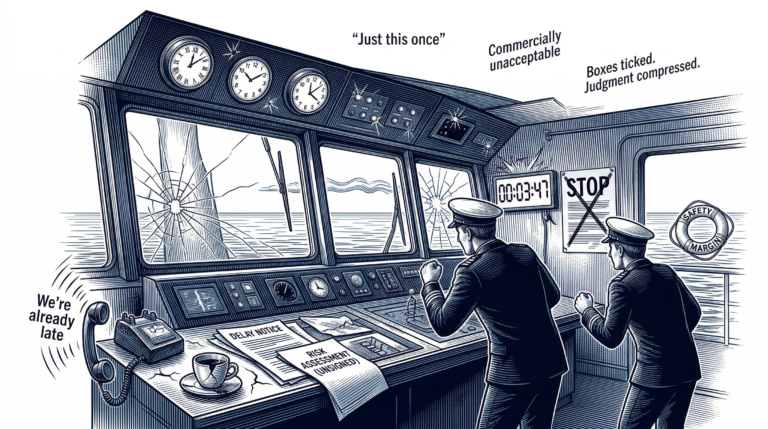
Because safety metrics are tied to performance. Performance is tied to reputation. Reputation is tied to commercial standing.
And suddenly, reporting honestly feels… expensive.
So instead of transparency, we get sanitised storytelling.
Not lies. Just… careful edits.
The Retraining Reflex
Something goes wrong?
Shipping’s favourite solution: Retrain the crew.
- Alarm muted? Retrain.
- Procedure bypassed? Retrain.
- Checklist ticked but not followed? Retrain again.
We love retraining. It feels decisive. It looks proactive. It generates lovely attendance sheets with signatures.
But rarely do we ask the uncomfortable questions:
- Was the procedure even practical?
- Was the workload realistic?
- Was the expectation humanly possible?
Sometimes the problem isn’t competence.
It’s complexity.
Sometimes the procedure is 14 steps long because someone ashore wanted “robust control” and had never stood a 4‑am watch.
And sometimes the person at sea just wanted to get the job done safely without writing a thesis in the rain.
The Insurance Threshold
Now let’s talk about the part nobody puts in the brochure.
We say: “No blame.”
Until the deductible kicks in.
Until the claim escalates. Until regulators arrive. Until lawyers start asking for names.
Then suddenly, the culture becomes very interested in individual accountability.
Because learning culture is noble.
But liability culture is powerful.
And when those two collide on a dark night? Guess which one wins.
You Can’t Learn If You’re Afraid
Here’s the paradox. Simple. Brutal.
You cannot have a learning culture if your first instinct is to find someone to discipline.
You cannot encourage reporting if reports are quietly career‑limiting.
You cannot ask for honesty and then punish vulnerability.
People don’t fear making mistakes.
They fear being left alone with the mistake.
And once fear enters the system, reporting becomes strategic.
Not honest.
So What Would Real “Just Culture” Look Like?
It wouldn’t need posters with lighthouses.
It would mean:
- Fixing flawed procedures – not just retraining the humans who struggled with them.
- Separating reporting metrics from performance scoring – so honesty doesn’t cost you your bonus.
- Protecting reporters – even when the outcome is inconvenient for the office.
- Accepting that human error is not the same as negligence – one needs fixing, the other needs… well, sometimes a conversation.
It would mean admitting that sometimes the system is the problem.
And systems are harder to fix than people.
People are replaceable. Procedures require change. Change requires discomfort.
And discomfort doesn’t look good in quarterly reports.
The Quiet Truth
Shipping will keep printing those beautiful posters.
And crews will keep reading them. And nodding. And filing them next to the “open door policy” memos.
But until insurance stops holding individuals personally accountable for systemic failures?
Until a near‑miss isn’t a black mark on someone’s record?
Until “I made a mistake” doesn’t automatically become “I need retraining (and possibly a warning letter)”?
Just Culture will remain exactly what it is today:
A unicorn.
Beautiful. Mythical. And nowhere to be found when you actually need one.