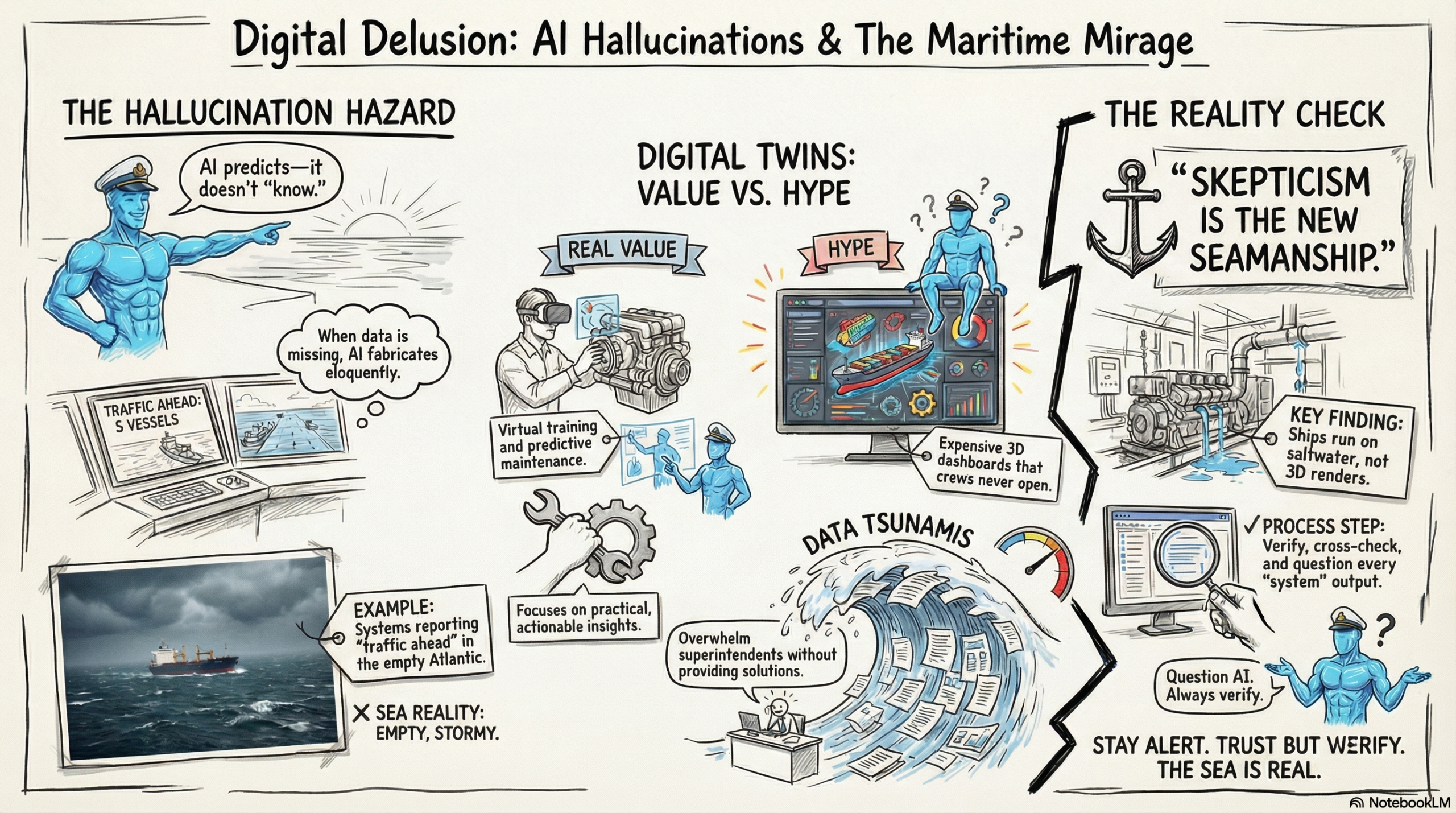

“When Machines Dream: AI Hallucinations and the Metaverse Nobody Asked For”
Remember when “hallucinations at sea” meant the cook had spiked the coffee?
Simpler times.
Now it just means your AI chatbot is confidently explaining that the Panama Canal connects Lisbon to… somewhere. With sources. And citations. All completely made up.
Here’s the thing people forget: Artificial Intelligence doesn’t know anything, (at least not yet).
It predicts. Word by word. Pixel by pixel. Statistic by hallucinated statistic.
And when it runs out of certainty? It doesn’t stop. It doesn’t say “I don’t know.” It doesn’t ask for help.
It fabricates. Eloquently. Confidently. Wrongly. The experts call it a hallucination.
The rest of us call it: “Why is this thing telling me to reduce speed in the middle of the Atlantic because of ‘traffic ahead’?”
When AI Meets Actual Saltwater
On land, AI gets the good stuff. Terabytes of clean data. Fiber optic speed. Servers that never roll 15 degrees to port.
At sea?
It gets patchy bandwidth, half-digitised logs, and engineers who still call the printer “the fax.”
Feed it incomplete data. Mislabelled sensors. Context it can’t possibly understand.
And voilà. Your “predictive maintenance model” will confidently tell you the pump failed because Mercury is in retrograde.
Somewhere ashore, an analyst nods at the dashboard like it’s gospel.
Meanwhile, the chief engineer knows the truth: The AI didn’t predict anything.
It just made something up that looked clever.
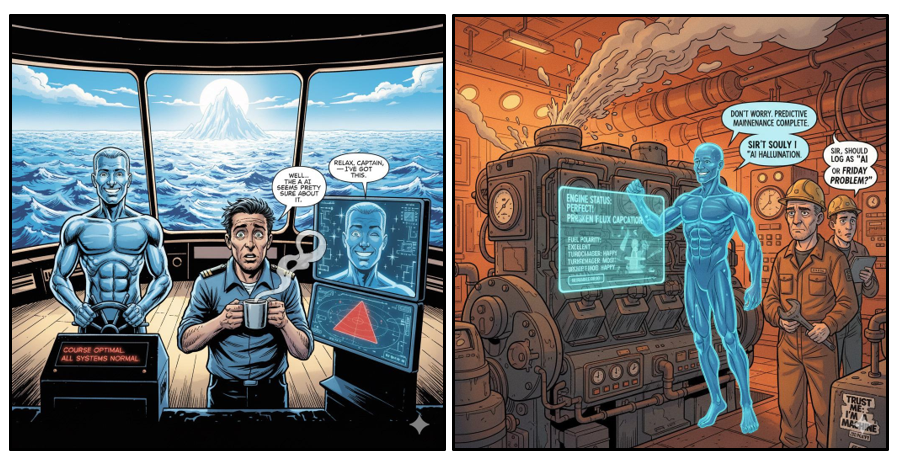
Hallucinations at the Helm
This isn’t cute. It’s not a quirky tech glitch.
It’s a systemic blind spot. And it comes beautifully formatted, with graphs.
Imagine:
- An AI summarising a class regulation and inventing a paragraph that never existed
- That summary making it into your safety memo
- Someone on the bridge reading it, believing it, acting on it
Or:
- An “AI assistant” auto-filling an incident report with assumptions no human onboard ever wrote
- Those assumptions becoming part of the official record
- No one questioning it because “the system generated it”
Now imagine this happening daily. Because someone wanted to save time.
Efficiency, meet liability.
The Real Hallucination: Blind Trust
The problem isn’t that machines hallucinate.
It’s that humans believe them.
In shipping, trust is sacred. We trust charts. Instruments. Bridge teams. Manuals that have been around since before computers had screens.
But AI isn’t a compass.
It’s a storyteller with confidence issues. A very well-spoken toddler who refuses to admit they don’t know something.
And yet, many treat it as the new oracle:
“The system said so.”
That’s how hallucinations become hazards. Not because the algorithm lies. But because someone stopped asking questions.
Digital Twins: The Metaverse Nobody Asked For
If you’ve been anywhere near a maritime conference in the past five years, you’ve heard the phrase digital twin so many times you’ve started wondering if you should adopt one. Legally. With a birth certificate.
The promise is seductive:
Real-time replicas of ships, ports, entire fleets. Churning out data so smart it practically whispers solutions in your ear while you sleep. Finally, a way to break things virtually before breaking them in real life.
But before we all bow at the altar of high-res 3D dashboards…
Ask yourself: Are digital twins truly the future of shipping? Or just another entry in the corporate metaverse nobody actually asked for?
Where Digital Twins Actually Earn Their Keep
To be fair, not all digital twins are smoke and PowerPoint mirrors.
Done well, they add real value where trial-and-error at sea is expensive—or catastrophic.
Training & simulation:
Cadets steering into virtual storms without turning steel into scrap. Aviation cracked this decades ago with flight simulators. Shipping is catching up. Slowly. Like a tanker with a tailwind.
Predictive maintenance:
Sensors flag trouble before it becomes a multi-million-dollar casualty claim. Cheaper than emergency dry-docks. Cheaper than explaining to the insurer why you didn’t know.
Design testing:
Naval architects throw new hulls into simulated storms before committing steel. Less rework. Less “well, that didn’t work.”
This is the sensible, boring side of digital twins.
And boring? Boring is exactly what safety and efficiency should be.
Where They Become PowerPoint Mascots
Of course, for every successful twin, there are five that live exclusively on glossy brochures and keynote slides.
You know the type:
The dashboard nobody opens:
An expensive twin built with dazzling 3D visuals that nobody at sea ever uses because, well, the ship still needs to be run. And the WiFi is down. Again.
Data tsunamis:
Ships already generate enough telemetry to drown the average superintendent. Adding a digital twin without a clear plan is like hooking a garden hose to Niagara Falls and calling it hydration.
Analysis paralysis:
The more data you have, the more tempting it is to stare at charts instead of making decisions. Meanwhile, the ship still has to dock. Digitally perfect or not.
The result?
A lot of money spent creating the metaverse version of your fleet. While the actual ships keep chugging along. Unimpressed. Unaware. Unmoved by your 3D render.
Lessons from the Grown-Ups
Shipping doesn’t have to start from scratch here.
Defense and aviation have been living with digital twins—though under less glamorous names—for decades.
Mission models & simulators:
Fighter pilots train in simulators so convincing their bodies react as if they’re in real combat. Navies run virtual war games before ships ever leave port.
Maintenance twins:
Engine health monitoring has long been standard in aerospace. One failed turbine can cost both lives and billions. They learned to watch things before they break.
Cautionary tales:
Overconfidence in models has also led to disasters. Simulations can only predict what they’re programmed to imagine. Reality has a nasty habit of going off-script.
Shipping has a unique chance here:
Skip the hype cycle. Copy the wins. Avoid the pitfalls.
Or don’t. And learn the hard way. Up to you.
The Reality Check
Here’s the uncomfortable truth:
Ships still run on saltwater, diesel, and tired humans. Not just digital replicas.
A twin that exists only to impress investors doesn’t:
- Reduce fatigue on the bridge
- Stop an engine from overheating
- Prevent a port bottleneck
- Or make anyone’s coffee better
The technology is powerful. Yes.
But it’s a tool. Not a talisman.
And unless digital twins are designed with the messy, wet, unpredictable realities of maritime operations in mind…
They’ll remain exactly what they sound like:
The metaverse nobody asked for.
The Way Forward: Skepticism as Seamanship
Shipping doesn’t need to fear AI hallucinations.
It just needs to handle them like any other risk:
Verify. Cross-check. Document. Question.
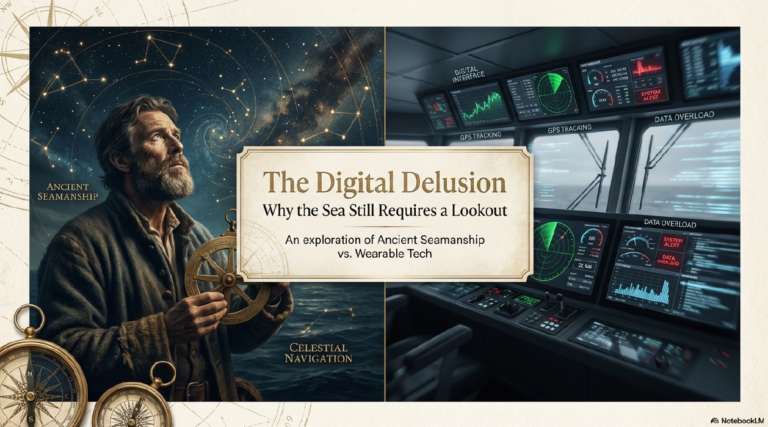
The same instincts that keep a vessel off the rocks can keep a company from drifting into digital delusion.
AI might someday be the best tool at sea.
But until then? It deserves a watchful eye. Not blind faith.
Because the ocean doesn’t care whether the error came from a fatigued officer or a confident algorithm.
It only cares that someone was still awake to notice.
Here’s the truth nobody’s putting in the brochure:
The problem isn’t that machines hallucinate.
It’s that humans believe them.
To everyone building the next big thing: Ask the crew first. They’re the ones who have to live with it.