
Sea, Shore, and the Biryani That Connects (and Divides) Us
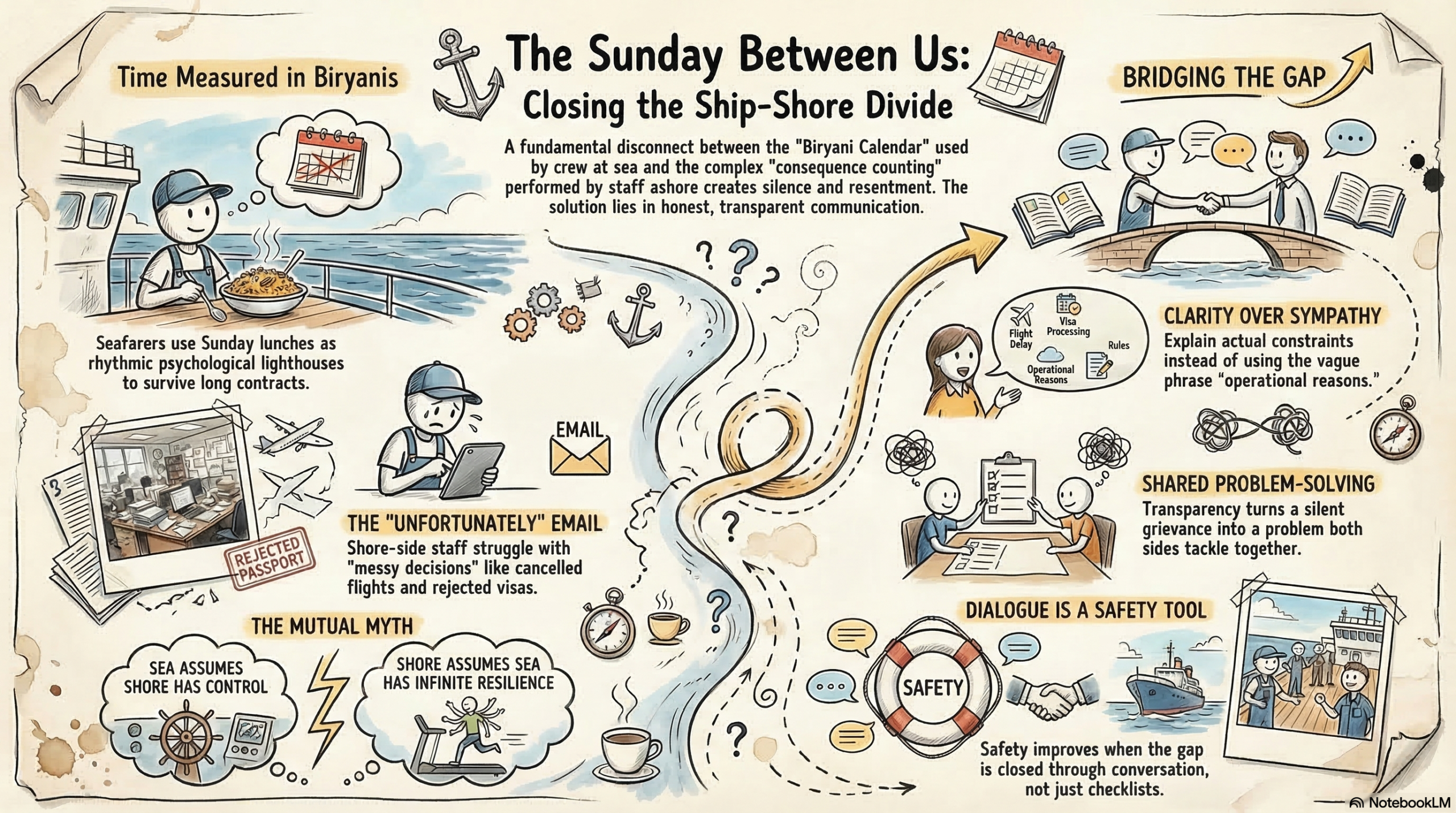
The Sunday Between Us – Seafarer mental health and family life collide every Sunday — the day the distance becomes impossible to ignore.
Two Sundays. Same Moment. Different Worlds.
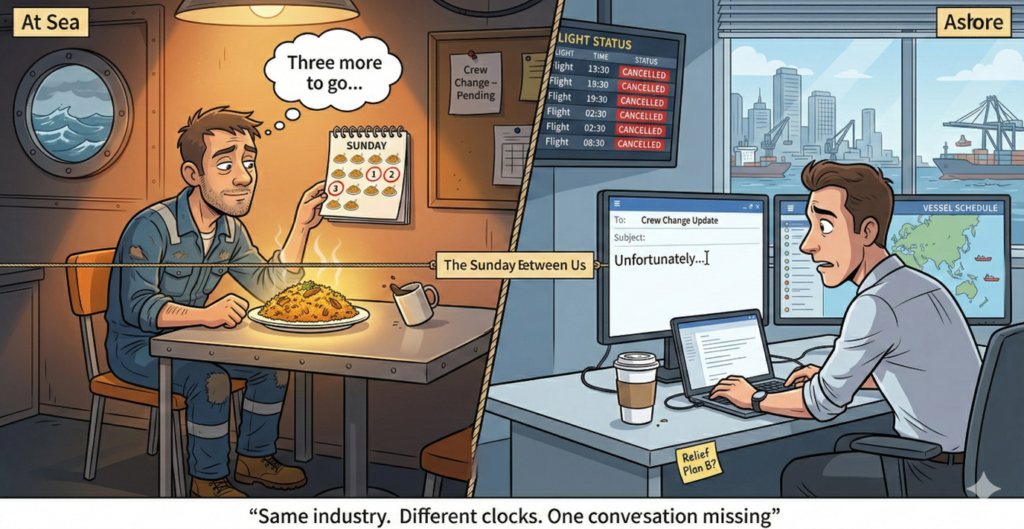
Somewhere right now, a ship’s cook is checking the pressure cooker.
Somewhere else, a fleet manager is checking flight availability.
Neither knows the other exists beyond an email signature.
Both are about to have a very long week.
At Sea: The Biryani Calendar
Let’s start where we left off. On a ship, time isn’t measured in days. It’s measured in Biryanis. Four-month contract? That’s 17. Clean number. Manageable. You can count down on one hand if you’re generous with fingers.
You know exactly which Sunday you’re on. You know exactly how many left. You’ve done the calculation so many times it lives in your brain like a screensaver.
Then the message arrives.
“Relief delayed. Just two more weeks.”
Just. Shipping’s favorite word. Right up there with “temporary” and “we’ll sort it next port.”
Two more weeks means two more Biryanis. On paper? Nothing. Two Sundays. Big deal.
In your head? The calendar just collapsed. You weren’t prepared for those two. You’d already spent them mentally. You’d already packed your bag in your imagination. You’d already tasted airport coffee.
Now you’re looking at rice that tastes suspiciously like extension. And here’s the thing no one talks about:
When rhythm breaks at sea, it doesn’t break loudly. It doesn’t make announcements. It just… leaks. Slowly. Into conversations. Into sleep. Into the way someone stirs their tea.
And when rhythm breaks at sea, morale follows quietly behind.
Ashore: The Other Kind of Sunday
Now let’s talk about the person who sent that message. Contrary to what you’re thinking—no, they didn’t wake up thinking: “How can I personally ruin 20 people’s Sunday today?”
Their Sunday probably started like this:
- Laptop open at home because the office doesn’t close.
- Flight notification: Cancelled.
- Visa portal: Pending since Tuesday.
- Port agent: “Weather window closed, next slot unknown.”
- Charterer: “We’re not paying for deviation.”
- Immigration: “Sir, it’s a public holiday. Which one? The one you didn’t know existed.”
Somewhere between the fourth email and the second coffee, they have to type the words: “Unfortunately, your relief has been delayed.”
They know what that message means. They’ve been at sea before. Or they’ve seen enough crew returns to understand the math. They also know the alternative is worse:
- Send someone unprepared? Safety risk.
- Force a change through a closed port? Commercial exposure.
- Pull crew from another vessel? Now two ships have problems.
The decision isn’t between good and bad. It’s between bad and catastrophic with a side of legal exposure. And yes—the email that begins with “Unfortunately…” is typed with a sigh you’ll never hear.
But you also never hear it. Because you’re not in the room. You’re just reading the words.
The Myth Factory
Here’s where it gets messy.
Sea looks at shore and sees: Air conditioning. Weekends. Family dinners. Control.
Shore looks at sea and sees: No traffic. No meetings. One job at a time. Simplicity.
Both are wrong. Both are right. Both have never said this out loud to each other.
At sea, the fatigue is physical. Your body knows it’s been months. Your sleep knows. Your patience with the same five faces knows.
Ashore, the fatigue is different. It’s not physical—it’s cumulative. It’s the 47th email about the same problem. It’s the 12th person asking for an update you don’t have. It’s explaining to your family why you’re “still working” at 9 PM on a Sunday.
Different scenery. Same slow burn. And because neither side explains the full picture, assumptions grow in the silence. Silence is efficient. Silence is also expensive.
Sea believes shore has control…. Shore believes sea has resilience…. Both overestimate the other. At sea, the fatigue is physical and emotional….. Ashore, the fatigue is systemic and cumulative. Different scenery. Same slow burn.
And because we rarely explain the full picture to each other, assumptions grow in the silence.
Silence is efficient…. Silence is also corrosive.
What We Measure (And What We Don’t)
We’re great at measuring things that move. We’re terrible at measuring things that don’t move.
- Like trust.
- Like “does this feel steady?”
- Like “does anyone here understand what I’m dealing with?”
Steadiness isn’t a soft concept. Steadiness is safety.
A crew member who knows why their relief is delayed works differently from one who only knows that it’s delayed. An office team that understands what fatigue actually feels like onboard makes different calls from one that only sees spreadsheets with green boxes.
But here’s the uncomfortable truth:
We are exceptional at managing systems…. We are inconsistent at managing conversations.
The Part Nobody Writes in the SMS
Your Safety Management System has chapters for everything. Emergency response. Cargo handling. Pollution prevention. Cyber security.
Nowhere does it say: “When things go wrong, tell people why. Not just what.”
Not because anyone’s hiding anything. Because writing it down feels unnecessary. It’s “soft.” It’s “obvious.” It’s “something we already do.”
Except we don’t. When extensions happen, we say “operational reasons.”
When flights cancel, we say “circumstances beyond our control.”
Both statements are true. Both statements are useless.
The actual reason? “Charterer refused the deviation and we couldn’t make the math work without exposing another vessel.” That’s not a secret. That’s context. And context reduces resentment faster than any wellness webinar
Resentment is what actually damages culture.
The Real Fix Is Boring (And That’s Why It Works)
No posters. No slogans. No “employee of the month” that everyone ignores.
Just:
- Reasons. When something changes, explain the actual constraint. Not “operational.” The real one.
- Earliest possible notice. Even if it’s bad news. Even if it’s incomplete. Silence creates space for imagination, and imagination always assumes the worst.
- Language that respects intelligence. Don’t dumb it down. Don’t dress it up. Just say it.
The Sunday Biryani will s till arrive. Flights will still cancel. Regulations will still expand.
Charterers will still charter.
But when both ends of the same line feel heard, the extension becomes a shared problem — not a silent grievance.
The Sunday Between Us
Somewhere, a ship’s cook is about to serve lunch.
Somewhere, a fleet manager is about to refresh a flight portal one more time.
Both are hoping the numbers add up this week. Both know they might not.
The gap between them isn’t distance. It’s not even time zones. It’s conversation. Close that—and safety improves without buying a single new device.
And the Biryani?
Might actually taste like Sunday again. Not extension.