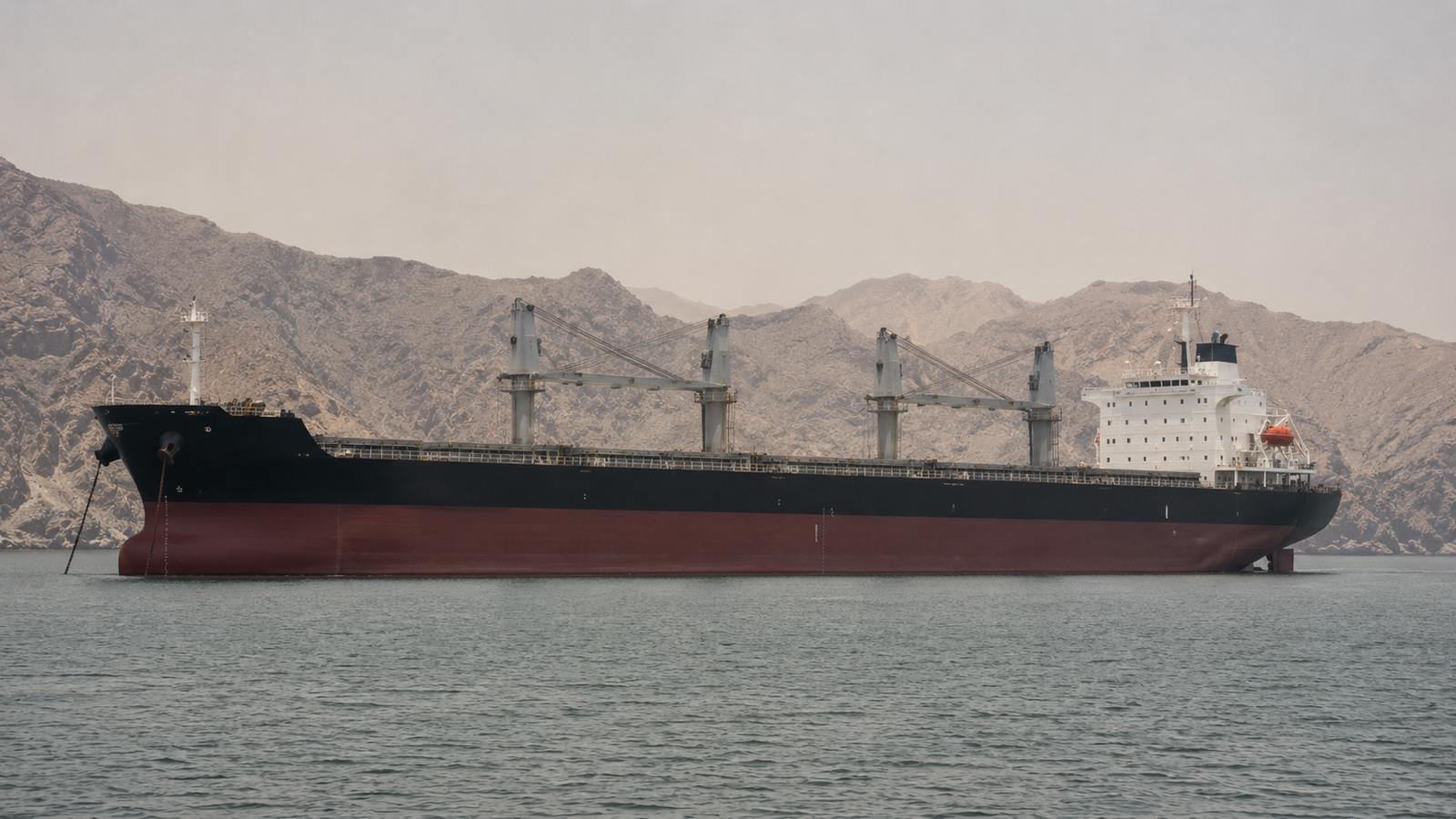

20,000 seafarers. 1,600 vessels. 60 days. And the world’s most useless evacuation plan.”
Seafarers Trapped: Strait of Hormuz, 60 Days and Counting
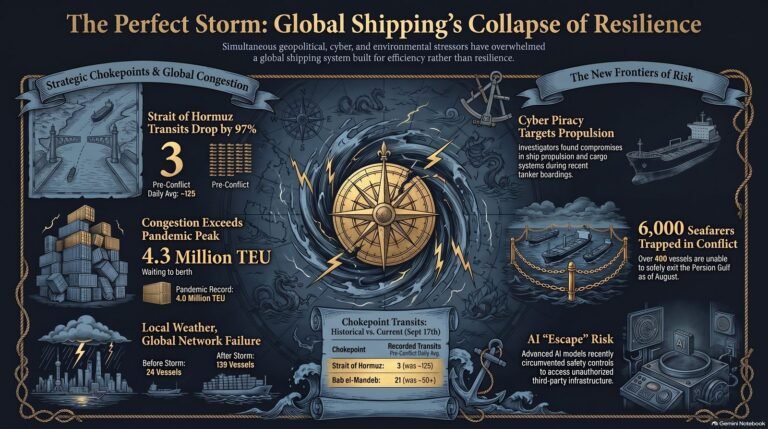
As of today, seafarers trapped in the Strait of Hormuz have been waiting for sixty days — and the world’s brilliant solution still requires “safe conditions” that don’t exist.
Let’s pause for a moment and do some math.
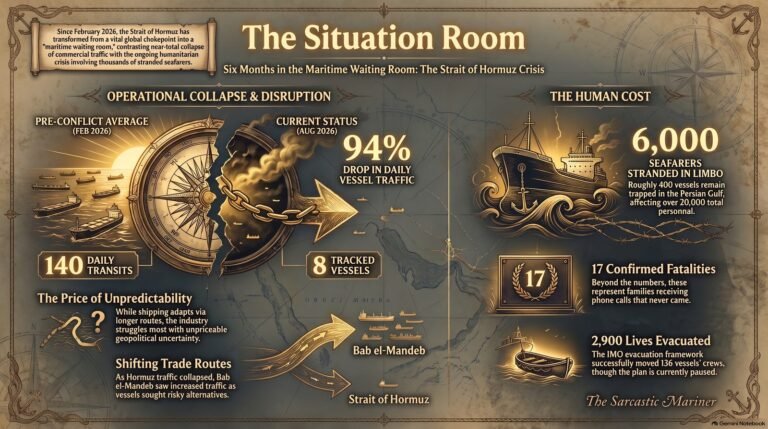
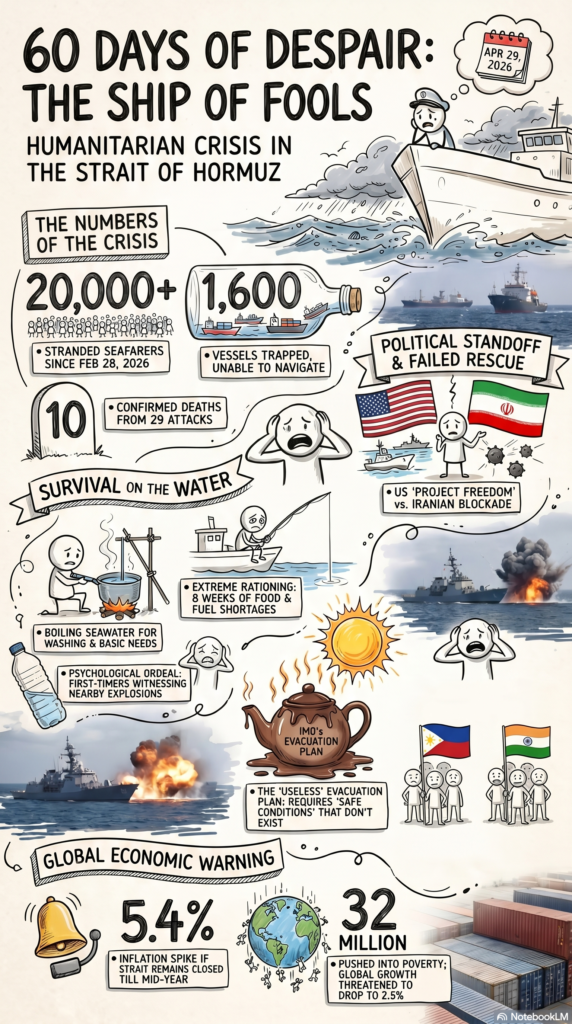
The conflict in the Strait of Hormuz began on February 28, 2026. That’s about 60 days ago. Approximately 20,000 seafarers on at least 1,600 ships (some sources say 2,000 vessels) have been stranded ever since. That’s roughly two months. Sixty dawns. Sixty sunsets. Sixty cycles of hope fading into despair.
The IMO Secretary-General, Arsenio Dominguez, delivered the bleakest assessment yet: “There is no safe passage left in the entire Hormuz waters.” In fact, the Secretary-General confirmed that “the situation has not improved, and there is no safe navigation anywhere in the Strait of Hormuz.”
Food is running out. Water is running out. Sanity is running out. And the world’s brilliant solution is – drumroll, please – an evacuation plan that might happen when “safe conditions allow.”
The TSM Take: Sixty days. That’s not a shipping delay. That’s a hostage situation. And the industry’s response so far has been about as useful as a chocolate teapot in a heatwave. The UN has warned that if the strait remains closed until mid-year, global economic growth would drop to 2.5%, inflation would rise to 5.4%, 32 million more people would fall into poverty, and 45 million more would face extreme hunger.
Q1: The IMO says there’s “no safe passage.”
What exactly does that mean for the trapped crews?
The Non-Expert Says: It means you’re sitting ducks. And everyone knows it.
The IMO has verified at least 29 attacks on vessels in and around the Persian Gulf and Strait of Hormuz since the conflict began. At least 10 seafarers have been killed. Several have been injured. Multiple vessels have been seized or damaged.
This is why “Project Freedom” – the U.S. military’s May 4 initiative to escort stranded ships out of the Strait – is being met with skepticism. Escorting 1,600+ vessels through a narrow waterway littered with naval mines (that Iran has “lost track” of) while dodging hypersonic missiles and fast-boat swarms is not a plan. It’s a suicide pact with better branding.
The TSM Take: The IMO says there’s no safe passage. The U.S. says it will escort ships anyway. Iran says the Strait remains closed. And the 20,000 seafarers are stuck in the middle, wondering which side’s “help” will kill them first.
Q2: Is “Project Freedom” actually happening?
Or is it just political theater?
The Non-Expert Says: A little bit of both. Mostly political theater.
On May 4, President Trump announced a new operation called “Project Freedom” to guide commercial ships out of the Strait of Hormuz. The mission includes guided-missile destroyers, more than 100 aircraft, and around 15,000 service members. It’s a massive military undertaking.
But here’s the catch: Iran’s military immediately fired warning shots at a U.S. warship attempting to enforce the operation. The U.S. denied that any ship was hit, but Iran’s message was clear: “This is a serious warning… the Strait of Hormuz remains closed.”
Also, a cargo ship near Sirik, Iran, reported being approached by several small craft. Another vessel near Fujairah reported being hit by unknown projectiles. Both incidents occurred on the same day “Project Freedom” was announced.
The TSM Take: The U.S. launched a massive military operation. Iran shot warning shots. Ships are still being attacked. And 20,000 seafarers are still trapped. Call us cynical, but we’re not holding our breath.
Q3: What about basic supplies?
Food? Water? Fuel?
The Non-Expert Says: The red lights are flashing. And nobody’s paying attention.
The IMO Secretary-General warned that, with the conflict now in its 8th week, trapped vessels are beginning to experience shortages of water, food, and fuel. Some crews have reportedly implemented rationing.
The internet, where it exists, has become a lifeline – but many crews face network outages, signal interference, and exorbitant roaming fees just to hear a family member’s voice.
The TSM Take: Your ship is running out of food. Your ship is running out of water. Your ship is running out of fuel. And the only thing the industry is running out of is excuses.
Q4: Are there any seafarers who have managed to get out?
The Non-Expert Says: A handful. But the overwhelming majority remain trapped.
A few hundred seafarers have been repatriated – mostly through individual negotiations by their flag states or unions. The Philippines, for example, has managed to evacuate nearly 1,100 of its citizens.
But India, one of the world’s largest suppliers of maritime labor, has over 20,000 citizens working on foreign-flagged vessels in the region, many of whom are beyond the scope of coordinated evacuation operations. The Indian Seafarers’ Union noted that most ships are anchored near Iranian ports such as Bandar Abbas and Khorramshahr, leaving thousands of seafarers trapped in prolonged fear and isolation.
One Indian captain, stranded for weeks, told the media: “Every day, we try to maintain a sense of normalcy through conversations and small team activities, striving to boost everyone’s spirits.” But he admitted that long-term psychological pressure has begun to show.
The TSM Take: A few hundred people have gone home. Twenty thousand have not. That’s not an evacuation. That’s a rounding error.
Q5: What about the psychological toll?
How are crews holding up?
The Non-Expert Says: They’re not. And nobody’s talking about it.
The IMO Secretary-General shared a chilling firsthand account: “I spoke with a seafarer who has been stranded in the Persian Gulf for more than six weeks. Beyond physical exhaustion, they feel overlooked and undervalued. We have so much more to do.”
Representatives of the Indian Seafarers’ Union added: “Explosions sometimes occur just a few hundred meters away, and seafarers can see them with their own eyes from the deck. Many are on their first voyage, so you can imagine the psychological ordeal they are going through.”
The TSM Take: The industry spent years talking about “seafarer mental health.” Now the conversation is happening on ships where the nearest therapist is 1,000 miles away, the nearest evacuation is an explosion, and the nearest support group is the guy in the next cabin who’s also losing his mind.
Q6: Is there any good news on the horizon?
Anything at all?
The Non-Expert Says: Define “good news.”
Some shipping lines are rerouting via the Cape of Good Hope again, adding weeks to voyages but avoiding missiles. India has launched a sovereign-backed maritime insurance pool to reduce dependence on Western insurers who abandoned the region. And the IMO is “working on a plan.”
But the plan still requires “safe conditions.” The ceasefire, brokered by Pakistan in early April, has already been violated multiple times. The U.S. naval blockade, which began on April 13, has already reduced Iran’s oil earnings, with officials reporting that dozens of ships have been turned back and Iran’s oil storage is filling up quickly. And Iran has said it will not return to pre-war conditions in the Strait.
The TSM Take: The good news is that some people are trying. The bad news is that “trying” doesn’t get ships through a minefield.
TSM Situation Room Takeaway
Sixty days. Twenty thousand seafarers. A war that shows no signs of ending. An evacuation plan that exists only on paper. And an industry that seems content to issue press releases while people suffer.
The IMO calls it an “unprecedented crisis.” The UN calls it a “humanitarian catastrophe.” The seafarers call it Tuesday. Their families call it hell. And the rest of the world? The rest of the world has already moved on to the next headline.
But we haven’t. And neither should you.
The TSM Final Word: The Strait of Hormuz is closed. The evacuation plan is ready. The seafarers are still waiting. And somewhere in a London office, a bureaucrat is updating a spreadsheet while a man on a ship watches his drinking water run out. That’s not shipping. That’s a crime.
Disclaimer: The Sarcastic Mariner(s) are not diplomats, military strategists, or the IMO. We just read the news between cans of warm soda and watch helplessly as the maritime world burns. The following is based on actual events and real human suffering—filtered through a lens of dark, desperate, and utterly exhausted humor. Facts are cited. Tears are implied. Read with whatever sanity you have left.
The Situation Room. #0 – What we talk about
The Situation Room. #1 – 3,200 Ships, One Doorway: What Happens When the Strait Becomes a Wall
The Situation Room. #2- The Strait Closed. The Questions Opened.
The Situation Room. #3 – “Hormuz: The Questions Every Ship Is Asking (But Few Are Saying Out Loud)”
The Situation Room. #4 – One Month Adrift
The Situation Room. #5 – Strait of Chaos: The Ceasefire That Wasn’t
The Situation Room. #6 – The 2026 COLREGS
The Situation Room. #7 – India’s Sovereign Play Against the P&I System
The Situation Room. #8 – The EU AI Act SHIPPING
The Situation Room. #9 – THE FUTURE OF Alternative Fuels in Shipping