
Why We Cling to Something When the Waves Get High
The Call You Don’t Prepare For
We had a plan for Season Two.
A neat list of topics. Letting go. Baggage. Silence. The usual suspects. Safe waters.
Then life did what it always does. It ignored the plan.
A friend called. Healthy. Active. Early forties. The kind who does annual checkups and reminds the rest of us to do the same.
“Stage one,” he said. “Early. Treatable. Still… stage one.”
There was a pause. The kind where nobody reaches for advice because nothing sounds right. Over the next few days, he did everything you’d expect. Read medical papers. Spoke to specialists. Cleaned up his diet. Started meditating.
And then, quietly, he added something else.
Temple on Tuesday. Church on Wednesday. Dargah on Friday.
We asked him, gently, “What happened to the rational man?” He didn’t smile.
“The rational one has a PET scan tomorrow,” he said. “The other one needs someone at 3 AM. I’m keeping both.”
We didn’t have a response for that.
So we just listened.
The Things We Cling to Something For
That conversation stayed with us. Not because it was unusual. Because it wasn’t.
We’ve seen versions of this before.
A bosun who never sails without an old coin in his pocket. He doesn’t know why. He just knows the one time he forgot it, the weather turned ugly faster than expected. He hasn’t forgotten it since.
A chief engineer with two degrees who can calculate everything from fuel efficiency to exhaust flow… but still knocks on wood before starting the main engine. “It’s not logic,” he once said. “It’s… insurance.”
We didn’t ask from whom.
A mother who fasts quietly when her son is at sea. No announcements. No negotiations. Just a quiet deal with something she hopes is listening.
And yes, even the occasional atheist who—when things tilt just a little too far—finds himself whispering, “Please… just this once.”
No one talks about it later. That’s the unspoken agreement.
No Sermons, Just Observations
We’re not trying to define faith here. We’re not qualified. But we’ve noticed something.
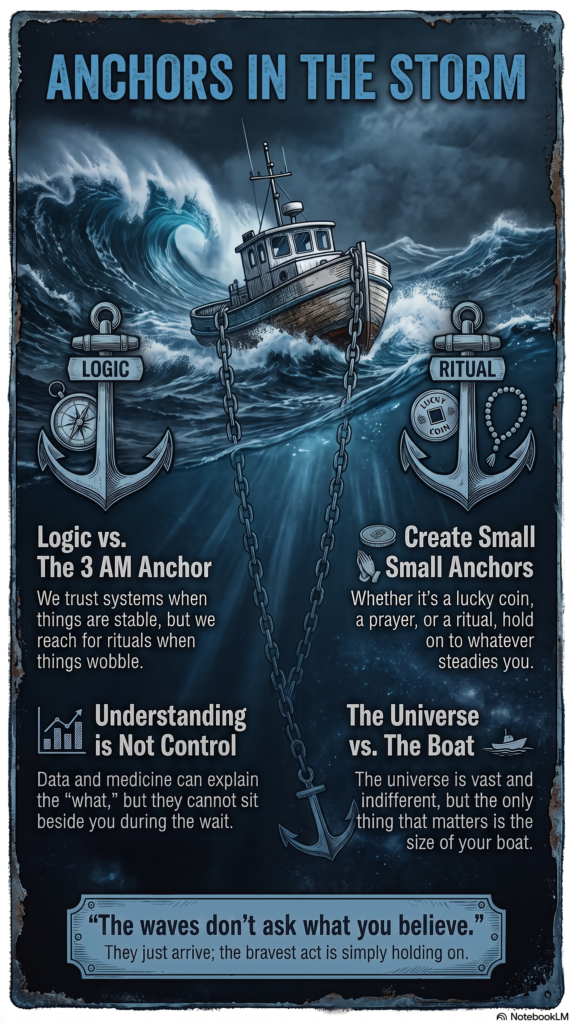
When things are stable, we trust systems.
Plans. Procedures. Data.
When things wobble—even slightly—we reach for something else.
Not always religion. Not always logic either.
Sometimes it’s ritual.
Sometimes it’s memory.
Sometimes it’s just a word repeated into the dark because silence feels heavier.
Maybe it’s not about belief. Maybe it’s about not wanting to feel alone in the moment when control slips.
The Part We Don’t Like Admitting
We like to think we’ve figured things out. We have better medicine. Better technology. Better explanations for how things work. We can scan the body, map the brain, predict the weather (most of the time). We understand more than we ever did.
And yet, one sentence in a quiet room can undo all of that.
“Stage one.”
Not catastrophic. Not the worst case. Still enough.
Enough to make a rational man hedge his bets across three places of worship. Enough to make anyone realise that understanding something is not the same as controlling it.
The Scale of Things (And Why It Doesn’t Help Much)
Every now and then, we zoom out.
The universe is vast. Old beyond comprehension.
We are, by any measurable standard, insignificant. A small species on a small planet, orbiting a fairly ordinary star.
We know this. We’ve known this for a while. But strangely, it doesn’t change much when things get personal.
The diagnosis still lands.
The phone still rings at the wrong hour.
The mind still searches for something to hold on to.
Perspective is useful. But it doesn’t sit beside you at 3 AM.
The Tiny Boat and Why We Cling to Something
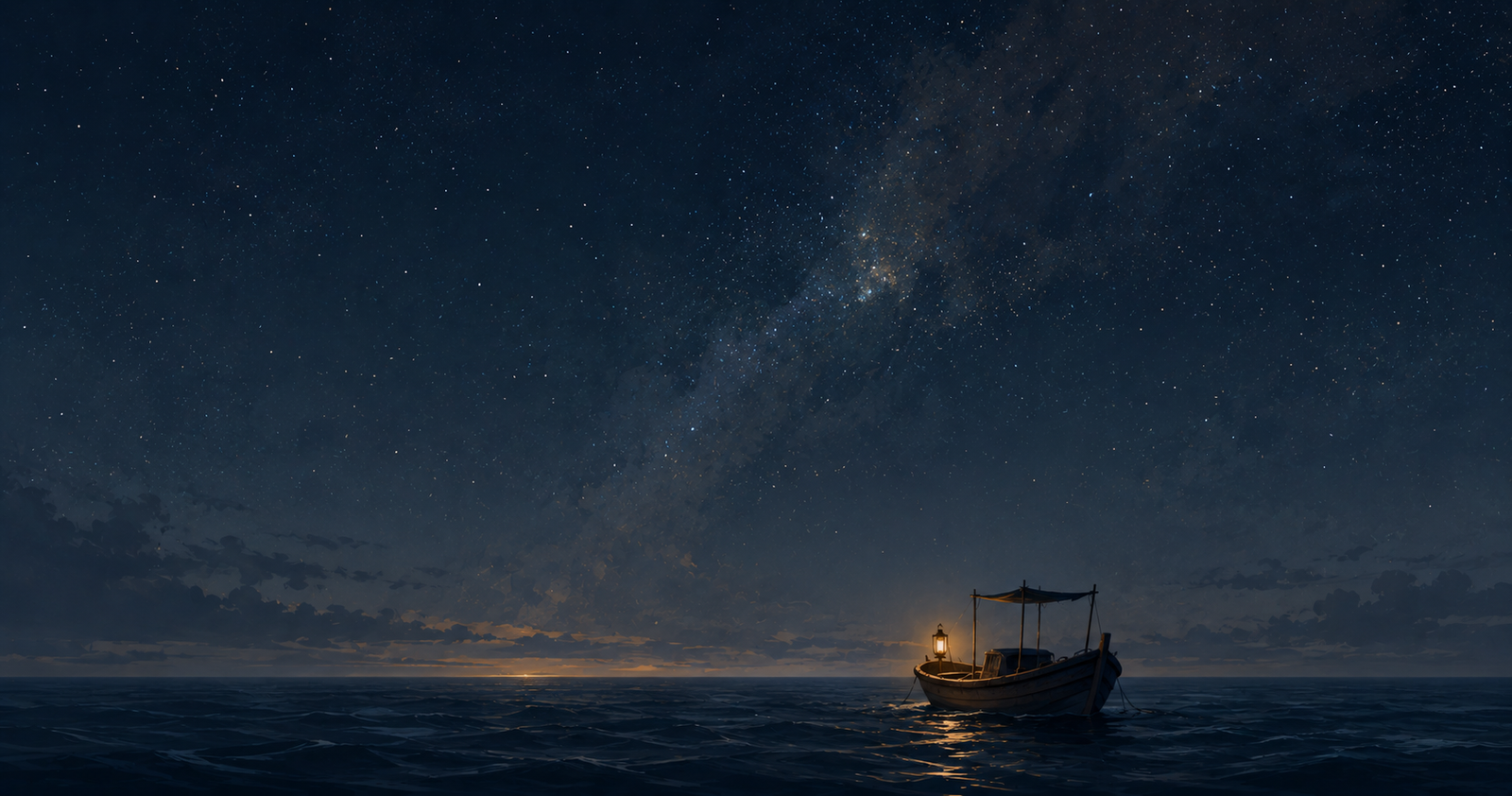
Maybe that’s the point. It’s not about the size of the universe. It’s about the size of the boat when the waves pick up.
And the boat is always smaller than we’d like. So we do what humans have always done. We create small anchors.
A coin.
A ritual.
A place to go on a particular day.
A quiet word said under our breath.
We know it may not change the outcome. But it changes how we sit with it. And sometimes, that’s enough.
Reflections from the Shore
So we find ourselves back here. Water around our ankles. Thoughts a little heavier than before. Thinking about a friend who decided not to choose between logic and faith—but to carry both.
Maybe that’s not contradiction.
Maybe that’s how we cope.
Because when the sea turns, nobody asks if your belief system is internally consistent. You just hold on to what steadies you.
So here’s what we’re taking from this one:
Hold on to your anchors—whatever they are.
Don’t question them too much when you need them the most.
And if someone else is holding on to something you don’t understand… let them.
We’re all just trying to stay afloat.
The waves don’t ask what you believe. They just arrive.
And sometimes, the bravest thing you can do… is hold on, and say quietly, “I’m still here.”
— The Sarcastic Mariner(s)
Somewhere between a PET scan and a supernova
If this made you pause, question, or smirk — you’ve been reading Sea, Salt & Reflections.
Start from the beginning →
Related reading: Season 2 Episode 3 – The Great Isolation · Season 2 Episode 2 -The Baggage We Carry