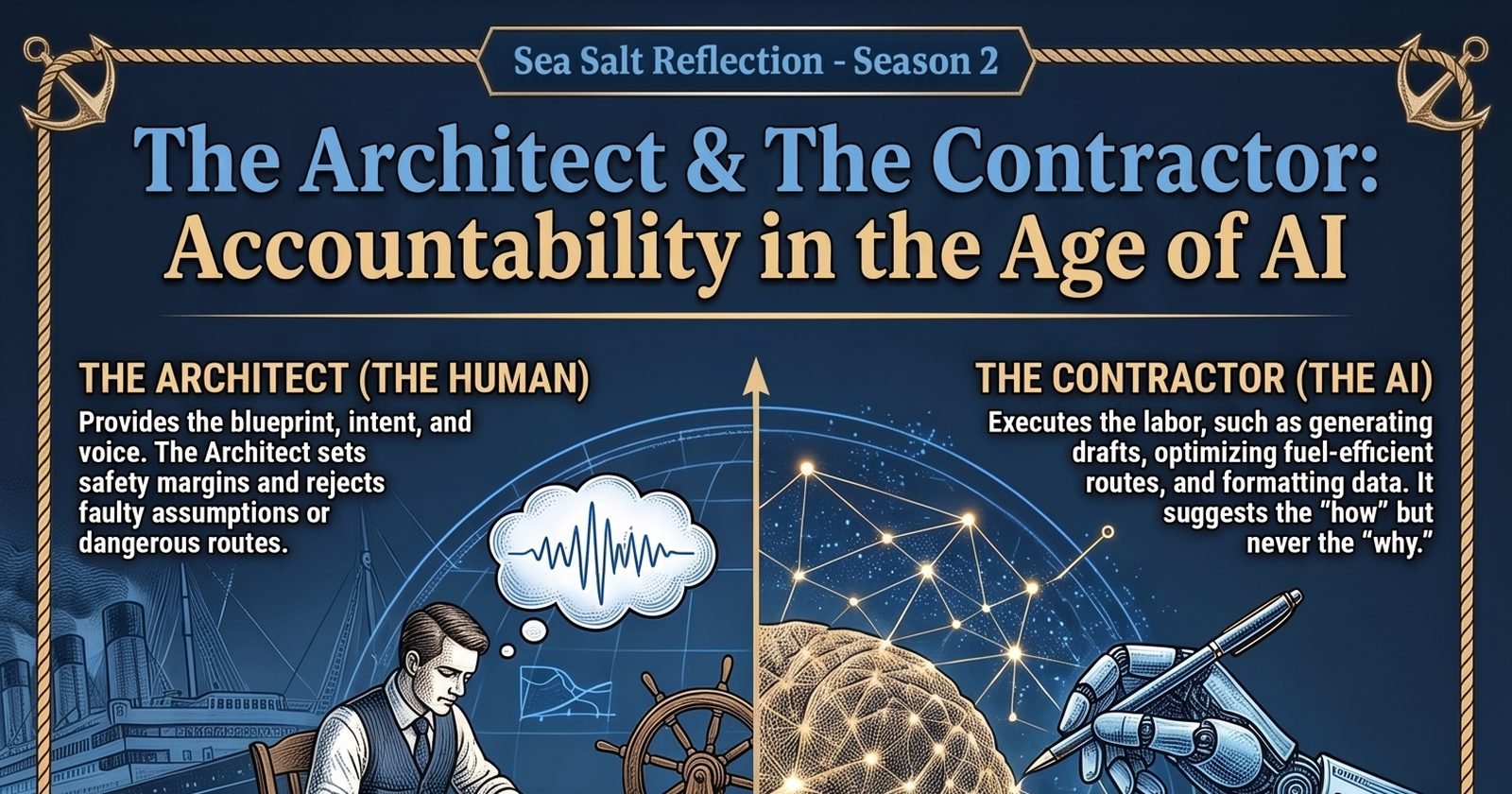

AI, Writing, and the Sea: A TSM Take on Responsibility in the Age of Automation
We’ve been watching the AI debate from the bridge. The panic. The hype. The hot takes.
“Writers will be replaced.”
“Engineers will lose their jobs.”
“The ship will sail itself.”
We’ve heard this before. Usually from someone who has never tried parallel indexing in monsoon traffic with a radar that suddenly develops personality issues.
At TSM, we have a different view. Not because we’re smarter. Because we’ve seen this cycle before. Every new tool — from the chronometer to the autopilot — was supposed to make the mariner obsolete. And yet, here we are. Still squinting at the horizon. Still tying knots. Still spilling chai on the radar screen.
The question isn’t whether to use AI. The sea doesn’t care about your principles. The question is how — and who gets the credit when the voyage is done.
This volume is about that. About the architect and the contractor. About the writer and the keyboard. About the captain and the autopilot. And about the one non-negotiable rule that applies to all of them:
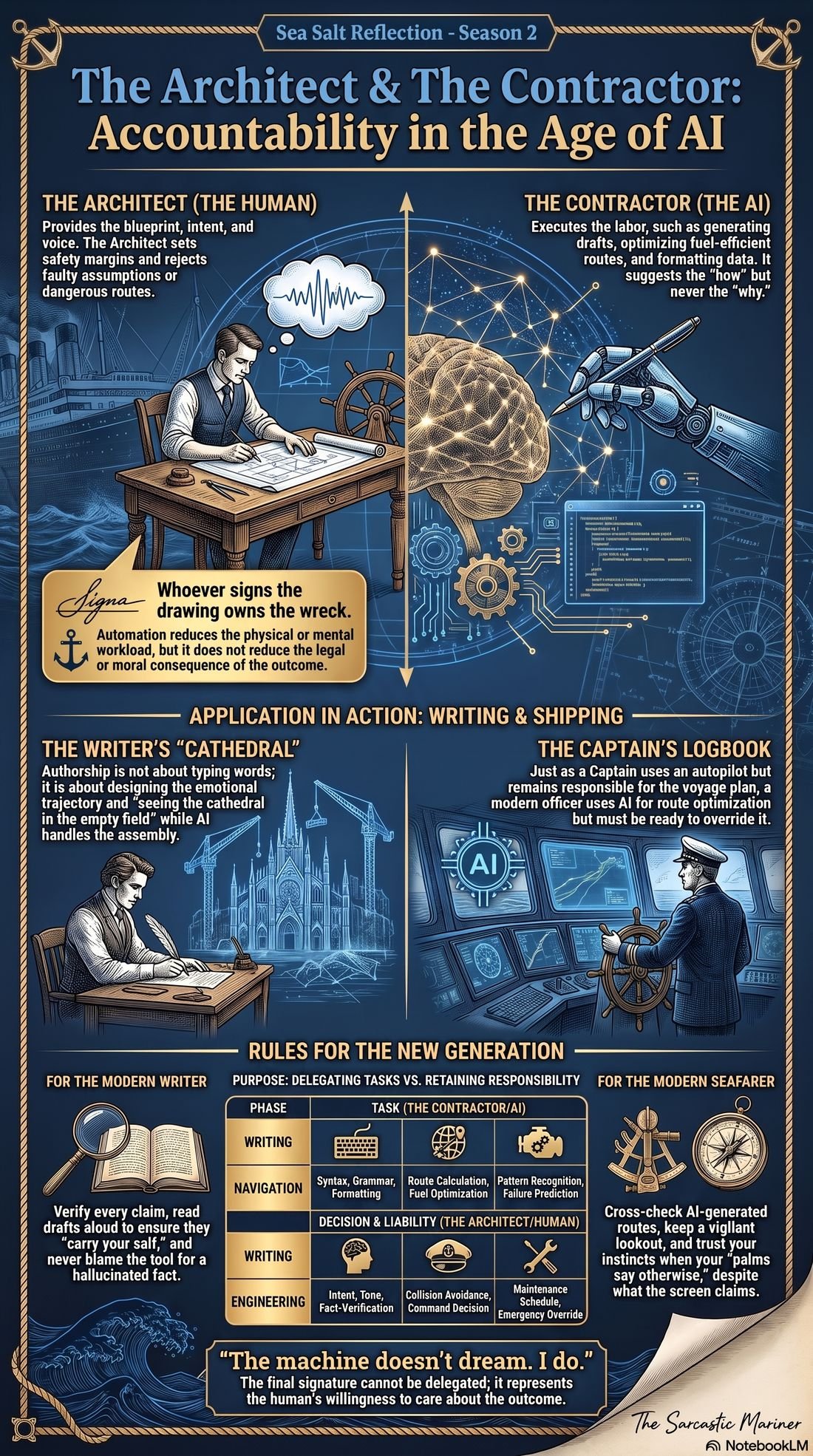
Whoever signs the drawing owns the wreck.
🏗️ Part I: The Analogy — Architect, Contractor, and the Skyscraper That Didn’t Collapse
In construction, no one expects the architect to pour concrete. Those tasks fall to the contractor. Yet when a skyscraper graces the skyline, it is the architect’s name remembered. Why? Because vision is the rarest currency.
The contractor executes. They solve problems, source materials, manage tolerances. But they do not decide that the building should “feel light as air” or “provoke wonder.” That is the architect’s brief.
In the TSM framework, the human writer is the architect. The AI — whether writing copy or calculating a fuel-efficient route — is the contractor.
The Architect (Human):
Provides the blueprint — outline, intent, voice. Sets the constraints — tone, deadlines, safety margins, regulatory limits. Rejects faulty beams, bad drafts, dangerous assumptions.
The Contractor (AI):
Pours the foundation — generating drafts, route plans, calculations. Installs the framework — structuring paragraphs, optimising speed, sorting patterns. Paints the walls — rephrasing, refining, formatting.
The contractor may suggest ten ways to build the wall. But it still doesn’t decide why the wall exists.
That part remains human.
And therefore, so does the responsibility.
✍️ Part II: Writing — The Architect Who Doesn’t Type Every Word
The panic around AI writing often comes from a misunderstanding: that typing every word yourself is the core of authorship.
It isn’t.
The core is design — structure, intent, emotional trajectory, voice.
A writer using AI can spend more energy on the parts that actually matter:
What are the few arguments this article absolutely must win?
How should the reader feel at 200 words versus 800?
Is the humour dry, bitter, warm, or quietly exhausted?
Where should the silence sit?
The AI handles grammar, syntax, formatting, and endless variations — the heavy lifting of assembly. This frees the human to focus on discernment.
As one of our mariners put it:
“I don’t care who lifted the stone. I care who saw the cathedral in the empty field.”
That’s authorship.
Not the typing. The seeing.
🚢 Part III: Shipping — The Captain Who Doesn’t Steer Every Second
Now apply the same logic to the sea.
Autopilots have existed for decades. No one accuses a captain of “not really sailing” because the vessel holds course automatically. The captain is still responsible — for the voyage plan, the monitoring, the overrides, and the moment when instinct disagrees with the screen.
AI is now entering the engine room too.
Predictive systems can flag patterns suggesting an engine failure long before a human notices them. Route optimisation software can simultaneously consider weather, piracy risk, traffic density, and fuel consumption. Autonomous vessels are already being trialled in controlled environments.
But here’s the thing:
The algorithm doesn’t sign the logbook.
The algorithm doesn’t face the port state inspector.
The algorithm doesn’t sit in the investigation room explaining why “the software suggested it” sounded convincing at 2 AM.
The human does.
That’s the architect’s signature.
It’s also the architect’s liability.
⚖️ Part IV: The One Rule That Matters — No Running Away, No Blaming the Tool
TSM insists on one non-negotiable rule, whether you’re writing a blog or transiting the Strait of Hormuz:
The architect remains accountable for the standing structure.
If the AI contractor builds a wall that collapses — hallucinates a fact, produces dangerous assumptions, or routes the vessel into traffic it should never have entered — the architect cannot blame the tool.
The architect signed the drawing.
Therefore the human must review, verify, edit, challenge, and assume responsibility for every word published and every nautical mile travelled.
That doesn’t mean you shouldn’t use AI.
It means you use it carefully, with full awareness that the final call remains yours.
Because automation reduces workload.
It does not reduce consequence.
For writers:
Verify every claim.
Read the draft aloud.
Does it sound like you?
Does it carry your salt?
For seafarers:
Cross-check the route.
Keep the lookout active.
Trust your instincts when the screen says “safe” but your palms say otherwise.
The sea has buried far more confident people than us.
🔗 Part V: Season Two — Baggage, Faith, and the New Generation
This volume sits squarely inside our Season Two journey.
We began with The Big Bang and the Tiny Boat — faith, insignificance, and the absurdity of believing we control anything at all.
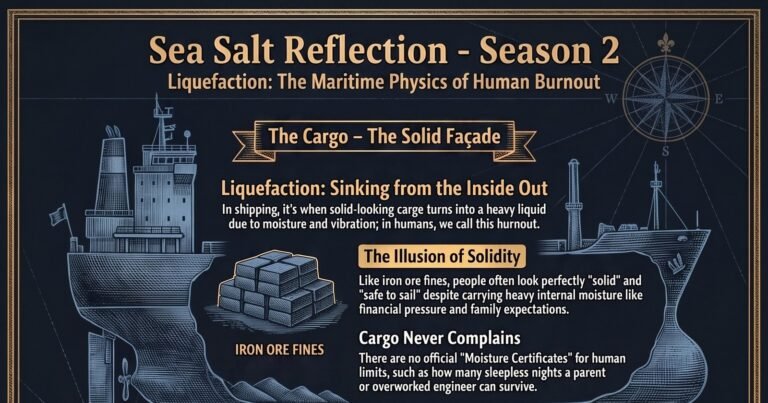
Then came The Baggage We Carry — expectations, burnout, piracy, war, guilt, and the invisible cargo people drag through life.
Now we arrive at the tools.
And how those tools change the weight.
The new generation — cadets raised on smartphones and instant answers — doesn’t see AI as a threat. They see it as another contractor. Another system. Another tool in the rack.
They are comfortable asking the algorithm for a first draft. Comfortable letting optimisation software suggest a route. Comfortable working alongside machines without treating them like magic.
But they also inherit a new responsibility:
To know when to override.
That is the real shift.
Not from human to machine.
From doing… to deciding.
And perhaps that is the most human thing of all.
Reflections from the Shore — The Signature That Cannot Be Delegated
So we stand here again, cold water around our ankles.
The autopilot hums quietly.
The ETA updates itself to the minute.
The dashboard glows green.
Everything appears under control.
And still — none of it matters if we stop watching.
Because the sea remains the sea. Indifferent. Patient. Completely uninterested in our clever software and polished presentations.
The architect gets the credit.
The architect also gets the blame.
That’s the deal.
So use the contractor. Let it pour the concrete. Let it write the first draft. Let it optimise the route and sort the data and calculate the numbers faster than you ever could.
But keep your hand near the tiller.
Keep your eyes outside the window.
Keep your name on the drawing.
And when someone asks:
“Who wrote this?”
“Who sailed this ship?”
Answer honestly.
“I did.
The machine helped.
But the machine doesn’t dream.
The machine doesn’t care.
I do.”
Here’s to the architects.
Here’s to the signatures.
And here’s to the beautiful, exhausting, terrifying responsibility of remaining human in an age of contractors.
— The Sarcastic Mariner(s)
Somewhere between a neural network and a wheelhouse
If this made you pause, question, or smirk — you’ve been reading Sea, Salt & Reflections.
Start from the beginning →
Fiction from the same sea: The Measurable Horizon, Book 5: Accountability in the Age of Visibility →