

Welcome to the First Annual (Probably Recurring) Boys-Men Mental Safety Month, brought to you by the same sarcastic mariners responsible for Sea, Salt & Reflections.
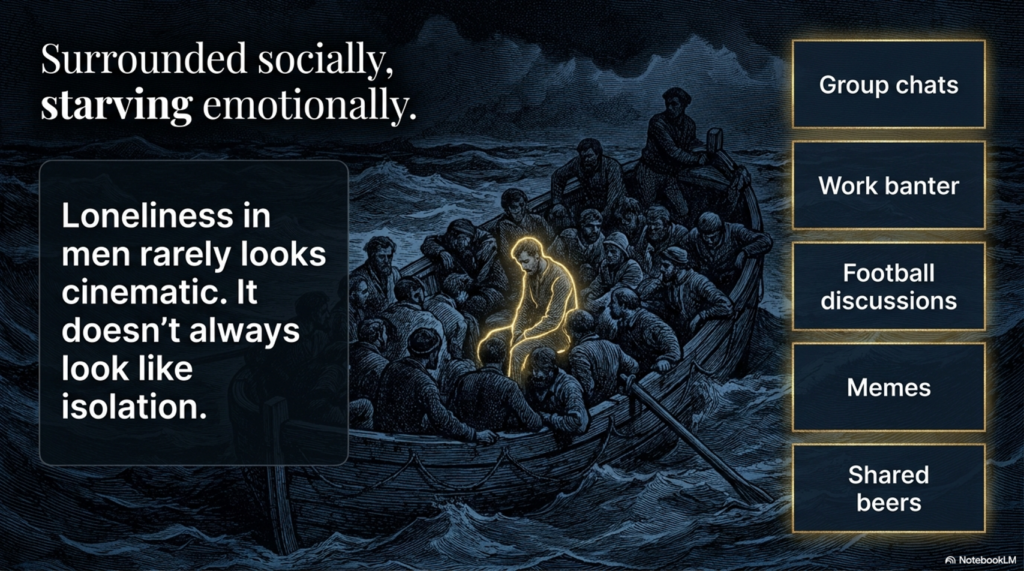
Male loneliness rarely looks like what people picture when they hear the word “lonely.”
It doesn’t always look like isolation.
Sometimes it looks like:
group chats,
work banter,
football discussions,
memes,
shared beers,
surface-level survival.
Many men are surrounded socially and starving emotionally.
Because somewhere along the line, emotional intimacy became confused with weakness.
So conversations stay safely shallow:
work,
sports,
traffic,
weather,
politics,
everything except fear.
Especially fear.
And over time, something dangerous happens:
men become visible socially but invisible personally.
People know what they do.
Very few know what they’re carrying.
Why male loneliness hides in plain sight
Which is why so many men discover, during divorce, grief, burnout or crisis, that they have nobody they can truly call.
Not because nobody cares.
Because vulnerability was never practised long enough to become fluent.
A lot of male friendships are built side-by-side rather than face-to-face. And the data on men’s shrinking friend groups backs this up — close friendships among men have been quietly collapsing for three decades.
Which is beautiful in its own way.
But dangerous when pain arrives.
Because suffering eventually requires language.
And many men were handed tools for performance, not confession.
So they disappear quietly into routine.
Humour.
Work.
Alcohol.
Scrolling.
Distance.
This is the quiet mechanics of male loneliness — not an absence of people, but an absence of anyone who’s seen underneath the routine.
Then one day someone says:
“You should have reached out.”
Without realising how difficult reaching out can feel to someone trained his entire life to minimise his own emotional gravity.
The answer is not forcing men to become different people overnight.
The answer is smaller.
Checking in properly.
Staying long enough for the second answer.
Creating spaces where men don’t feel they must perform strength every minute.
Sometimes saving someone starts with making it safe for them to stop pretending.
#ISeeU
The novel behind this series: I See U →