
Dr. Kumud R. Jha · Singapore · Doctorate in AI · US Patent Holder View LinkedIn Profile
Why AI and Identity Is the Question I’ve Been Saving
AI and identity is the question I have been saving for this series. Not about AI in organisations. Not about AI in governments or economies or democracies. About you. About what happens to the experience of being a person when you are surrounded by systems that have modelled you with extraordinary precision.
Because everything else in this series — the governance, the jobs, the bias, the creativity — ultimately lands here. On the individual. On what it means to live a self-directed life in an age of intimate machine intelligence.
Here is what is already true.
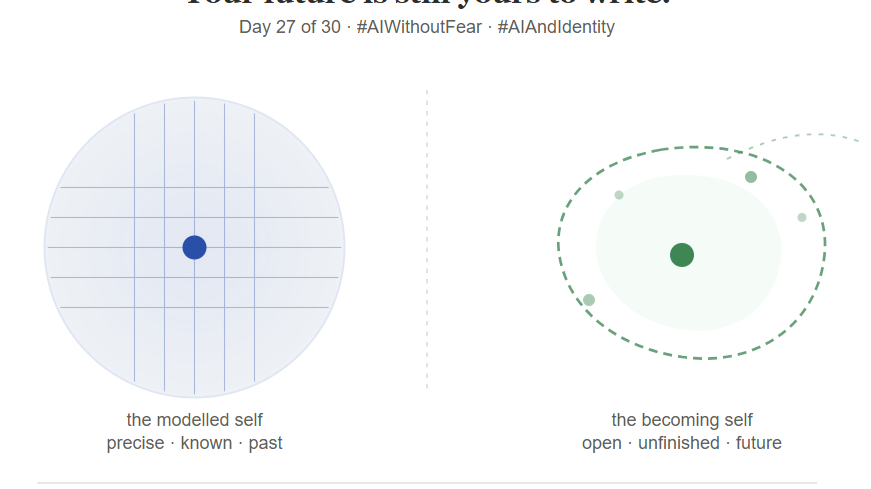
The recommendation systems you interact with daily have built a model of you that is, in many measurable ways, more accurate than your own self-conception. They know which content you will engage with before you do. They know when you are vulnerable to a purchase, a fear, an outrage. They have observed thousands of micro-decisions you made without reflection and distilled them into a profile that predicts your future behaviour with unsettling accuracy.
This is not science fiction. It is the operational basis of every major platform you use.
And here is the uncomfortable question that follows: if a system can predict your choices with high accuracy — are those choices really yours? Or are they the choices of a pattern that was shaped, over years, by the systems themselves?
This is not paranoia. It is a genuine philosophical question with practical implications.
The Autonomy Paradox at the Heart of AI and Identity
AI can make you more capable of acting on your stated preferences. It can help you find the book you would love, the job that fits, the route that saves time. In this sense it extends your autonomy — it removes friction between your intentions and your actions.
But AI can also quietly reshape your preferences themselves. When the content you see is selected to maximise your engagement — not your flourishing — the system is not serving your autonomy. It is substituting its objective for yours. Slowly. Imperceptibly. Over years.
The insidious thing is that you cannot easily feel the difference from the inside. Manipulated preferences feel exactly like authentic ones. The question of which is which is genuinely hard — and it was hard before AI. But AI has industrialised the capacity to shape preferences at scale, in real time, without consent or disclosure.
What psychological research actually shows: people who outsource more decisions to algorithmic systems report higher satisfaction in the short term and lower sense of personal agency over time. The convenience is real. The cost is subtle and cumulative.
There is a concept in psychology called identity foreclosure — the premature settling of the self around a particular version of who you are, cutting off the exploration that builds a more robust, flexible identity. Personalisation algorithms, by design, show you more of what you already are. They are structurally opposed to the kind of friction, surprise, and discomfort that identity development actually requires.
The self is not a fixed thing to be accurately modelled. It is an ongoing project. And projects require resistance.
What to Actually Do About It
This is not an argument for rejection. I am not suggesting you delete your accounts, opt out of personalisation, and navigate the world without assistance. That is neither realistic nor necessary.
I am suggesting something more modest and more important: intentional friction.
Occasionally choose what the algorithm did not recommend. Read the book nobody suggested. Take the meeting that does not fit your profile. Follow the thread that leads somewhere you did not expect.
Not because the algorithm is wrong. Because the unoptimised path is where you find out who you are becoming — rather than who you have already been.
As we covered in Day 26, personalisation reshapes shared reality at the societal level. AI and identity is the same force operating on the self — and the machine knows your past with impressive accuracy. Your future is still yours to write.
That distinction — between the self that has been modelled and the self that is still becoming — is worth protecting.