
Dr. Kumud R. Jha · Singapore · Doctorate in AI · US Patent Holder View LinkedIn Profile
Why AI and Democracy Keeps Serious People Awake at Night
AI and democracy is the question that keeps serious people — not just AI researchers, but political scientists, historians, and constitutional scholars — genuinely awake at night. What happens to democracy when the information environment it depends on is no longer shared?
Democracy is not just a voting mechanism. It is a system that assumes, at its core, that citizens can access roughly the same facts, debate their meaning, and arrive at collective decisions through that process. It assumes a common informational ground — not agreement, but shared reality.
AI is not the first technology to threaten that ground. The printing press enabled both the Reformation and the pamphlet wars. Radio enabled both Roosevelt’s fireside chats and Nazi propaganda. Social media enabled both the Arab Spring and January 6th. Every powerful communications technology has been simultaneously liberating and destabilising.
But AI introduces something qualitatively different: the scale and personalisation of reality.
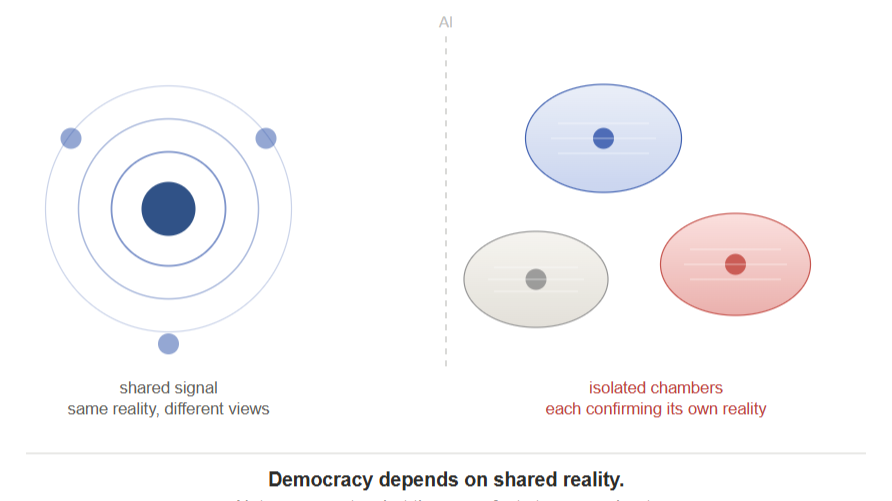
Previous technologies broadcast the same content to many people. A newspaper, a television channel, a radio station — the same signal reaching different ears. People could disagree about its meaning, but they were disagreeing about the same thing.
AI-enabled personalisation means that increasingly, different people are not just interpreting different things — they are receiving fundamentally different information environments, algorithmically constructed around their existing beliefs and behaviours. Not a shared town square with different factions arguing. A set of isolated chambers, each acoustically perfect, each confirming exactly what its occupant already believes.
Add generative AI to this. The cost of producing personalised, targeted, emotionally resonant content — at the individual level, at scale, in real time — has fallen to near zero. The ability to construct an entirely coherent, internally consistent, plausible-sounding version of reality for any audience, optimised for maximum persuasive effect, now exists. And it is being used.
What This Does to the Democratic Process Specifically
Elections are won at the margins. Small shifts in turnout, small changes in perception among narrow segments of the electorate, are decisive. The tools now exist to target those margins with surgical precision — not with arguments, but with emotionally engineered content designed not to persuade but to suppress, demoralise, or inflame.
The threat is not that AI will tell people who to vote for. The threat is subtler: that it will corrode the epistemic conditions under which meaningful democratic choice is possible. That it will make the question of what is true so contested and exhausting that people stop asking it.
That is not a hypothetical. It is already observable in multiple electoral democracies.
What an Honest Defence of AI and Democracy Looks Like
It is not censorship. Attempts to control information at the platform level consistently produce more problems than they solve — driving content underground, creating martyrs, and handing governments tools that are inevitably turned against legitimate dissent.
The honest defence is institutional. Strong, independent public media that maintains editorial standards. An education system that teaches epistemic hygiene — not what to think, but how to evaluate competing claims. Electoral laws that treat AI-generated political content with the same disclosure requirements as paid advertising. And international coordination on the use of AI in electoral interference — because the threat is cross-border and the response must be too.
None of this is fast. None of it is glamorous. All of it is necessary.
As we covered in Day 25, trust is built through accountability, not assumed. The same is true of AI and democracy: it depends on conditions — shared reality, good-faith debate, informed participation — that have to be actively maintained.
AI is making that maintenance harder. The response is not to slow down AI. It is to accelerate the maintenance.