
Dr. Kumud R. Jha · Singapore · Doctorate in AI · US Patent Holder View LinkedIn Profile
Why AI Trust Sits Underneath Every Other Question
AI trust is the question that sits underneath almost every other question in this series. Because everything we have covered — hallucination, bias, governance, jobs, privacy, creativity, misinformation, leadership, the environment — all of it ultimately comes back to a single, harder question: under what conditions should you trust an AI system? And what does it even mean to trust something you cannot fully understand?
This is not a new problem. It is an ancient one in a new form.
You do not understand how the aircraft you board stays in the air. Not really. You understand the principle — lift, thrust, drag — but you cannot verify the tolerances of every component, the decisions of every engineer, the training of every pilot. And yet you board. You trust.
You do not understand how the medication your doctor prescribes works at the molecular level. You trust the regulatory system, the clinical trials, the doctor’s training, the pharmacist’s check. A chain of institutions, each accountable to the next.
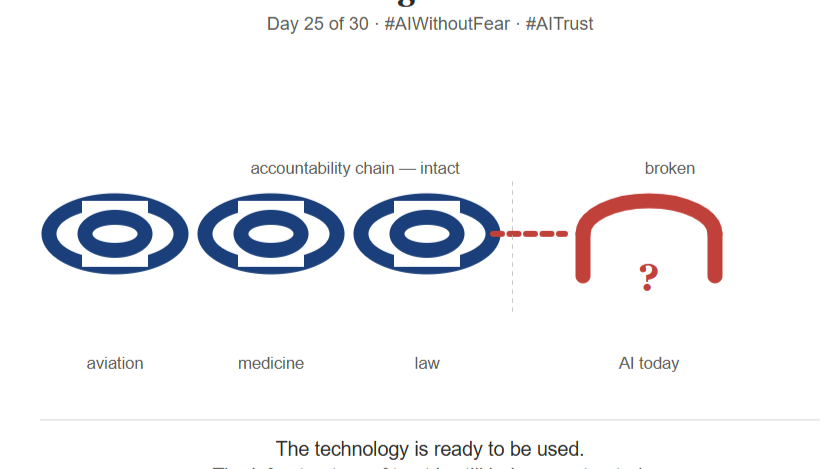
Trust in complex systems has never required full understanding. It has always required something else: a credible chain of accountability. Someone — some institution, some process — that you can hold responsible if it goes wrong.
Why AI Breaks the Usual Chain of Accountability
AI breaks this chain in a specific and important way.
When an aircraft fails, there is an investigation. There are black boxes. There are engineers who can be questioned, regulations that can be examined, decisions that can be traced. The chain of accountability is long but it is intact.
When an AI system produces a harmful output — a wrong medical diagnosis, a biased hiring decision, a falsely generated piece of evidence — the chain is often opaque. The model weights are proprietary. The training data is undisclosed. The decision pathway is not interpretable even to the people who built the system. There is nobody to call. There is no black box.
That is not a reason to reject AI. It is a precise description of the work that needs to be done to make it trustworthy.
What Actually Builds AI Trust
One — Explainability. Can the system give an account of why it produced a particular output? Not a perfect account — humans cannot always explain their decisions either. But a meaningful, contestable account. Something that can be examined and challenged.
Two — Track record. Trust is built through repeated, verifiable performance over time. A system that has been tested rigorously, in conditions that resemble real deployment, and that has failed gracefully and predictably, is more trustworthy than one with impressive benchmark scores and no deployment history.
Three — Independent oversight. The most trusted human systems — courts, medicines, aircraft — are not trusted because the people who built them say they are trustworthy. They are trusted because independent institutions, with the power to investigate and sanction, have verified that trust over time. AI needs the equivalent.
Four — Skin in the game. The organisations deploying AI systems should bear meaningful consequences when those systems cause harm. Currently the liability landscape is thin. Changing it would change what gets built and how carefully.
The Honest Position on AI Trust
You do not need to understand AI fully to use it wisely. But you do need to understand enough to know when to trust it, when to verify it, and when to override it.
That is not a technical skill. It is a judgment skill. And judgment, as we have established over the past twenty-five days, is irreducibly human.
As we covered in Day 24, being honest about AI’s real costs is part of building AI trust — not undermining the case for the technology, but earning it properly.
Trust is not given. It is built. Slowly, verifiably, accountably. The technology is ready to be used. The infrastructure of trust is still being constructed. Your job is to know the difference.