
Liquefaction – What Sinks Us from the Inside Out
The Shore Translation
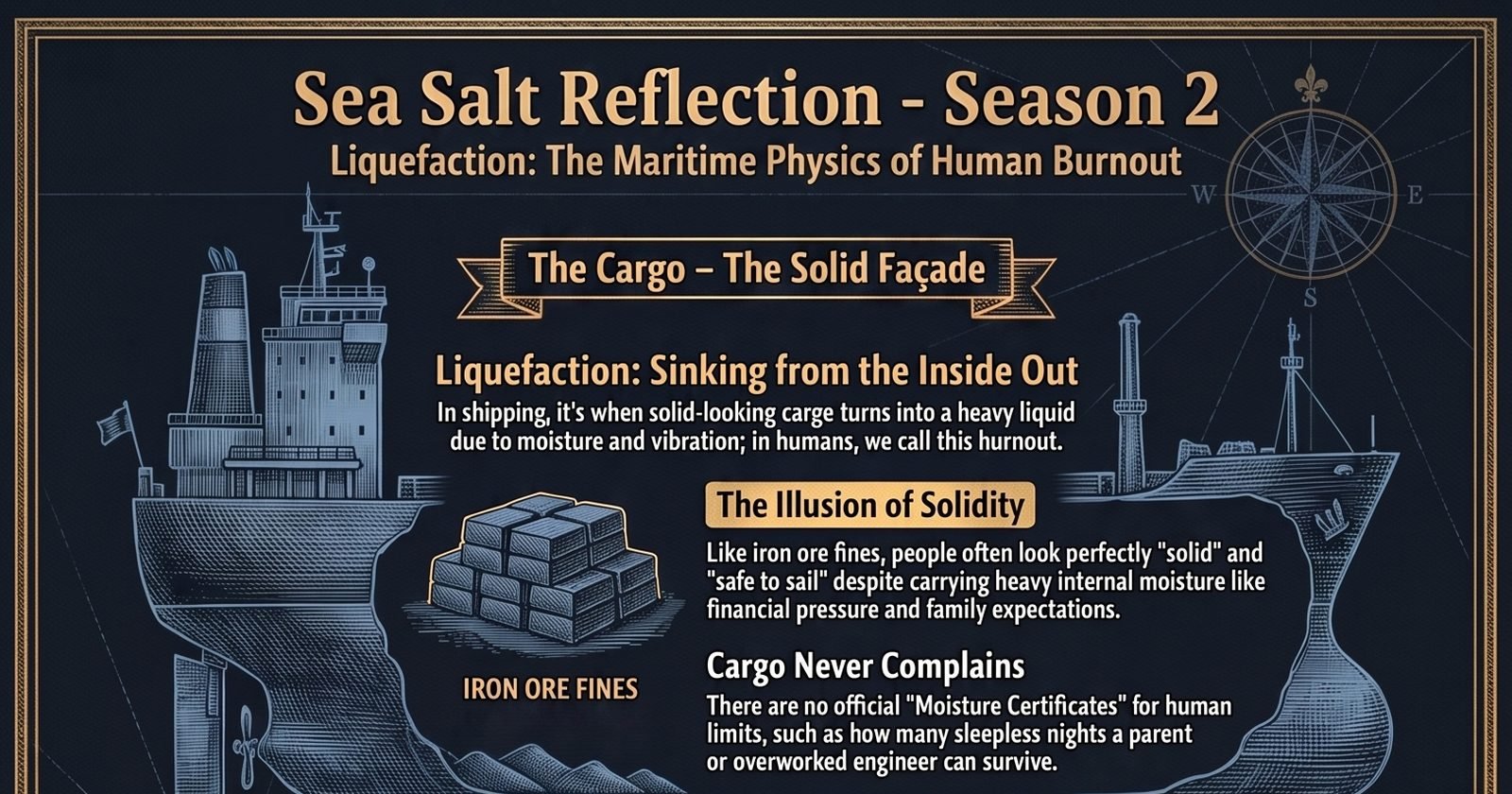
In shipping, some of the most dangerous cargoes don’t look dangerous at all.
Iron ore fines. Nickel ore. Mineral concentrates.
They arrive looking solid, are loaded correctly, trimmed neatly, and pass every visual inspection. Nothing appears out of place. The ship sails with confidence.
Then the voyage begins.
The engines vibrate.
The propeller turns.
The hull flexes.
Hour after hour.
Day after day.
Slowly, moisture trapped within the cargo begins to migrate. Friction between the particles disappears. What once behaved like a solid gradually becomes a heavy liquid, surging from side to side inside the cargo hold.
The ship doesn’t need a storm.
It doesn’t need another vessel.
It doesn’t even need a large wave.
It simply loses stability.
And sometimes…
it sinks.
Human beings do something remarkably similar.
We call it burnout.
The sea simply calls it liquefaction.
Part I – The Cargo That Doesn’t Complain
We’ve loaded cargoes in Brazil, Australia, Indonesia and South Africa.
Before loading, surveyors measure moisture content. Samples are tested. Flow tables are prepared. Transportable Moisture Limits are checked. If the cargo is too wet, the answer is simple.
The ship doesn’t sail.
Nobody argues with physics.
But humans don’t come with a moisture certificate.
There’s no laboratory measuring how many sleepless nights a new parent can survive before forgetting who they are.
No flow table for the engineer covering two watches because the company can’t find relief.
No moisture limit for the young officer smiling through a fourth month of contract extension while his father battles illness thousands of miles away.
We simply keep loading ourselves.
Responsibilities.
Deadlines.
Financial pressure.
Family expectations.
The endless vibration of modern life.
We look perfectly solid.
So everyone assumes we’re safe to sail.
Cargo never complains.
It simply waits for physics to win.
Part II – The Vibration Nobody Notices
Every ship vibrates.
Engines.
Generators.
Propellers.
Pumps.
After a few days, you stop noticing.
Your body adapts.
But the machinery never stops.
Over time, vibration loosens bolts, wears bearings, fatigues steel and finds every weakness that wasn’t visible in port.
Burnout works exactly the same way.
It is rarely one dramatic event.
It’s thousands of tiny vibrations.
The tenth email that should have been a conversation.
The third interrupted night because your mind thinks 2 a.m. is the perfect time to replay every mistake you’ve ever made.
The meeting where your idea is ignored—until someone else repeats it.
Missing another school concert.
Telling your parents, “I’ll call this weekend,” knowing you probably won’t.
None of these sink us.
Together…
they change us.
We’ve seen it ourselves.
A chief engineer.
One of the dependable ones.
Notebook always in his pocket.
Every defect documented.
Every maintenance schedule remembered.
Never complained.
Never raised his voice.
Never asked for help.
One morning he didn’t arrive for the 0800 meeting.
The captain knocked.
Silence.
When they opened the cabin, he was sitting on the edge of his bunk, fully dressed, staring at the floor.
He had been sitting there for hours.
“Chief… what’s wrong?”
He looked up.
“I don’t know.”
A long pause.
“I just can’t.”
No shouting.
No tears.
No dramatic collapse.
Just a man whose internal stability had quietly disappeared.
Eighteen months of crew shortages.
Pandemic delays.
Family problems he never spoke about.
The vibration finally won.
We called it burnout.
The sea has a more precise word.
Liquefaction.
Part III – The List Begins Quietly
Perhaps that’s why burnout is so difficult to recognise.
We’re looking for explosions.
Real life offers lists instead.
The colleague who quietly stops joining lunch.
The friend whose daily messages become the occasional emoji.
The high performer who suddenly starts missing deadlines.
The parent who still cooks, cleans and smiles—but somehow never laughs anymore.
At sea, there’s an old truth.
The cargo doesn’t shout.
It shifts.
People aren’t very different.
Most don’t send a Mayday.
They simply become a little quieter.
A little slower.
A little harder to reach.
Until one day, someone says,
“I never saw it coming.”
The sea usually did.
Part IV – The Moisture Test
Shipping learned this lesson years ago.
We don’t wait until the middle of the Indian Ocean to discover whether cargo is stable.
We test it before departure.
Perhaps we’ve been asking the wrong question ashore.
Instead of asking people to be stronger…
perhaps we should be checking their moisture content.
When did you last sleep properly?
When did you last eat without staring at a screen?
When did you last tell someone you weren’t okay?
Who would answer if you called them at three in the morning?
Maybe that’s what the younger generation has understood before the rest of us.
When they say,
“I need a break.”
“I can’t do another shift.”
“I need to talk.”
Perhaps they aren’t becoming weaker.
Perhaps they’re simply performing the moisture test before leaving port.
Ships don’t become safer because the cargo pretends to be dry.
Neither do people.
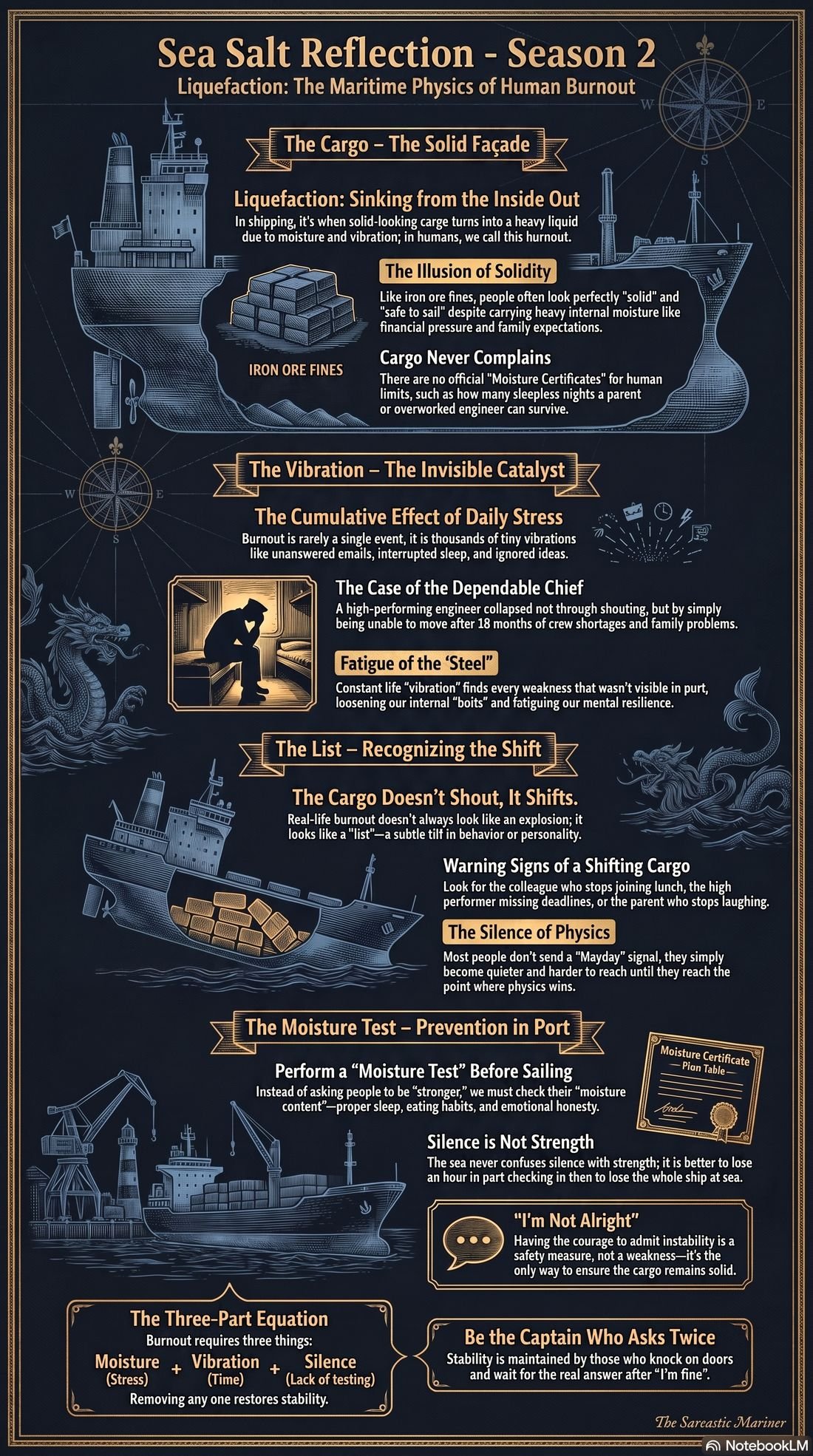
Reflections from the Shore
So here we stand again.
Cold water around our ankles.
Watching another tide arrive.
The sea never blames cargo for liquefying.
It understands the equation.
Moisture.
Vibration.
Time.
Remove any one of those, and stability returns.
Perhaps people aren’t so different.
Life guarantees vibration.
There will always be deadlines.
Family responsibilities.
Unexpected losses.
Emails.
Bills.
Long nights.
The tide has never promised calm seas.
But perhaps we can check the moisture before we sail.
Rest.
Sleep.
Honest conversations.
The courage to say,
“I’m not alright.”
Not because we’re weak.
Because we’d rather lose an hour in port…
than lose the whole ship at sea.
The sea has never confused silence with strength.
Neither should we.
Here’s to the people who knock on cabin doors.
Here’s to the captains who ask twice.
Here’s to the friend who waits for the real answer after “I’m fine.”
Because cargo doesn’t suddenly liquefy.
It simply reaches the point where physics wins.
Let’s make sure the people around us never have to.
— The Sarcastic Mariner(s)
Somewhere between a solid façade and a sudden list
If this made you pause, question, or smirk — you’ve been reading Sea, Salt & Reflections.
Start from the beginning →