
A glacier collapsed. A river destroyed a trade corridor. Then another border crossing closed. Suddenly, a landlocked country’s supply chain had almost nowhere left to go.
The Disclaimer
The Sarcastic Mariner(s) are not hydrologists, disaster-response coordinators, trade economists, or certified fortune-tellers. We’re simply people who read the news, connect the dots, and occasionally wonder how a country without a coastline can still be so deeply connected to the sea. This article reflects publicly reported information and official updates available through 31 August 2026. The disaster remains an active search, rescue and recovery operation, and casualty figures, damage assessments and border conditions may continue to change.
Facts belong to the sources. The commentary belongs to us. And given the scale of this disaster, the sarcasm is being kept deliberately light.
The Short Version
You don’t need a coastline to feel the weight of the ocean. Sometimes, all it takes is a mountain, a glacier and a river that suddenly decides to rewrite the map.
On 26 August 2026, a catastrophic flood and debris-flow event struck the Bhote Koshi corridor in northern Nepal, following the collapse of a large section of glacier/ice in the high Himalayas near the Nepal–Tibet border.
The consequences were catastrophic.
- Communities disappeared.
- Bridges and roads were destroyed.
- Hydropower infrastructure was damaged.
- And one of Nepal’s most important trade gateways with China—Rasuwagadhi—was effectively wiped out.
Then came another blow.
On 31 August, China suspended trade through Tatopani, citing landslide risk on the Nepal side.
That left Korala in Mustang as the only functioning overland trade route between Nepal and China, albeit one with significant infrastructure, capacity and weather limitations.
This isn’t a traditional shipping casualty.
No containership sank.
No tanker caught fire.
No port was struck.
But it is absolutely a supply-chain casualty.
Because shipping doesn’t end at the port. It ends when the cargo reaches someone.
🏔️ Q1: What Actually Happened?
The Non-Expert Says:
A glacier gave way. A wall of ice, rock, water and debris followed. And Nepal is still counting the cost.
On 26 August, a catastrophic flow developed in the Bhote Koshi river system in northern Nepal.
The event swept through Rasuwa district and downstream areas, carrying enormous quantities of mud, rock, water and debris.
The human toll has been immense.
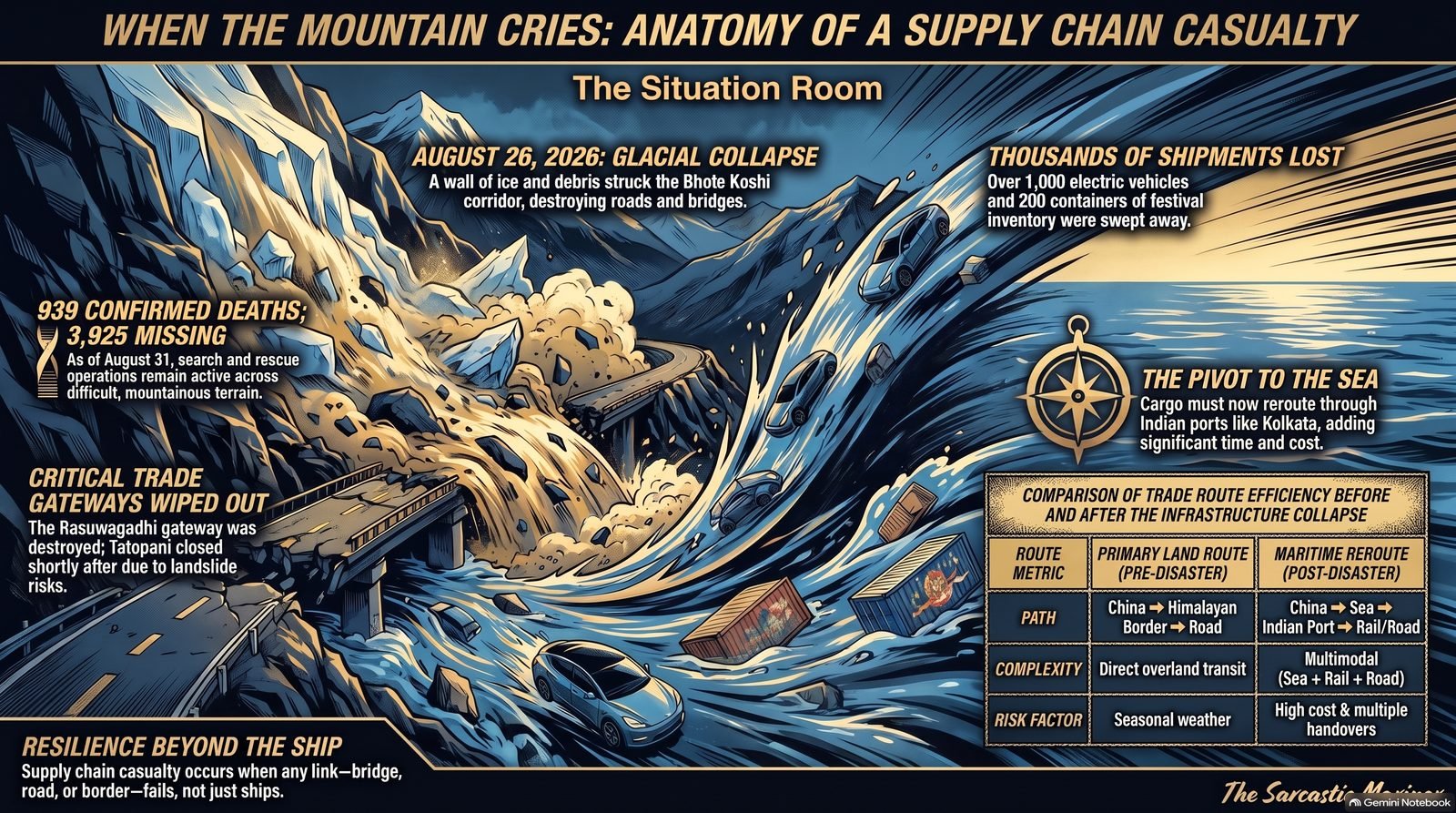
By 31 August, Nepalese authorities were reporting 939 deaths and 3,925 people missing, while China had reported 16 deaths and 546 missing on its side of the border. Because search and rescue operations were still underway, these figures should be treated as evolving rather than final.
Hundreds of people were also reported trapped or unaccounted for at hydropower projects, with rescue teams working to reach workers inside tunnels. The disaster has affected tens of thousands of people and displaced communities across the affected areas.
The physical geography has made the rescue operation exceptionally difficult.
- Roads are gone.
- Bridges are gone.
- Communications have been disrupted.
And in some locations, helicopters are the only practical means of access.
The TSM Take
A glacier doesn’t check the traffic forecast. A river doesn’t care about customs clearance. And nature doesn’t wait for your risk assessment to be approved. When the water comes down from the mountains, everything in its path becomes part of the flow… including your infrastructure.
🚚 Q2: What Happened to the Cargo?
The Non-Expert Says:
The flood didn’t just destroy infrastructure. It destroyed inventory, vehicles, commercial plans and livelihoods.
At the Rasuwagadhi customs and dry-port area, reports indicated that around 200 containers were swept away or severely affected. The cargo included goods intended for Nepal’s major festival season, including clothing, footwear, electronics and food products.
The area was also holding a large number of imported vehicles awaiting customs clearance. Reports indicated that hundreds of vehicles, including electric vehicles, were swept away or damaged. One vehicle importer estimated that around 1,000 EVs and containers containing spare parts had been lost in the disaster.
The precise financial loss will take time to establish. And that distinction matters. Disaster headlines are very good at producing large numbers very quickly. Audited loss assessments are not.
The TSM Take
A container sounds like a logistics statistic.
- Until you remember that every container has an owner.
- Every vehicle has a buyer.
- Every shipment has a commercial contract.
- Every delivery has someone waiting for it.
And somewhere behind every manifest is someone asking: “Where is my cargo?”
The mountains don’t care about your supply chain.
🌏 Q3: Why Does This Matter for Shipping?
The Non-Expert Says:
Because Nepal is landlocked. And landlocked countries are still part of the maritime supply chain.
Nepal has no coastline. That doesn’t mean it has no relationship with the sea. Quite the opposite. Its international trade depends on a network of:
ships → ports → railways → roads → border crossings → customs facilities → warehouses → customers.
Break one link and the consequences travel through the network. Rasuwagadhi was Nepal’s principal overland gateway for trade with China. That gateway has now been severely destroyed.
A container originally intended to cross the Himalayas by road may now need to travel by sea before continuing inland.
More distance.
More handling.
More time.
More cost.
More opportunities for something else to go wrong.
The TSM Take
A container doesn’t know whether its final destination has a coastline. It only knows that someone has to move it.
Ship – Port – Rail – Truck – Border – Warehouse – Customer.
Remove one piece of that chain and the rest suddenly gets very busy.
🇮🇳 Q4: Why Does Kolkata Suddenly Matter?
The Non-Expert Says:
Because when northern land routes fail, the sea becomes part of the alternative.
Nepal’s international trade is heavily connected to Indian ports and inland transport corridors. Kolkata and other Indian gateways provide maritime access for Nepal’s third-country trade through combinations of sea, rail and road transport.
With both major Nepal–China northern crossings disrupted, traders face a choice between attempting to move cargo through the constrained Korala crossing or using longer routes through Indian ports. Nepalese trade experts have warned that sea-based rerouting will increase transportation time and costs.
This is exactly why supply-chain resilience cannot be measured by asking: “Do we have another port?”
The better question is: “Do we have another complete route?”
A port is not an alternative if the road beyond it is broken. A border crossing isn’t a redundancy if it cannot handle the volume.
And a second route isn’t really a second route if everyone needs it at the same time.
The TSM Take
Redundancy looks fantastic on a PowerPoint slide.
Until you actually need it… Welcome to resilience.
🤝 Q5: What’s Being Done?
The Non-Expert Says:
Rescue first. Relief second. Recovery… eventually.
Nepal’s security forces, police, army personnel and emergency teams have been mobilised in large numbers. Helicopters are being used to evacuate people and deliver essential supplies. India and China are supporting rescue and relief operations, while international agencies are providing humanitarian assistance.
The immediate priorities are brutally simple:
- Find people.
- Evacuate survivors.
- Provide food and water.
- Restore communications.
- Open roads.
- Reach the missing.
- And somehow begin rebuilding while the disaster is still unfolding.
There are also continuing concerns about secondary flooding, landslides and unstable terrain.
In other words, the first disaster may be over. The risk environment isn’t.
The TSM Take
The world responds. Planes fly in. Aid arrives. Rescue teams search.
But for a family waiting for news of someone missing, relief doesn’t arrive on a manifest. For a trader who has lost an entire shipment, insurance paperwork isn’t recovery. And for a truck driver sitting behind a collapsed road, “supply-chain resilience” isn’t a particularly comforting phrase.
Sometimes resilience simply means getting through the next hour.
👨✈️ TSM Situation Room Takeaway
This isn’t a shipping casualty. Not in the traditional sense. No containership was lost. No tanker was damaged. No port was destroyed.
But it is a supply-chain casualty — and perhaps that is the more important story.
Global trade is not a collection of ships.
It is a chain.
- A ship depends on a port.
- A port depends on roads and railways.
- Roads depend on bridges.
- Borders depend on functioning infrastructure.
And every one of those links depends on geography, weather, people and politics. Your backup can disappear too. That is the real lesson.
Supply-chain resilience isn’t having a Plan B written in a boardroom document. It’s having a Plan B that can actually handle the cargo. And a Plan C that doesn’t collapse when everyone invokes Plan B.
🌊 The Maritime Connection
The most interesting part of this story may ultimately be what happens next. Cargo that once travelled directly through a northern land corridor may have to take a longer multimodal route.
That can mean:
China → port → sea → Indian port → rail/road → Nepal
instead of:
China → Himalayan border → road → Kathmandu
The sea hasn’t become the problem. The sea may become part of the solution. But every extra kilometre and every extra handover introduces time, cost and risk.
This is why the maritime industry should pay attention to events far beyond the traditional shipping map. And eventually, something that started as a mountain disaster becomes a maritime logistics problem.
The Human Element
There is another reason this matters.
Behind the cargo statistics are people.
- The seafarer navigating a high-risk waterway.
- The truck driver waiting at a border.
- The customs officer trying to account for missing cargo.
- The trader watching an entire shipment disappear.
- The rescue worker entering a damaged tunnel.
- The family waiting for news of someone who hasn’t come home.
Different crises.
Different locations.
Different causes.
But the same human response: Waiting.
- Waiting for the danger to pass.
- Waiting for the road to reopen.
- Waiting for the cargo to arrive.
- Waiting for the phone to ring.
The TSM Final Word
The mountains don’t negotiate. Rivers don’t issue notices. And supply chains don’t come with spare roads.
Nepal will rebuild.
But rebuilding isn’t simply about replacing concrete and steel. It is about restoring connectivity. Restoring livelihoods. Restoring confidence. And reconnecting people with the world outside the disaster zone.
For the maritime industry, perhaps the biggest lesson is a simple one: We spend an enormous amount of time analysing what can go wrong at sea.
Maybe we should spend a little more time understanding what happens before the cargo reaches the ship—and after it leaves.
Because the next supply-chain casualty may not happen in a shipping lane. It might happen somewhere you’ve never heard of. On a road you’ve never travelled.
Beside a river you’ve never seen. And when it does, the effects may eventually reach a port thousands of kilometres away.
The sea isn’t always the beginning of the supply chain. Sometimes, it’s the backup plan.
— The Sarcastic Mariner(s)
Stirring the pot so the industry remembers to think beyond the ship.
Previous Situation Room reports
The Situation Room. #13 – The Month Shipping Lost Its Mind (Again)
The Situation Room. #14 – Nearly Six Months of “Just a Little Longer”