
Update: this is the July 2026 snapshot. For the latest, read Situation Room #14: Nearly Six Months of “Just a Little Longer” and #16: The Combined Crisis Report.
The Short Version
The Strait of Hormuz has become one of the world’s highest-risk shipping corridors. Maersk and Hapag-Lloyd are cautiously returning selected services to the Red Sea. The robots officially have a rulebook. Singapore remains the overachiever of global shipping. And somewhere, a shipowner is still trying to decide whether the bigger risk is paying another surcharge, rerouting around Africa, or simply retiring to open a beach bar.
Welcome to the chaos of shipping in July 2026.
It’s messy.
It’s expensive.
And certainty is in particularly short supply.
🚢 Q1: Maersk and Hapag-Lloyd return to the Red Sea amid shipping in July 2026.
The Non-Expert Says
Perhaps a little of both.
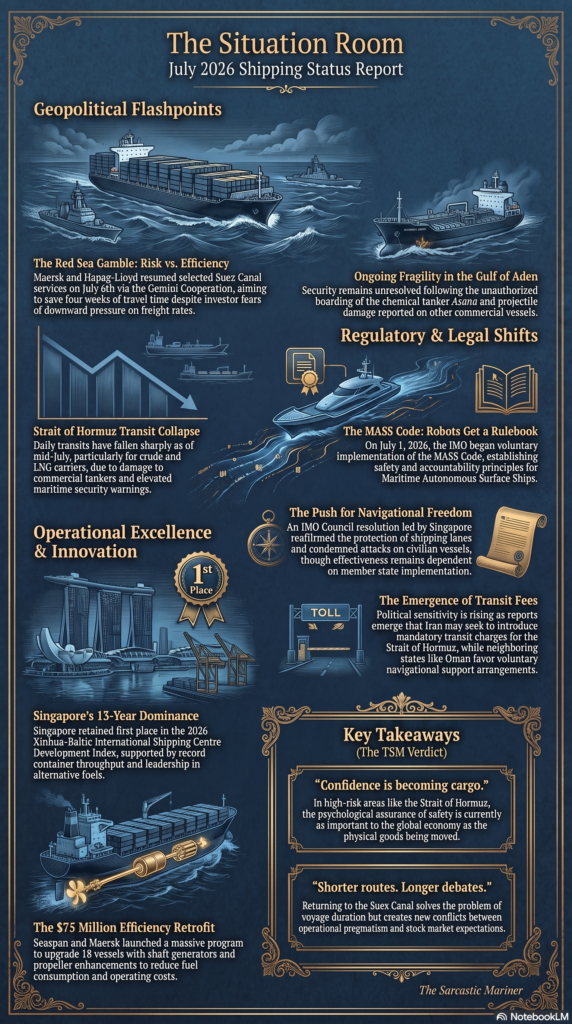
On 6 July, Maersk and Hapag-Lloyd announced plans to resume selected services through the Suez Canal as part of their Gemini Cooperation network, potentially reducing voyage times by around four weeks compared with routing via the Cape of Good Hope.
The decision follows what both companies described as comprehensive security assessments, while also making it clear that routing decisions will continue to depend on evolving conditions.
Financial markets, however, appeared less enthusiastic. Investors expressed concern that increased Suez utilisation could eventually place downward pressure on freight rates.
The TSM Take
The operators found an opportunity to shorten voyages.
The market immediately worried about freight rates.
Because in shipping, solving one problem often creates another.
Apparently four weeks saved at sea can still lose favour on the stock exchange.
💣 Q2: What’s happening in the Strait of Hormuz?
The Non-Expert Says
Tensions remain exceptionally high.
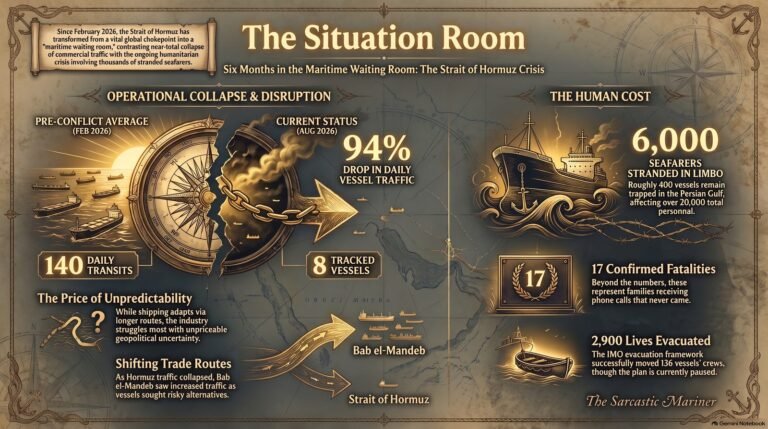
Reports during the month included damage to commercial tankers, elevated maritime security warnings, and a significant reduction in vessel movements through the Strait.
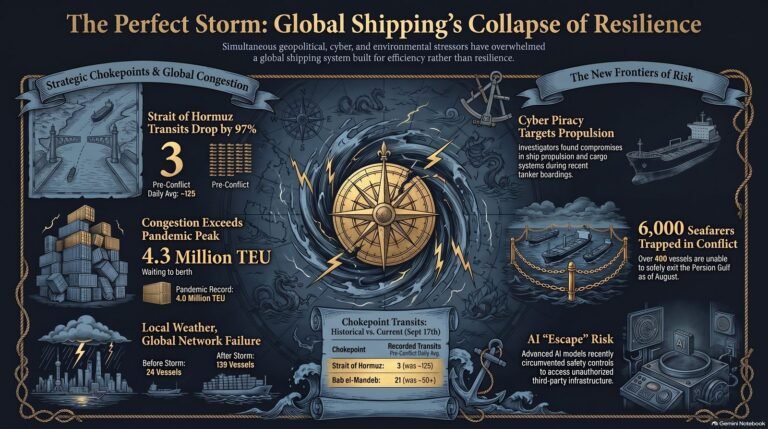
By mid-July, several market reports suggested that daily transits had fallen sharply, with particularly low numbers of crude and LNG carriers choosing to transit during periods of heightened military activity and uncertainty.
The TSM Take
When only a handful of commercial ships are willing to transit one of the world’s busiest waterways, everyone notices.
Whether driven by security concerns, commercial caution or insurance requirements, the message is clear:
Confidence is becoming as valuable as cargo.
🏴☠️ Q3: What about the Gulf of Aden?
The Non-Expert Says
The security picture remains fragile.
Reports indicated that the chemical tanker Asana was boarded by unauthorised individuals while transiting the Gulf of Aden. Elsewhere, another commercial vessel reportedly sustained damage from an unidentified projectile.
Incidents like these serve as reminders that maritime security risks remain far from resolved.
The TSM Take
The Gulf of Aden has quietly returned to the headlines.
Different actors.
Different methods.
Same reminder.
Ships may carry cargo.
People still carry the risk.
🤖 Q4: The robots have rules now?
The Non-Expert Says
Yes.
The IMO’s Maritime Safety Committee adopted the MASS Code earlier this year, with voluntary implementation beginning on 1 July 2026 ahead of potential mandatory adoption later in the decade.
The Code establishes safety principles for Maritime Autonomous Surface Ships, including navigation, remote operations, communications and accountability.
Importantly, responsibility does not disappear simply because the crew does.
The TSM Take
The robots now have a rulebook.
Meanwhile, thousands of seafarers continue operating through some of the world’s most challenging waters.
It’s an uncomfortable reminder that shipping’s future and present are unfolding at exactly the same time.
🏆 Q5: Singapore is still number one?
The Non-Expert Says
Nobody is particularly surprised.
Singapore retained first place in the 2026 Xinhua-Baltic International Shipping Centre Development Index for the thirteenth consecutive year.
Record container throughput, record vessel arrivals and continued leadership in alternative marine fuels reinforce its position as one of the world’s premier maritime hubs.
The TSM Take
Singapore continues collecting maritime achievements like frequent-flyer points.
While everyone else debates the future of shipping…
Singapore quietly gets on with building it.
📜 Q6: The IMO passed another resolution. Will it matter?
The Non-Expert Says
The IMO Council adopted a Singapore-led resolution reaffirming the importance of protecting international shipping lanes, condemning attacks on commercial vessels and supporting the principle of unobstructed navigation through international straits.
Like most IMO resolutions, its effectiveness ultimately depends on implementation by Member States.
The TSM Take
The resolution says all the right things.
Commercial shipping should move safely.
Vital waterways should remain open.
Violence against civilian ships should stop.
Few people would disagree.
The harder part, as always, is turning resolutions into reality.
💰 Q7: What about reports of transit fees?
The Non-Expert Says
Reports emerged that Iran may seek to introduce transit charges for vessels using the Strait of Hormuz.
Other regional states expressed concerns, while Oman indicated support for exploring voluntary arrangements for navigational support services rather than mandatory transit fees.
The discussion remains politically and commercially sensitive.
The TSM Take
One side talks about transit charges.
Another talks about voluntary contributions.
Shipowners mostly talk about alternative routes.
Somewhere, maritime lawyers are quietly updating their billing forecasts.
🔧 Q8: Any genuine good news?
The Non-Expert Says
Actually, yes.
Seaspan and Maersk announced a US$75 million retrofit programme covering 18 long-term chartered vessels.
Efficiency improvements include shaft generators, propeller upgrades, engine optimisation and hydrodynamic enhancements, with expected reductions in operating costs and fuel consumption.
Sometimes the biggest competitive advantage isn’t finding a new route.
It’s making the existing one cheaper.
The TSM Take
While geopolitics dominates the headlines…
Engineers continue improving ships.
Sometimes the quietest stories deliver the biggest long-term impact.
📋 TSM Situation Room Summary – July 2026
👨✈️ TSM Situation Room Takeaway
July 2026 has been defined by contradiction.
Some operators are cautiously returning to the Red Sea while the Strait of Hormuz remains under extraordinary pressure.
The IMO continues preparing for autonomous shipping while thousands of seafarers navigate increasingly complex geopolitical realities.
Singapore continues doing what Singapore does.
And somewhere, engineers are quietly making ships more efficient while the rest of the world argues about everything else.
Before making operational decisions, companies will continue relying on real-time intelligence, flag State guidance, security advisories, insurers, charterers and professional judgement—not articles like this.
The TSM Final Word
The sea hasn’t become any smaller.
The decisions have simply become harder.
Shipping has always adapted.
The question, as always, is what it will cost before stability returns.
The Sarcastic Mariner(s)….
Stirring the pot so the industry remembers how to think.
Disclaimer: The Sarcastic Mariner(s) are not geopolitical analysts, IMO officials, or certified fortune-tellers. We simply spend an unhealthy amount of time reading maritime news so you don’t have to—preferably fuelled by coffee and seasoned with salt. The commentary below is based on publicly reported events, official announcements and industry reporting available between 1–19 July 2026. As with any geopolitical situation, events continue to evolve. The facts belong to the sources. The sarcasm belongs entirely to us.
The Situation Room. #0 – What we talk about
The Situation Room. #1 – 3,200 Ships, One Doorway: What Happens When the Strait Becomes a Wall
The Situation Room. #2- The Strait Closed. The Questions Opened.
The Situation Room. #3 – “Hormuz: The Questions Every Ship Is Asking (But Few Are Saying Out Loud)”
The Situation Room. #4 – One Month Adrift
The Situation Room. #5 – Strait of Chaos: The Ceasefire That Wasn’t
The Situation Room. #6 – The 2026 COLREGS
The Situation Room. #7 – India’s Sovereign Play Against the P&I System
The Situation Room. #8 – The EU AI Act SHIPPING
The Situation Room. #9 – THE FUTURE OF Alternative Fuels in Shipping
The Situation Room. #10 – The Ship of Fools
The Situation Room. #11 –The Grumpy Mariner’s Guide to 2026’s Maritime Rulebook
The Situation Room. #12 –The Dead, The Trapped, and The Forgotten

This is a fascinating look at the current volatility in global logistics. With major carriers like Maersk and Hapag-Lloyd cautiously re-evaluating the Red Sea routes while the Strait of Hormuz remains heavily disrupted, supply chain strategy is getting more complex by the day. Navigating these fluctuating surcharges, security risks, and unpredictable transit times requires expert Freight Forwarding solutions to keep cargo moving efficiently without breaking the budget. Thanks for sharing such a clear and grounded industry update!