
The Grumpy Mariner’s Guide to 2026’s Maritime Rulebook
If you’re trying to make sense of maritime compliance 2026, you’re not alone — and you’re not imagining the panic. Your LinkedIn feed is probably full of consultants, compliance experts, and self-proclaimed AI gurus screaming about the end of the world as we know it.
And for once, they might not be completely wrong.
The maritime industry is staring down a perfect storm of regulatory changes driving maritime compliance 2026. And unlike that “urgent” weather alert you ignored last week, these ones actually come with teeth.
Here’s your curated guide to the new rules that matter — presented in classic TSM fashion: minimal patience, maximum sarcasm, and just enough useful information to keep your Certificate of Competency out of hot water.
🤖 Topic 1: The EU AI Act — the Core of Maritime Compliance 2026
Q1: The EU AI Act. Is this just another GDPR for shipping people to panic about?
The Non-Expert Says:
Potentially worse. Much worse.
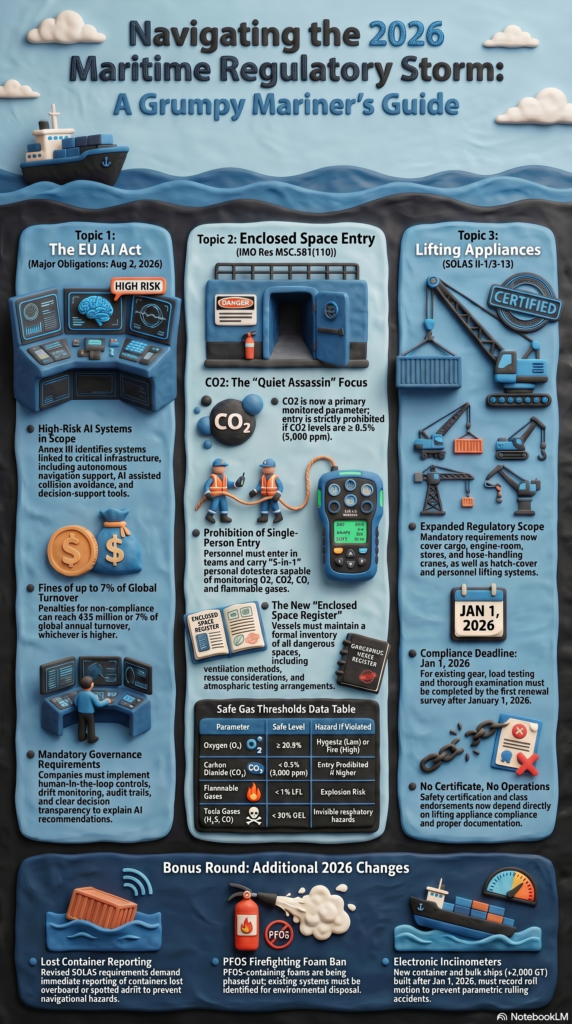
The EU AI Act officially entered into force on 1 August 2024, with phased implementation running through 2027. But the date shipping companies are increasingly focused on is 2 August 2026, when major compliance obligations for high-risk AI systems begin applying — arguably the single biggest driver of maritime compliance 2026 so far.
And yes — parts of shipping may fall directly into scope.
Annex III of the Act identifies certain AI systems linked to critical infrastructure and transport as high-risk categories. Depending on deployment and operational reliance, this could include autonomous navigation support, AI-assisted collision avoidance, predictive operational systems, or decision-support tools connected to vessel safety and operations.
The fines are designed to get your CFO’s attention:
up to €35 million or 7% of global annual turnover, whichever is higher.
For a shipping line pulling in €10 billion a year, that’s €700 million. Enough to buy a small fleet of newbuilds. Or just light the money on fire directly and save time.
One maritime technology executive put it bluntly:
“Major compliance obligations under the EU AI Act are approaching quickly, and companies unable to demonstrate governance of their AI processes may face severe penalties.”
The TSM Take:
If you think your onboard AI is “just software,” think again.
That collision avoidance support system? Potentially high-risk.
That predictive maintenance engine? Possibly in scope.
That AI quietly analysing operational patterns in the background? Regulators may eventually want to know how it works, who oversees it, and whether a human can override it before something expensive hits something steel.
Q2: Does this even apply to ships? We’re not exactly Silicon Valley.
The Non-Expert Says:
Yes. And the “Brussels Effect” does not care about your flag state.
The EU AI Act has broad extraterritorial reach. If your AI systems affect operations, services, personnel, commercial activities, or data connected to the EU market, regulators may eventually take an interest — regardless of where the vessel is flagged.
Companies are increasingly being advised to implement:
• Human-in-the-loop controls
• Drift monitoring
• Audit trails
• Decision transparency
• Risk management procedures
In plain English:
you need to prove a human can override the system, explain what the AI was doing, and reconstruct why it made a recommendation after the fact.
The Act categorises systems into:
• Prohibited risk
• High-risk
• Limited-risk
• Minimal-risk
High-risk systems require extensive lifecycle governance covering design, deployment, monitoring, oversight, documentation, and ongoing review.
The TSM Take:
The EU may have just turned parts of your navigation ecosystem into a compliance department’s new favourite headache.
Hope your IT budget is healthier than the snack locker.
Q3: What should companies actually do now?
The Non-Expert Says:
Stop arguing about AI on LinkedIn and start auditing your systems.
With the 2026 obligations approaching, companies ignoring governance gaps may discover regulators are significantly less forgiving than internal project meetings.
Here’s the operational reality:
Step 1: Inventory your AI
Identify systems using machine learning, predictive analytics, or autonomous decision-support:
• Navigation support
• Route optimisation
• Predictive maintenance
• Cargo planning
• Operational analytics
• Crew scheduling tools
• AI-enabled monitoring platforms
If it influences operational or safety-critical decisions, somebody should probably understand how it works.
Step 2: Document everything
• Model version history
• Data sources
• Human oversight procedures
• Audit trails
• Override capability
• Incident escalation processes
If nobody can explain a system after an incident, that becomes a very uncomfortable meeting.
Step 3: Train people
The Act introduces AI literacy obligations.
That means personnel using these systems should understand:
• what the AI does
• where its limitations are
• when humans should intervene
• and why blindly trusting dashboards is how future investigation reports get written
Step 4: Prepare for scrutiny
Even companies without direct EU operations are increasingly reviewing exposure now rather than waiting for enforcement surprises later.
The TSM Take:
The deadline clock is ticking.
And somewhere in Brussels, a regulator just discovered shipping uses algorithms too.
⚠️ Topic 2: Enclosed Space Entry
Q4: We’ve had enclosed-space rules forever. What’s actually changed?
The Non-Expert Says:
CO₂. Specifically, the IMO finally decided the silent killer deserved centre stage in this round of maritime compliance 2026.
The IMO adopted Resolution MSC.581(110) during MSC 110 in June 2025, replacing previous guidance under Resolution A.1050(27).
The revised recommendations place far greater emphasis on carbon dioxide monitoring during enclosed-space entry.
Under older practices, focus largely sat on:
• oxygen depletion
• flammable gases
• toxic vapours
CO₂ was recognised as dangerous — but often not treated as a primary monitored parameter.
Now it is.
Why?
Because enclosed spaces continue killing people at horrifying consistency.
Since 1996, an estimated 350 people have died from asphyxiation in enclosed spaces aboard ships. Many were experienced seafarers, surveyors, stevedores, and contractors performing completely routine tasks.
Cargo holds.
Ballast tanks.
Pump rooms.
Void spaces.
Chain lockers.
Places that look harmless right up until they are not.
The TSM Take:
CO₂ is the quiet assassin of the maritime world.
It does not smell.
It does not announce itself.
And now the IMO has finally pinned its photograph to the regulatory wanted board.
Q5: What gas thresholds actually matter now?
The Non-Expert Says:
Here’s the cheat sheet your permit-to-work system wishes everyone actually remembered.
| Parameter | Safe Level | Why It Matters |
|---|---|---|
| Oxygen (O₂) | ≥ 20.9% by volume | Too low = hypoxia. Too high = fire hazard. |
| Carbon Dioxide (CO₂) | < 0.5% (5,000 ppm) | Above this? Entry prohibited. |
| Flammable gases/vapours | < 1% LFL | Explosions remain unpopular. |
| Toxic gases | < 50% OEL | Covers H₂S, CO, and other invisible nightmares. |
And one major operational shift:
Single-person entry is now strictly prohibited.
Personnel entering enclosed spaces should carry calibrated personal gas detectors capable of monitoring:
• O₂
• CO₂
• CO
• flammable gases
• additional identified hazards
Always verify limits against:
• flag-state requirements
• company procedures
• maker instructions
• latest IMO guidance
The TSM Take:
If your gas detector still thinks CO₂ is optional, it may now be approximately as useful as a chocolate fireguard.
Q6: What’s this “Enclosed Space Register”?
The Non-Expert Says:
Exactly what it sounds like:
a formal inventory of every dangerous hole on your ship.
The revised guidance introduces a structured requirement to maintain an Enclosed Space Register covering:
• identified enclosed spaces
• associated hazards
• ventilation methods
• atmospheric testing arrangements
• connected spaces
• rescue considerations
• estimated ventilation times
Connected and adjacent spaces must also be treated cautiously because hazardous atmospheres migrate surprisingly well when they feel like ruining someone’s day.
The revised guidance also includes:
• warning sign templates
• emergency response examples
• simplified ship-space diagrams
The TSM Take:
Your ship’s “dangerous holes spreadsheet” just became official documentation.
And yes — that includes tanks everyone forgot existed after the last dry dock.
Q7: How many gas detectors do we need now?
The Non-Expert Says:
Probably more than whatever is currently hiding inside your safety locker.
SOLAS XI-1/7 already required at least two sets of portable gas-detection equipment onboard.
MSC.581(110) effectively raises expectations further for vessels carrying cargoes capable of generating hazardous atmospheres and requiring routine hold entry.
In many operational discussions, this is now informally being called the “5-in-1 detector era.”
The TSM Take:
That old detector measuring only oxygen, flammables, and optimism?
Its retirement plan may have arrived.
🔧 Topic 3: Lifting Appliances
Q8: We’ve used cranes forever. Why is this suddenly a problem?
The Non-Expert Says:
Because the IMO finally decided “we’ve always done it this way” was not an inspection standard.
IMO Resolution MSC.532(107) introduced SOLAS II-1/3-13, establishing mandatory requirements for lifting appliances and anchor handling winches.
The scope includes:
• cargo cranes
• engine-room cranes
• stores cranes
• hose-handling cranes
• hatch-cover lifting systems
• tender launch systems
• personnel lifting arrangements
And yes — even smaller lifting appliances may fall within scope unless specifically exempted by the Administration.
The TSM Take:
That tiny engine-room crane nobody has documented properly since 2011?
Congratulations.
It now has paperwork.
Q9: What are the compliance deadlines?
The Non-Expert Says:
The transition started from 1 January 2026.
For new lifting appliances:
Installed on or after 1 January 2026:
• certification
• plan approval
• fabrication oversight
• testing
• examination
• documentation
must all be completed before entering service.
For existing lifting appliances:
Load testing and thorough examination are required by the first renewal survey after 1 January 2026.
Existing valid ILO Convention No.152 documentation may still support compliance.
Where documentation is missing, owners may need to establish safe working loads through engineering review and testing.
The TSM Take:
Your class surveyor will not accept:
“Pretty sure we tested it sometime before COVID.”
Q10: What happens if companies ignore this?
The Non-Expert Says:
Certificates become difficult.
Operations become awkward.
Surveyors become extremely interested in your paperwork.
For many vessels, safety certification and class endorsements now depend directly on lifting appliance compliance.
IACS Recommendation No.198 was specifically developed to support implementation and reduce failures linked to:
• fatalities
• injuries
• dropped loads
• structural damage
• lifting equipment loss
The TSM Take:
No certificate.
No operations.
Suddenly that forgotten stores crane became everybody’s priority.
Right after the coffee machine.
📦 Bonus Round: Other 2026 Changes You Should Know About
Lost Container Reporting
Containers lost overboard or spotted adrift now require immediate reporting under revised SOLAS requirements.
Because nothing says “navigational hazard” like a 40-foot steel box floating around waiting to ruin someone else’s voyage plan.
PFOS Firefighting Foam Ban
PFOS-containing firefighting foams are effectively being phased out and prohibited under updated environmental requirements.
Translation:
that ancient foam system is becoming tomorrow’s disposal problem.
Electronic Inclinometers
New container ships and bulk carriers above 3,000 GT built after 1 January 2026 require electronic inclinometers capable of displaying and recording roll motion.
Because parametric rolling has already donated enough containers to the ocean.
Fuel Flashpoint Verification
Bunker suppliers now face stricter expectations regarding flashpoint verification and declarations on Bunker Delivery Notes.
“No worries chief, fuel should be okay” is no longer considered a robust compliance system.
TSM Situation Room Takeaway
Maritime compliance 2026 just got a whole lot thicker.
The AI era is colliding with maritime regulation.
Enclosed spaces just became even less forgiving.
And lifting appliances nobody thought about for years are suddenly survey-critical.
None of this is optional.
The fines are painful.
The surveys unforgiving.
And the regulators increasingly data-driven.
But underneath all the compliance language sits a very old truth:
Most of these rules exist because people died.
The enclosed-space fatalities.
The lifting failures.
The fires.
The lost containers.
The preventable accidents that quietly became “industry lessons learned.”
So yes:
update the procedures.
Train the crew.
Audit the systems.
Replace the detector that still thinks CO₂ is somebody else’s problem.
Because welcome to the new normal of maritime compliance 2026.
The paperwork got smarter.
The deadlines got shorter.
And the margin for pretending you didn’t know just got very, very small.
The Sarcastic Mariner(s)…
Stirring the pot so the industry remembers how to think.
Disclaimer: The Sarcastic Mariner(s) are neither class surveyors nor EU lawmakers. We just read through a mountain of regulatory updates so you don’t have to — while mainlining coffee and muttering salty comments under our breath. The information below is based on actual IMO resolutions and EU legislation, filtered through a lens of exhausted maritime sarcasm. Always consult your flag state, class society, equipment manufacturer, or legal counsel before doing anything rash — like throwing your old gas detectors overboard.
The Situation Room. #0 – What we talk about
The Situation Room. #1 – 3,200 Ships, One Doorway: What Happens When the Strait Becomes a Wall
The Situation Room. #2- The Strait Closed. The Questions Opened.
The Situation Room. #3 – “Hormuz: The Questions Every Ship Is Asking (But Few Are Saying Out Loud)”
The Situation Room. #4 – One Month Adrift
The Situation Room. #5 – Strait of Chaos: The Ceasefire That Wasn’t
The Situation Room. #6 – The 2026 COLREGS
The Situation Room. #7 – India’s Sovereign Play Against the P&I System
The Situation Room. #8 – The EU AI Act SHIPPING
The Situation Room. #9 – THE FUTURE OF Alternative Fuels in Shipping