
Dr. Kumud R. Jha · Singapore · Doctorate in AI · US Patent Holder View LinkedIn Profile
What AI Leadership Actually Requires
AI leadership is not about understanding the technology. Most great leaders do not understand the technology that runs their organisations. They never did. The CEO of a bank does not need to understand core banking architecture. The managing partner of a law firm does not need to understand document management systems.
What they need — what they have always needed — is to understand the implications. The risks. The opportunities. The effect on their people. And the values they want to uphold as the organisation navigates change.
That is still the job. AI does not change the job. It changes the context in which the job is done.
Here is what AI leadership looks like in practice, in an AI-augmented organisation.
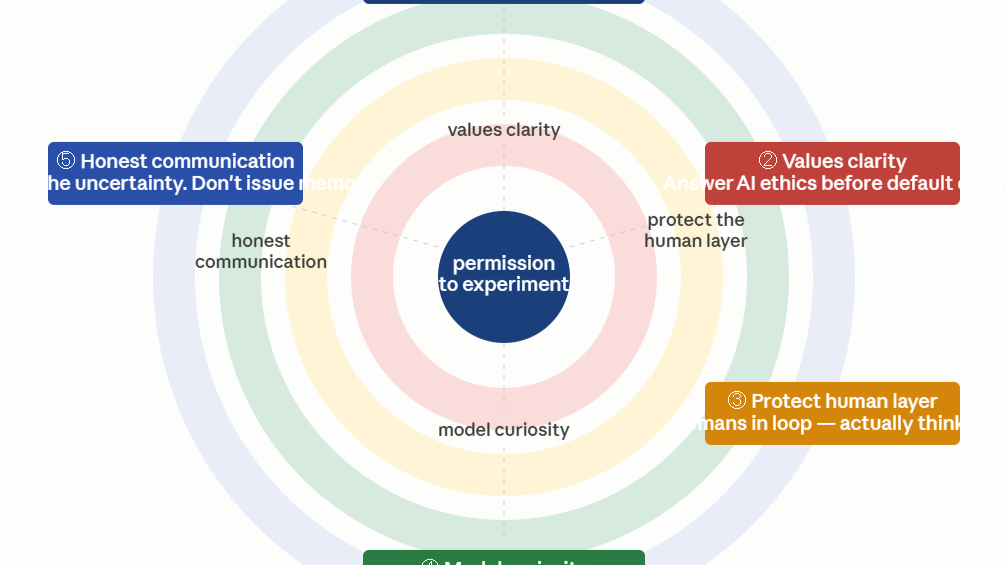
One — Permission to experiment. The organisations moving fastest with AI are not the ones with the biggest technology budgets. They are the ones where people feel safe trying things, failing quietly, and sharing what they learned. That culture does not come from a technology strategy. It comes from a leader who says — out loud, repeatedly, with their own behaviour — that thoughtful experimentation is expected and failure is information.
Two — Clarity about values. AI will surface decisions that previously never needed to be made explicitly. Should we use AI to monitor employee productivity? Should we allow AI-generated client communications without disclosure? Should we use predictive AI in hiring? These are not technology questions. They are values questions. And the leader who has not thought them through will find them answered by default — by whoever made the vendor decision, or by the junior team member who had to make a call at 11pm on a Friday.
Three — Protection of the human layer. The most dangerous failure mode in AI adoption is not the technology failing. It is the organisation quietly removing the human judgment layer because AI outputs feel authoritative. The leader’s job is to ensure that the humans in the loop are genuinely in the loop — not rubber-stamping, not overwhelmed, not incentivised to defer. Actually thinking. Actually accountable.
Four — Honest communication with your people. The fear of AI displacement is real and it is personal. Leaders who pretend it is not — who issue optimistic memos about AI being a tool that will make everyone’s job better — lose credibility fast. The leaders who earn trust are the ones who name the uncertainty honestly, share what they know and what they don’t, and demonstrate through their decisions that the people in the organisation are not just costs to be optimised.
Five — Modelling curiosity. This is the one most often missed. Leaders who use AI tools themselves, who talk about what they are learning, who ask questions in public about things they do not understand — they give the whole organisation permission to do the same. The leader who is visibly learning is the most powerful signal an organisation can receive that learning is the expectation, not the exception.
The Honest Question Every Leader Should Ask
If I removed myself from every AI-related decision in my organisation for the next six months — what would happen? Who would make the values calls? Who would protect the human layer? Who would tell the people the honest truth?
If the answer is unclear, that is the work.
As we covered in Day 18, the roles and skills the next five years reward all depend on this kind of judgment at the top. AI leadership is what determines whether those emerging skills get room to matter, or get quietly optimised away.
AI does not need a technology leader. It needs a human one.