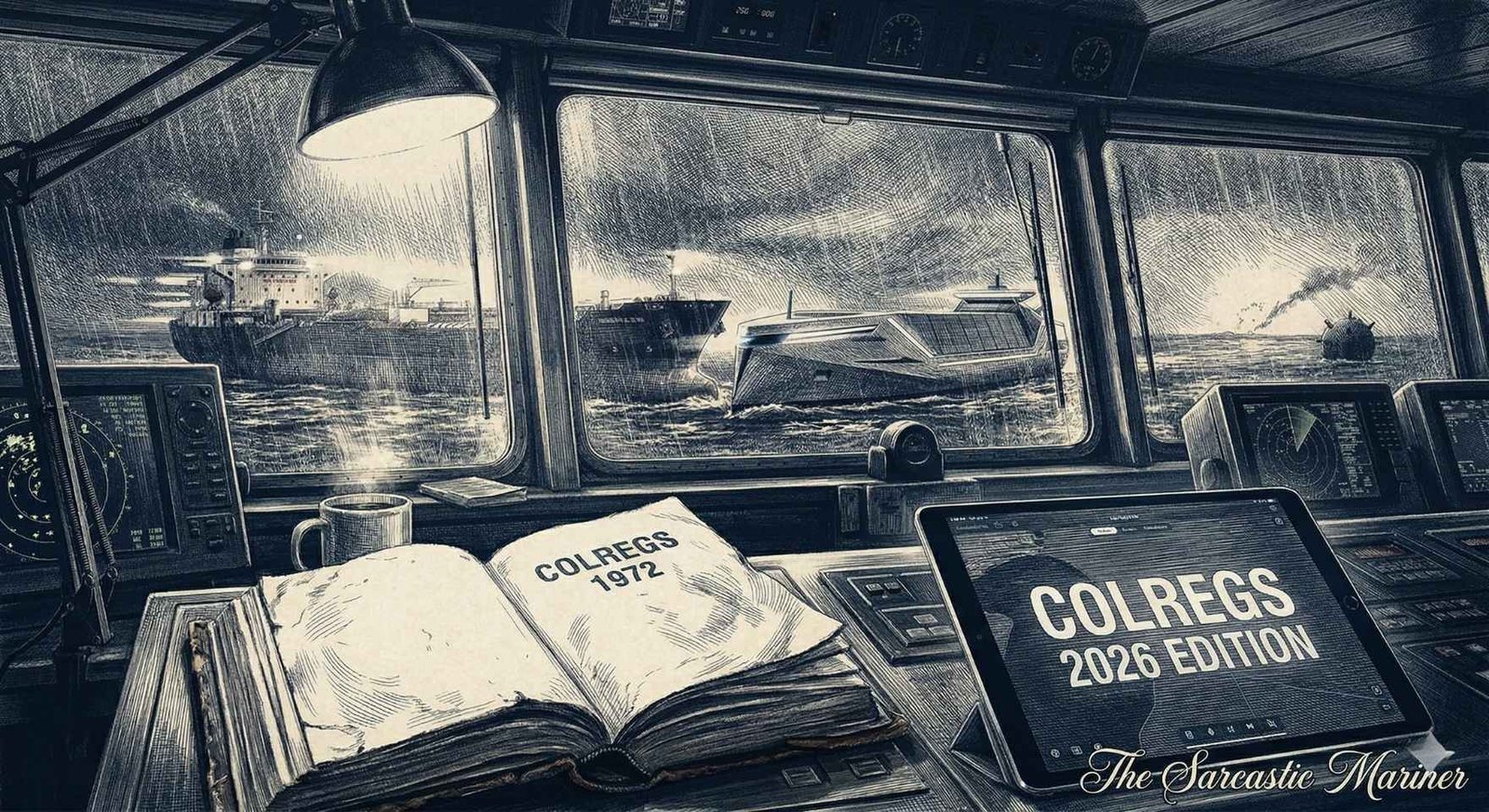

A New Cover Page for the Same Old Rulebook of “Don’t Hit That Other Ship”
Ah, the 2026 COLREGS. The closest thing shipping has to a universal language — and the one most creatively interpreted when things go wrong.
While the world burns, ships reroute around conflict zones, and operators quietly factor “floating hazards” into voyage plans, the IMO has done what it does best: released a freshly consolidated version of the rules we were already supposed to be following.
No revolution. No dramatic rewrite. No shiny new chapter on “How Not to Collide with Autonomous Ghost Ships.”
Just a cleaner, consolidated, officially updated publication of the International Regulations for Preventing Collisions at Sea, 1972 — now aligned with all amendments adopted up to the last major housekeeping cycle.
Progress, maritime style.
So… what actually changed?
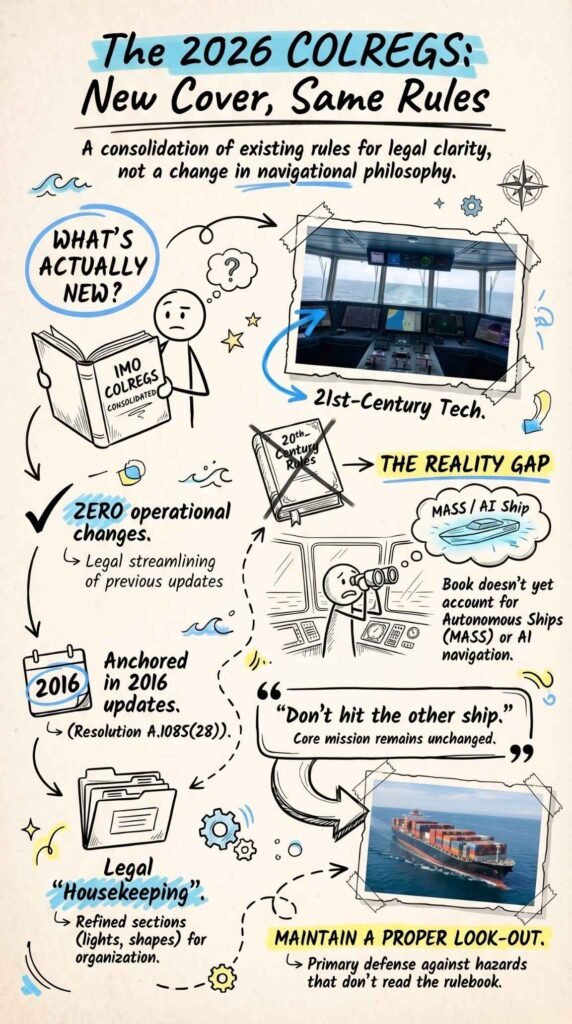
Short answer: nothing operationally new.
The latest consolidated publication essentially brings together:
The original 1972 Convention
Amendments adopted over the years
Most notably, those under Resolution A.1085(28)
That resolution — adopted in 2013 and in force since 1 January 2016 — was the last meaningful clean-up exercise. It didn’t rewrite navigation philosophy. It refined it.
We’re talking:
Adjustments to lights and shapes
Clarifications for specialized vessels (dredgers, fishing vessels, underwater ops)
General structural tidying of a rulebook that was starting to resemble legislative archaeology
In other words: not new rules — just better-organized old ones.
Why “the 2026 COLREGS” still matters
Because in shipping, what you use matters almost as much as what you know.
The older consolidated versions — especially pre-2003 formats — required cross-referencing amendments like a legal puzzle. Functional, but messy.
This updated publication gives you:
A single, consolidated reference point
Alignment with currently applicable law
A cleaner document for audits, inspections, and courtrooms
And let’s be honest — when something goes wrong, nobody cares that you knew the rule.
They care which version you were using when you didn’t follow it.
Meanwhile, the real world has moved on
Here’s where things get interesting. While the 2026 COLREGS remain beautifully stable, the environment they govern is anything but.
The industry is actively working through:
Maritime Autonomous Surface Ships (MASS)
Remote operations and sensor-based navigation
AI-supported collision avoidance systems
Which raises an awkward question:
What does “a proper look-out by sight and hearing” mean… when there’s no one on the bridge?
Current thinking leans toward:
Sensor fusion – Shore-based monitoring – Hybrid human-machine decision loops
But none of that is formally embedded into COLREGS yet.
So for now, we’re applying a 20th-century rulebook to a 21st-century operating model — and trusting interpretation to carry the gap.
The lawyers are going to love this.
And while you were updating your rulebook…
The real regulatory movement hasn’t been in COLREGS.
It’s been happening around it.
Recent regulatory focus has shifted toward:
Expanded Polar Code applicability
Stronger emphasis on crew welfare and conduct
Environmental controls, including firefighting substances and emissions
In other words:
We’re getting better at regulating how ships operate, how people behave, and how damage is prevented.
But the core rule remains unchanged: Don’t hit the other ship.
TSM Situation Room Takeaway
The 2026 COLREGS publication is a monument to stability in an industry that’s anything but stable.
It won’t help you:
Navigate geopolitical tension
Predict autonomous vessel behaviour
Or explain to a machine why Rule 15 still matters
But it will do one thing exceptionally well: Stand up in court.
And sometimes, that’s the only test that matters.
TSM Final Word
The 2026 COLREGS are the highway code of the sea.
And just like on land, the real danger isn’t the rules — it’s the assumption that everyone else is following them.
So keep the book updated. Keep your bridge alert. And for the love of all that floats — Maintain a proper look-out.
Because the hazards out there? They’re not reading the rulebook.
This is part of the Situation Room series. Read [#0 — What We Talk About], [1 — 3,200 Ships, One Doorway], [2 — The Strait Closed], [3 — Hormuz Questions], [#4 — One Month Adrift], [#5 — Strait of Chaos].
TSM Disclaimer
This is commentary based on publicly available information from the International Maritime Organization, including Resolutions A.1085(28), MSC.500(105), and MSC.501(105), and the COLREG Convention 1972 as amended. It is not legal advice or official guidance. Always refer to IMO publications, flag state requirements, and company procedures for compliance. TSM takes no responsibility for decisions made based on this content.
The Sarcastic Mariner(s)…
Stirring the pot so the industry remembers how to think.