
A.P.E.M. – Appraisal. Planning. Execution. Monitoring.
Sounds like a Navy SEAL mission, doesn’t it?
It’s actually the OG, classic four-step approach to Passage Planning—quietly sitting in the background of maritime operations for decades—now tweaked, stretched, and occasionally stress-tested for maritime Casualty Management.
It’s 2026. The tools are sharper, the data is faster, the expectations are higher—and the working conditions? Sometimes it’s a full crisis room. Sometimes it’s you, a laptop, and unstable WiFi in your living room.
Same framework. Very different battlefield.
“If you want to see A.P.E.M. applied to a specific incident narrative, read our earlier breakdown of A.P.E.M. of a Casualty — this article builds on it.”
🔍 A – APPRAISAL (a.k.a. “What Just Happened?!”):
Back in the day, appraisal meant piecing together fragments: a delayed telex, a broken satcom call, maybe a blurry photo if you were lucky. Most decisions were built on incomplete information and a fair bit of professional instinct.
“Vessel aground. Cargo shifted. More details to follow.”
Which, in practice, meant: Good luck.
Now? We’re flooded with data. AIS tracks, engine logs, tank readings, drone footage, live photos, voice notes, WhatsApp updates, and sometimes conflicting reports from five different sources—all within minutes.
And that’s the real challenge: not the lack of information, but the overload of it.
Modern appraisal is about filtering signal from noise.
- What’s verified vs. assumed?
- What’s current vs. already outdated?
- What matters now vs. what can wait?
Because early decisions—divert, hold position, evacuate, stabilise—are made here. And they’re often made fast, under pressure, with incomplete clarity.
💡 Good appraisal isn’t about having all the data. It’s about knowing which data to trust.
🧭 P – PLANNING (a.k.a. “Round up the Usual Suspects”):
This is where structure tries to impose itself on chaos.
The emails start. The calls multiply. Someone opens a Teams meeting. Someone else says, “Let’s stay calm.”
Which, as we all know, is code for: This is escalating quickly.
Planning in maritime casualty management isn’t just technical—it’s organisational.
You’re aligning:
- Ship staff
- Office teams
- Salvors
- P&I Clubs
- Class
- Flag
- Port authorities
- Sometimes, half a dozen consultants with very strong opinions
And everyone wants clarity, quickly.
The challenge? Everyone is working off slightly different assumptions, priorities, and risk tolerances.
So planning becomes an exercise in convergence:
- Defining a common understanding of the situation
- Establishing roles and decision authority
- Agreeing on immediate vs. secondary actions
- Building contingency paths for when Plan A inevitably meets reality
And yes—the whiteboard still works. Because when everything is digital, something physical feels… trustworthy.
💡 A good plan doesn’t remove uncertainty. It makes uncertainty manageable.
🚨 E – EXECUTION (a.k.a. “No, Seriously, Who’s in Charge?”):
Execution is where theory meets saltwater—and saltwater usually wins the first round.
This is the phase where plans collide with:
- Weather that didn’t read your briefing
- Equipment that works… until it doesn’t
- Human fatigue
- Communication gaps between ship and shore
Back then:
- Print the checklist
- Follow the manual
- Adjust as you go
Now:
- Share live drone feeds
- Update cloud-based logs
- Track actions across multiple teams in real time
- Repeat “as per protocol” while quietly adapting the protocol
And here’s the uncomfortable truth: execution exposes leadership gaps very quickly. We explored exactly this in our piece on leadership blind spots in maritime safety culture — worth reading alongside this.”
Because when multiple parties are involved, the biggest risk isn’t always technical—it’s unclear command.
Who makes the final call?
Who owns the risk?
Who says stop?
Meanwhile, the update requests don’t stop.
Insurers want summaries. Lawyers want wording. Cargo interests want reassurance. Media might even want a headline.
All before lunch.
💡 In maritime casualty management, execution doesn’t fail because plans are bad. It fails because alignment breaks under pressure
📈 M – MONITORING (a.k.a. “Refresh Email, Repeat”):
In active maritime casualty management, it’s the phase that separates reactive teams from resilient ones.
It’s continuous reassessment. A loop of:
Observe → Interpret → Adjust → Communicate → Repeat
You’re tracking:
- Vessel stability
- Cargo condition
- Structural integrity
- Weather windows
- Operational progress
- And the emotional temperature of every stakeholder involved
Because by this stage, the technical problem is only half the battle. The other half is perception.
Everyone is looking at the same dashboards—but drawing different conclusions:
- One sees “stable”
- Another sees “risk increasing”
- A third sees “potential claim exposure”
Your job is to keep the narrative aligned with reality—without underplaying risk or over-amplifying noise.
And yes, your phone will buzz constantly.
Sometimes for critical updates.
Sometimes because a sensor moved 0.3° and an algorithm got excited.
💡 Monitoring isn’t about watching. It’s about knowing when to intervene—and when not to.
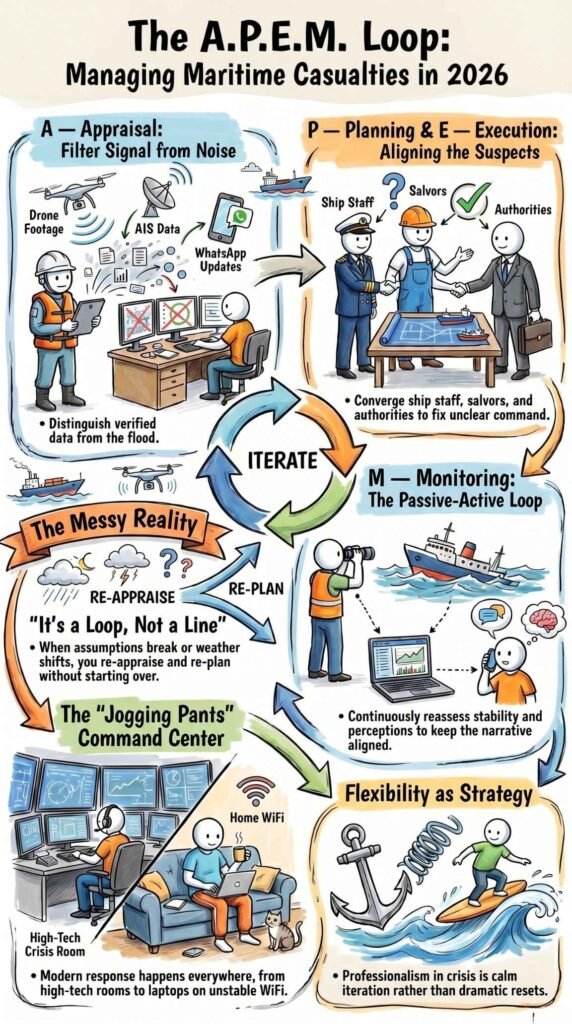
♻️ Bonus round: It’s not linear:
Here’s the part no one puts neatly into a framework diagram.
A.P.E.M. is not a straight line.
It’s a loop.
You appraise, plan, execute—then realise something’s changed.
New data comes in. Weather shifts. Equipment fails. Assumptions break.
So you go back. Re-appraise. Re-plan. Adjust execution. Keep monitoring.
And you do it without announcing, “We’re starting over.”
Because professionalism in casualty management often looks like calm iteration—not dramatic resets.
Modern casualty handling is adaptive. Iterative. Occasionally chaotic.
And yes—sometimes managed in jogging pants with a coffee going cold beside you.
💡 Flexibility isn’t a weakness in crisis response. It’s the entire strategy.
📦 Why A.P.E.M. Still Defines Maritime Casualty Management
Maritime casualty management isn’t getting simpler.
But it is getting smarter—and more transparent.
The A.P.E.M. framework still holds because it was never about tools.
It was about thinking.
Structured thinking.
Under pressure.
With imperfect information.
Whether you’re on deck in full PPE or dialling in from a café with questionable WiFi, the principles remain the same:
- Understand the situation
- Align the response
- Act decisively
- Keep watching, keep adjusting
The tools have evolved. The pace has accelerated. The scrutiny has intensified.
But the core hasn’t changed.
And that’s the quiet strength of A.P.E.M.—
still doing its job, just with better bandwidth and fewer faxes.
📌 What’s your go-to casualty management tip?
Share your wisdom. (Jogging pants optional.)