
Nobody plans an oil spill during bunkering. But port casualty management — the decisions made in the first minutes after a spill — is what investigators, insurers, and port authorities will scrutinise long after the sheen has disappeared. And yet every investigation somehow begins with the same comforting sentence:
“Bunkering was conducted as per procedure.”
Sure it was.
In port — especially in well-regulated ones — the spill itself is only half the story.
The other half is what happens in the first few hours. Because that’s what authorities, insurers, and investigators will replay long after the sheen has disappeared.
Top 5 mistakes crews and operators still make (and why they hurt more than the spill)
1️⃣ Delaying notification (or “Let’s just see how bad it is first”)
Late reporting remains one of the most common—and most damaging—missteps.
Most port authorities and coastal states require immediate notification of any oil entering the water, regardless of quantity. This expectation aligns with international obligations under frameworks like MARPOL Annex I.
Delays rarely improve the situation. They raise questions.
Because from an investigator’s perspective:
Delay = hesitation
Hesitation = possible concealment
💡 A small spill reported early is an incident. The same spill reported late becomes a credibility issue.
2️⃣ Treating the checklist as a formality
Checklists prevent incidents. After an incident, they become evidence. In port casualty management, the checklist is retrospective proof.
Investigators will examine:
- Timing of checklist completion
- Tank soundings and verification records
- Agreed pumping rates and communication logs
- Topping-off procedures and monitoring practices
A rushed or inconsistently completed checklist doesn’t just reflect poor paperwork—it suggests operational shortcuts.
💡 Neat paperwork doesn’t save you. Consistent, time-aligned paperwork does.
3️⃣ Fixating on the slick—and ignoring the source
The visible spill draws attention. The cause determines liability.
Industry data—including loss prevention insights from groups like International Group of P&I Clubs—consistently points to operational failures, not equipment breakdowns, as the primary cause of bunkering spills.
Typical contributors include:
- Inadequate monitoring during transfer
- Over-reliance on high-level alarms
- Miscommunication between vessel and barge
- Improperly maintained venting systems
Cleaning the surface is expected.
Explaining why the system failed is what decides consequences.
💡 Containment shows response. Root cause shows competence.
4️⃣ “Tidying up” the records too quickly
This is where minor incidents become major investigations.
Post-incident, documentation becomes critical:
- Oil Record Book entries
- Bunker logs
- Alarm history
- Digital timestamps (often cross-referenced)
Attempts to “clarify” or retrospectively align records often create inconsistencies that are far more damaging than the initial spill.
Modern investigations rely heavily on data triangulation—bridge logs, engine data, ECDIS timestamps, even CCTV where available.
💡 Ink can be corrected. Digital trails cannot. Record facts—don’t refine them.
5️⃣ Treating human factors as an afterthought
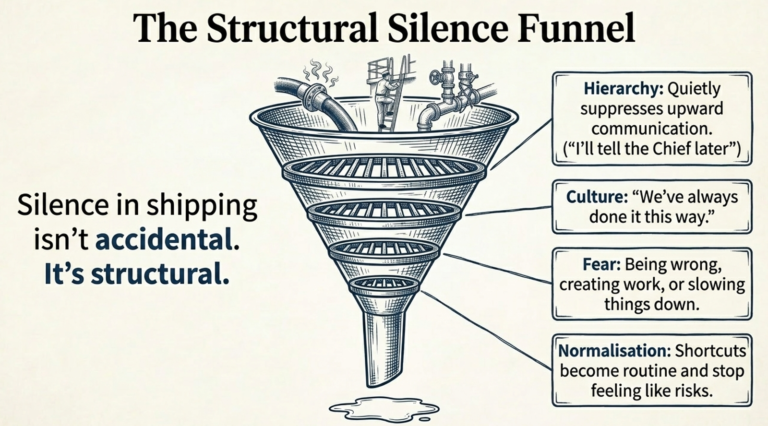
Spills rarely happen because someone chose to ignore procedure.
They happen because conditions made failure more likely.
Common contributing factors:
- Watch handovers during critical operations
- Schedule pressure from port turnaround expectations
- Role ambiguity between vessel and bunker barge
- Familiarity-driven complacency (“we’ve done this before”)
The International Maritime Organization has spent years pushing the importance of the human element—and for good reason.
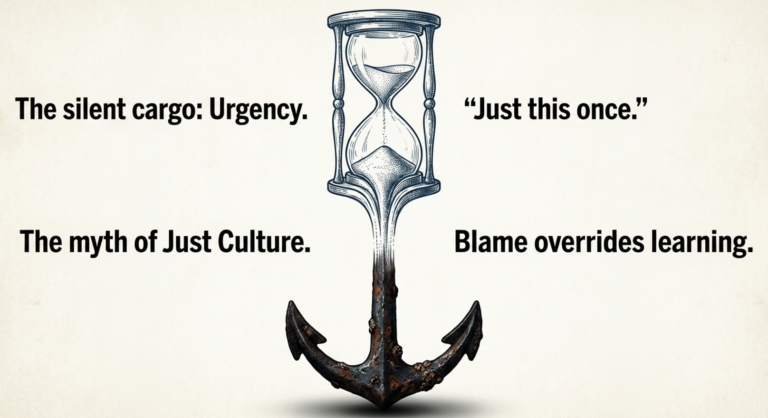
As we explored in urgency quietly bends the rules, shipping doesn’t really have emergencies — it has habits
💡 Human factors aren’t an excuse. They’re usually the root cause.
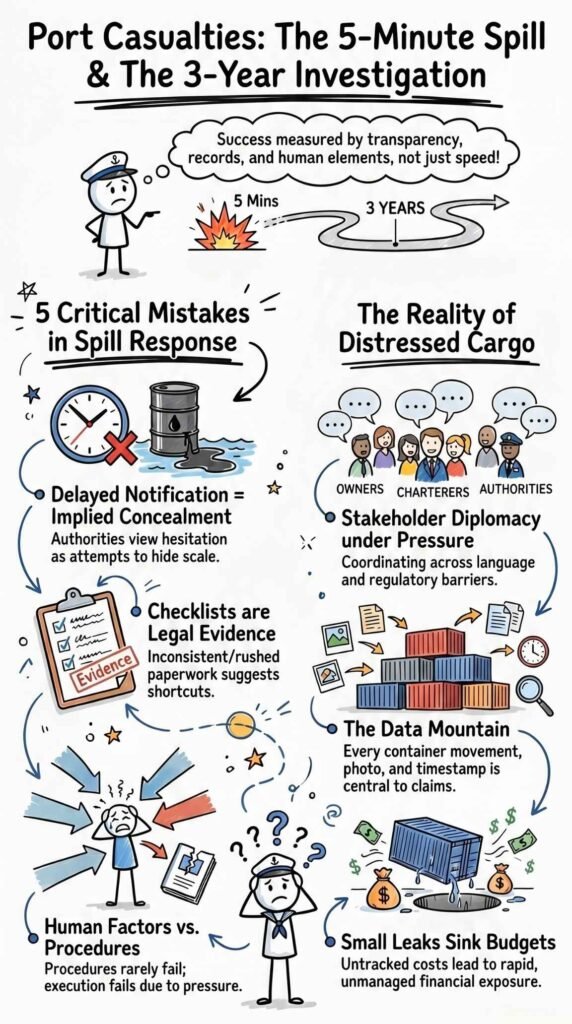
And then there’s distressed cargo—where the real chaos begins
Oil spills are visible, contained, and (relatively) short-lived.
Distressed cargo is where complexity multiplies.
After incidents like fire, flooding, grounding, or power loss, response shifts from containment to coordination—and that’s where things get messy.
This is where port casualty management becomes crisis management.
🔍 1. Cargo risk profiling & hazard assessment
Before a single container is moved, risk must be understood.
BAPLIE files—sometimes covering 20,000+ TEUs—are analysed to identify:
- Dangerous goods
- Temperature-sensitive cargo
- Structurally compromised units
Because one overlooked container can escalate the entire operation.
One spreadsheet. Thousands of variables.
🧭 2. Stakeholder coordination & regulatory engagement
Early alignment with:
- Owners
- Charterers
- P&I Clubs
- Local authorities
…is critical.
In many cases, this involves multi-agency briefings, often across language and regulatory barriers.
Early alignment with P&I Clubs and local authorities is critical — and in a shifting insurance landscape, that relationship is changing
This isn’t just logistics. It’s diplomacy under pressure.
🤝 3. Contractor identification & negotiation
Finding capable local contractors is not guaranteed—especially in remote or high-pressure situations.
Tender processes, capability checks, and negotiations must happen fast—but not blindly.
Small port. Limited options. Unlimited expectations.
🏗 4. Yard setup & site readiness
Cargo handling yards don’t magically exist.
They require:
- Regulatory approval
- Environmental compliance
- Physical setup and segregation planning
Delays here can define the entire timeline.
Sometimes, progress is measured in permits—not containers.
⚙ 5. Operational management on the ground
Once operations begin:
- Cargo is received
- Logged
- Segregated
- Processed
All under time pressure, weather exposure, and regulatory oversight.
Rain or shine—the boxes keep coming.
📊 6. Record-keeping & data management
Every movement must be documented:
- Offloading
- Inspection
- Storage
- Disposal or delivery
Data volume grows rapidly—and becomes central to claims and recovery.
Photos. Reports. Timesheets. Repeat.
🧾 7. Survey coordination & inspection
This is where the “survey” actually happens—but at scale.
Multiple stakeholders, multiple interests, multiple inspections—often dozens per day.
And every decision has financial implications.
♻ 8. Cargo processing
Each unit follows its own path:
- Delivery
- Reconditioning
- Salvage sale
- Disposal
Some are straightforward. Others are… not.
Not all cargo was meant to survive what it went through.
💰 9. Budgeting & cost control
Costs accumulate quietly:
- Handling
- Storage
- Labour
- Disposal
Tracking per container becomes essential to avoid runaway exposure.
Small leaks don’t just sink ships—they sink budgets.
What Good Port Casualty Management Actually Looks Like
Oil spills in port are not judged by:
- How fast you cleaned
- How small the quantity was
They are judged by:
- How quickly you reported
- How controlled your response was
- How aligned your team appeared under pressure
In regulated environments, calm transparency beats reactive efficiency.
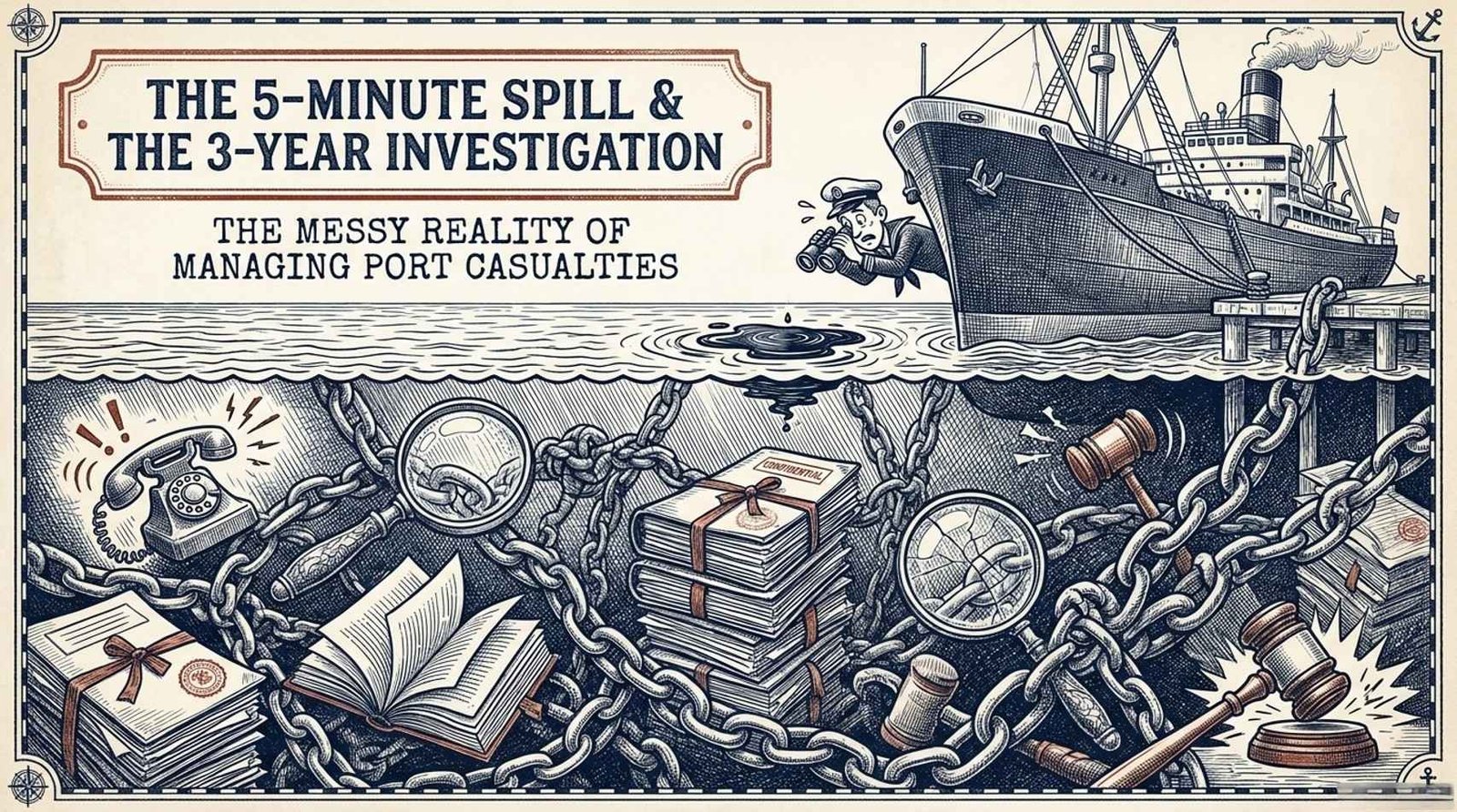
Because the spill may last minutes.
But the investigation lasts years.That is the real weight of port casualty management — it outlives the incident by years.
And it remembers everything.
As for distressed cargo?
It’s never routine. Never predictable. And never just “survey work.”
It’s logistics, crisis response, and stakeholder management—happening all at once.
So the next time someone says:
“Oh… so you just do surveys?”
Just smile.
Calm transparency beats reactive efficiency — and as we noted in The Unicorn of Shipping, the rarest thing in this industry is someone who stays composed when it matters
That’s the real test of port casualty management — not speed, but composure.”
📌 Ever handled a port casualty?
What’s the one decision in the first hour that made—or broke—the outcome?
Related reading: The A.P.E.M. Framework: Managing Maritime Casualties in Jogging Pants
Part of our guide to marine casualty management →