
Remember 2017?
Ballast water regulations hit the shipping world like a wave of confusion, cost, and creative cursing. Everyone was pointing fingers, nobody was sure who had to install what, and the words “approved treatment system” caused more migraines than a week of night watches.
Fast forward to now.
The industry is doing it again — except this time it’s EU ETS shipping compliance driving the chaos. The storm isn’t about invasive species hitching a ride across oceans.
It’s about carbon maths. Fines. Indecision. And a brand new game that everyone’s playing:
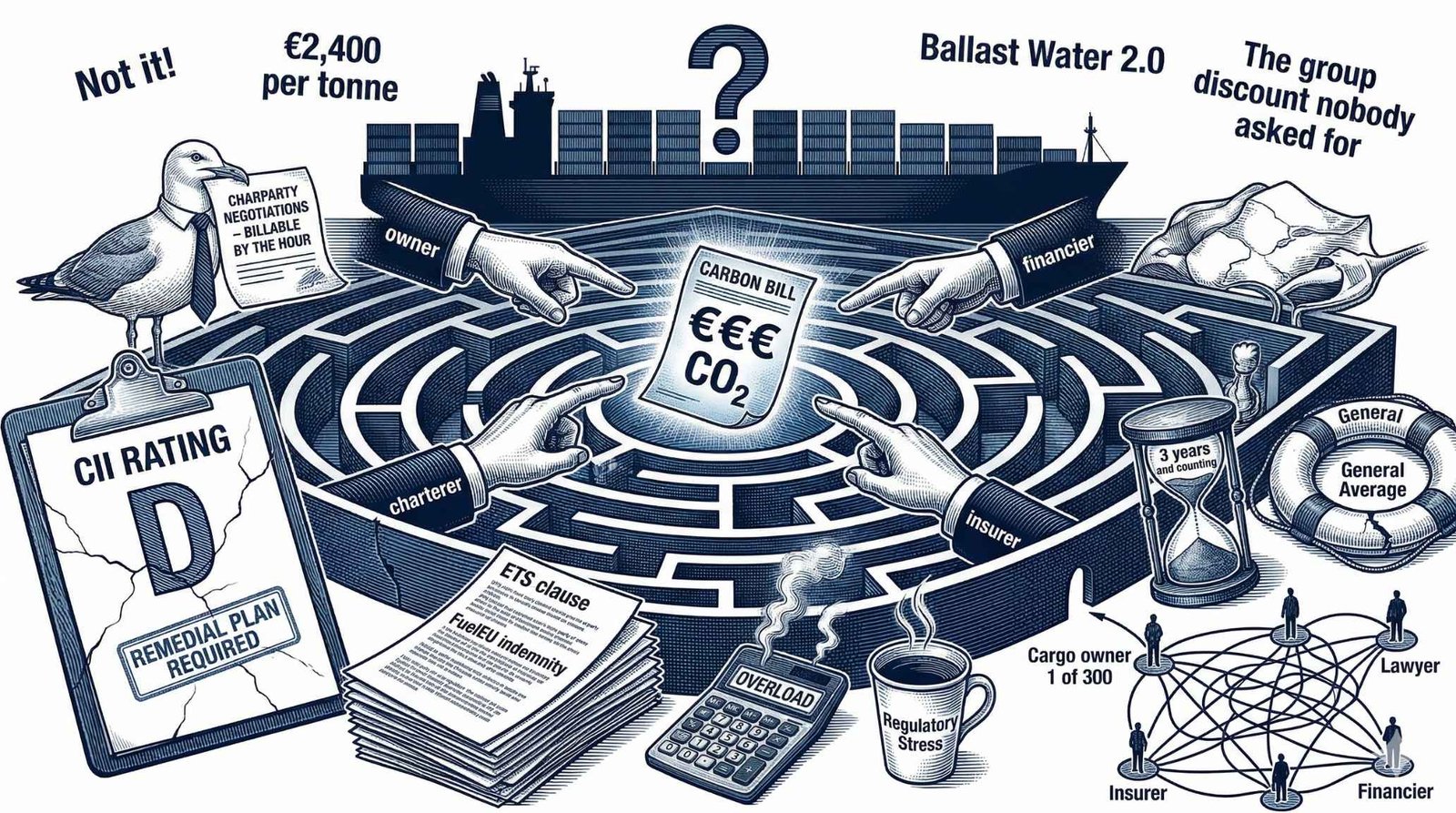
“Not it! Who pays for the damn carbon?”
Welcome to Ballast Water 2.0. Bigger stakes. More lawyers. And no scrubbing system to save you.
The Alphabet Soup of Suffering
Let’s start with the acronyms. Because shipping loves acronyms almost as much as it loves blaming the other guy.
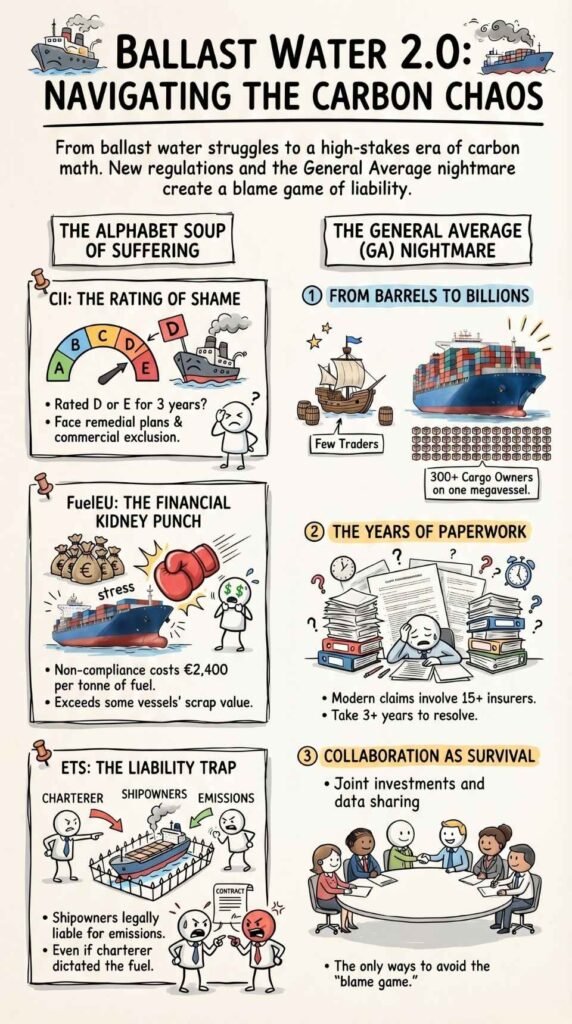
CII. Carbon Intensity Indicator. Rates your ship from A to E. Get a D or E for three years? Say hello to remedial plans and commercial shame.
ETS. Emissions Trading Scheme. Now covers shipping. 100% of emissions for intra‑EU voyages. 50% for cross‑border trips. The bill? Lands on the shipowner’s desk. Even if the charterer burned the fuel.
FuelEU Maritime. The heavyweight. Demands lower greenhouse gas fuel intensity. Fail to comply? €2,400 per tonne fine. Per tonne. That’s not a slap on the wrist. That’s a financial kidney punch.
Suddenly, shipowners, charterers, financiers, and regulators are all starring in everyone’s favourite reality show:
“Pass the Parcel – Carbon Edition.”
And nobody wants to be holding it when the music stops.
That’s EU ETS shipping compliance in a nutshell — three acronyms, one bill, endless finger-pointing.
EU ETS Shipping Compliance: The Finger Pointing Olympics
Here’s the fun part about the EU ETS shipping compliance.
Legal liability sits with the shipowner. Even if the vessel is on time charter. Even if the charterer dictated the speed, the route, and the fuel purchase.
So when the quarterly carbon bill arrives, the owner looks at the charterer. The charterer looks at the sub‑charterer. The sub‑charterer looks at the cargo interest. The cargo interest looks at the consumer.
And somewhere, a lawyer quietly books another yacht.
Clever operators? They’ve already rewritten their charterparty clauses. They’ve added emissions adjustment factors. They’ve built carbon into their freight rates.
The rest? Still arguing about who’s “it.”
Meanwhile, the clock ticks. The deadline passes. And the fine gets bigger.
FuelEU: When Fines Meet Indecision
FuelEU Maritime is the follow‑up act. Less famous. More dangerous.
It doesn’t just ask nicely. It demands that the fuel you burn gets cleaner over time. Not tomorrow. Not next year. Now.
The penalty structure is simple. And brutal.
€2,400 per tonne of non‑compliant fuel. Not per ship. Per tonne.
To put that in perspective: a single vessel burning heavy fuel oil for a year could rack up fines that exceed its scrap value.
Switching to cleaner fuel makes sense. In theory.
In practice? Nobody wants to pay for it.
- Charterers want fuel flexibility. They don’t want to be locked into expensive green fuels when their competitors are burning cheaper options.
- Owners want to avoid penalties. But they also don’t want to invest millions in retrofits that the next charterer might not value.
- Managers just want a strong coffee and a week without a regulatory update that changes everything.
The result? Regulatory stress with a side of spreadsheet migraines.
And everyone secretly hoping for a technological miracle that makes the problem disappear.
(Spoiler: it won’t.)
Split Incentives: Sailing in Circles While the Planet Warms
This is the classic shipping headache. The one nobody has solved since the first coal‑fired steamer.
Who invests? Who benefits?
The owner pays for the retrofit. The dual‑fuel engine. The shore power connection. The energy efficiency measures.
The charterer reaps the fuel savings. Lower consumption. Better CII rating. Commercial advantage.
So why would the owner invest?
Why would the charterer pay more for a greener ship if the market doesn’t reward them?
Nobody wants to be first. Everyone wants to be second. Preferably third.
So the industry moves in circles. Waiting for a carbon price that actually bites. Or a regulatory mandate that leaves no room for interpretation. Or a miracle.
Whichever comes first.
The ship vs. shore tension isn’t new — it just gets more expensive every year
This is where EU ETS shipping compliance gets philosophically annoying — everyone wants the benefit, nobody wants the invoice.
Collaboration as Survival (Because Blame Games Get Old)
Some players are learning the lesson that ballast water taught us:
Finger‑pointing is fun. For a while. But it doesn’t fix the problem.
Collaborative strategies are emerging. Slowly. Like a tanker with a tailwind.
- Joint investment in energy efficiency measures, shared between owner and charterer.
- Fuel hubs where multiple players pool resources to make green fuels available.
- Data sharing to optimise routes, speeds, and consumption across fleets.
Take Odfjell. They tied fuel performance metrics to charterer incentives. Better efficiency meant lower costs for everyone. Suddenly, the charterer wanted the vessel to go slower. The owner didn’t have to fight for it.
Finally. A bit of sanity in a sea of carbon chaos.
Odfjell’s approach shows what EU ETS shipping compliance could look like when incentives are actually aligned.
Ballast Water 2.0 – Now With Exponential Headaches
Ballast water compliance once melted margins. Introduced new liabilities. Forced owners to install expensive equipment that sometimes didn’t work.
Carbon compliance is doing the same. But worse.
- Fleet deployment now depends on carbon rules, not just commercial demand.
- Voyage planning includes emissions calculations alongside weather and fuel.
- Charterparty clauses have grown longer than the phone book.
- Fuel sourcing requires certificates, guarantees, and a small team of analysts.
- Carbon accounts need tracking, auditing, and reconciling.
And spoiler alert: you can’t scrub carbon like ballast water.
There’s no filter you bolt onto the funnel. No treatment system you switch on when entering a control zone. No bypass option when the equipment fails.
Carbon is going into the atmosphere. Every tonne. Every mile. Every voyage.
And someone has to pay.
Unlike ballast water, EU ETS shipping compliance has no bypass switch — the carbon still goes into the atmosphere.
General Average: The Group Discount Nobody Asked For
Now let’s talk about the other financial headache hiding in the fog.
General Average.
The ancient maritime principle where, if cargo is sacrificed to save the ship and remaining cargo, everyone chips in to cover the loss.
Simple. In theory.
In practice? Welcome to the 21st century.
Once upon a time, GA meant throwing a few barrels overboard and splitting the bill with a handful of traders. Weeks. Done.
Now? Try 300 cargo owners. 15 insurers. 6 financiers. 4 law firms. And 3 years of paperwork.
The age of the mega‑vessel changed everything.
When the Ever Given blocked the Suez Canal, it didn’t just delay traffic. It reminded the world that GA on a 20,000+ TEU ship is a logistical and financial nightmare.
One fire on a boxship. One grounding in a narrow channel.
Suddenly, billions of dollars in cargo are tied up. Insurers are debating exclusions. Financiers are discovering their “secured goods” are entangled in 18th‑century maritime law. Charterers are reading their contracts and realising the fine print wasn’t written in English—it was written in invisible ink.
GA has gone from:
- “A few barrels lost overboard” → “Tens of millions in electronics, machinery, and raw materials”
- “Resolve it in weeks” → “Good luck finishing this before your next grey hair”
- “A handful of stakeholders” → “A wedding where every distant cousin insists on bringing a plus‑one”
Bigger ships. Bigger stakes. Bigger headaches.
And if you think P&I clubs have it easy, think again
Digital Tools (In PowerPoint, At Least)
The good news? Technology could make GA efficient.
We have blockchain‑based cargo registries. Data analytics to instantly value shipments. Digital claims platforms that promise to shave months off the process.
The bad news? The industry still loves its faxes. Wet signatures. Couriered stamped forms. The warm comfort of doing things the way they’ve always been done.
Progress is optional. And shipping usually chooses “optional” over “urgent.”
So while the tools exist to resolve GA claims in weeks, most cases still crawl along at the speed of a harbour tug with engine trouble.
Why embrace digital efficiency when you can preserve the noble tradition of drowning in paperwork?
We’ve written about this before — the digital delusion in shipping runs deep
The Bottom Line (Because Someone Has to Say It)
Green compliance isn’t just another regulation.
It’s Ballast Water 2.0.
Technical. Painful. Expensive. And eventually, normalised.
The finger‑pointing might be entertaining for a while. But it won’t calm the storm. It won’t pay the fines. It won’t make the carbon disappear.
Collaboration. Clever incentives. A little forward thinking.
That might just keep the ship afloat, Because EU ETS shipping compliance isn’t going away — and neither are the fines.
And General Average?
It remains the only time in maritime commerce where losing cargo feels like a group discount.