
Why Both Generations Are Just Navigating the Same Tide
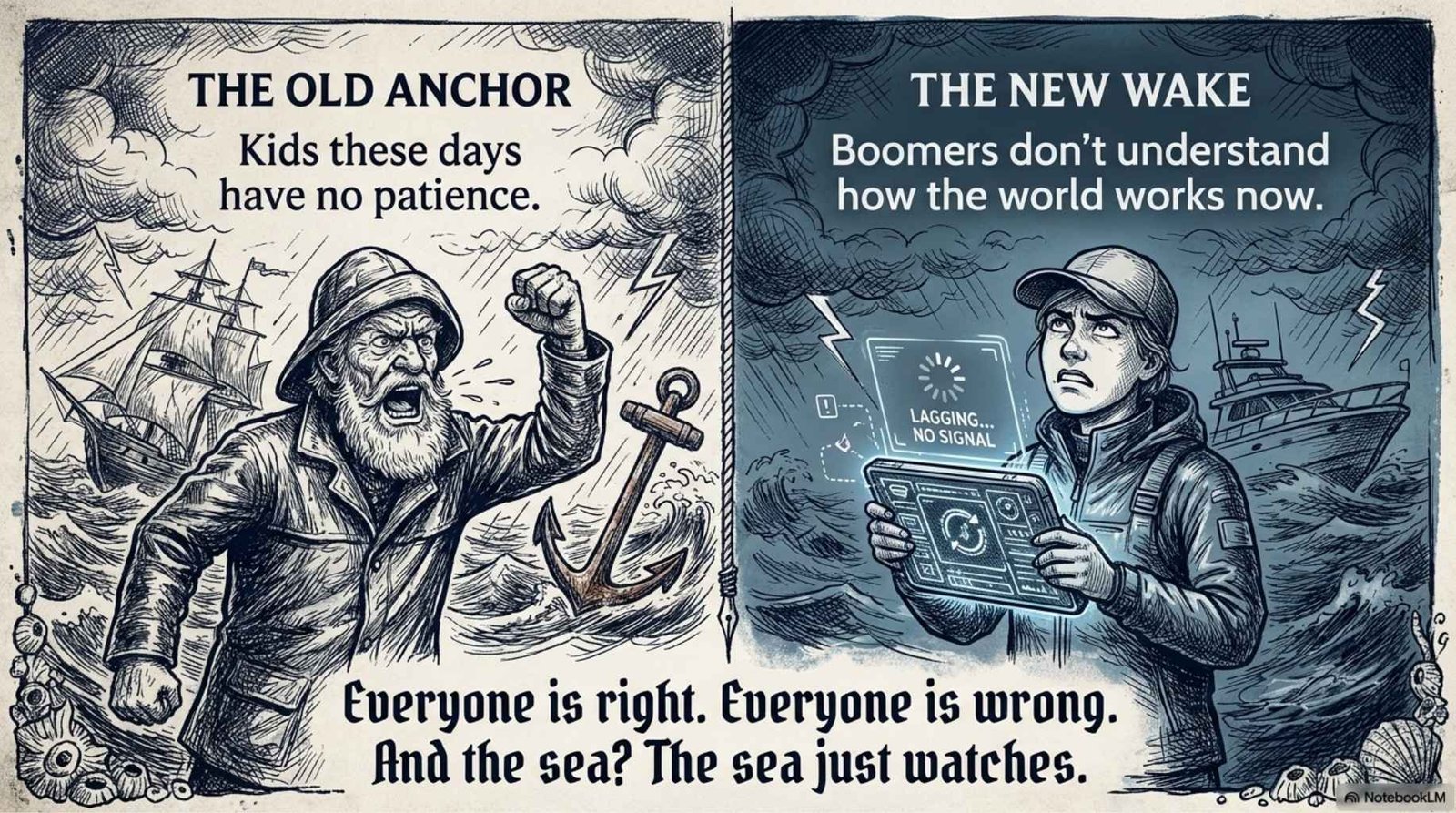
We hear it all the time. “Kids these days have no patience.” And then, almost on cue, the counter current: “Boomers don’t understand how the world works now.”
The generation gap, it seems, is everyone’s favourite argument — and no one’s favourite mirror. Everyone is right. Everyone is wrong. And the sea?
The sea just watches — because it has seen this argument before, long before hashtags and hindsight.
Let’s drop anchor and look at the tide that keeps pulling us apart — and maybe, just maybe, find the current that brings us back together.
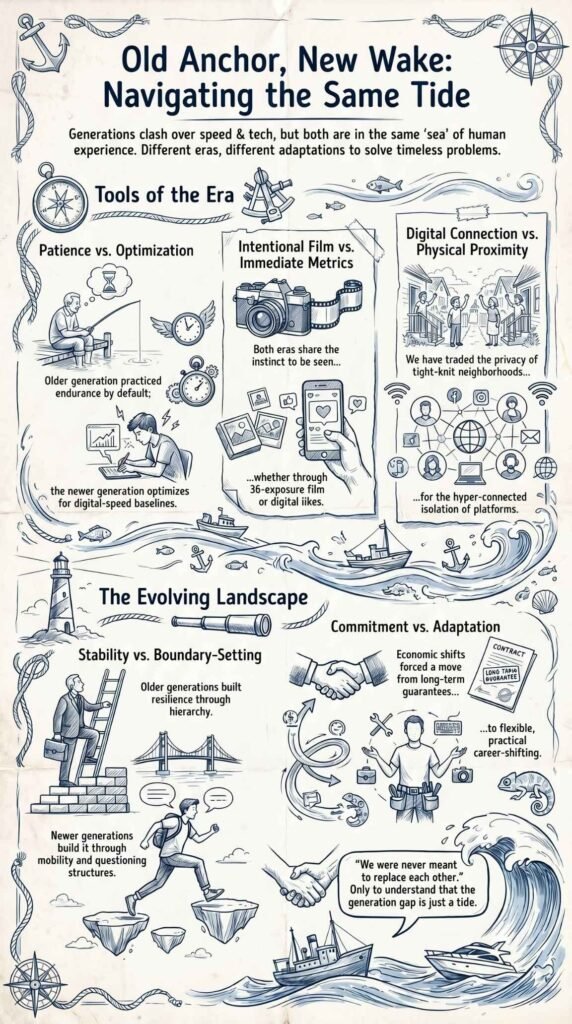
⏳ Patience vs. ASAP – The Speed of Light vs. The Speed of Salt
The new generation grew up in a world of high-speed internet, instant messaging, same-day delivery, and answers before the question is fully typed. Expectations adjusted accordingly. Speed is no longer a luxury — it’s the baseline. When systems lag, frustration isn’t entitlement; it’s a mismatch between design and expectation.
The older generation grew up differently. Waiting wasn’t optional — it was embedded into daily life. Letters took days, sometimes weeks. Photos required development. Meals took time. Patience wasn’t preached — it was practiced by default.
Who’s wrong? No one. The sea doesn’t accelerate because you have 5G. But neither does it reward waiting for the sake of waiting. The tide moves on its own clock.
Reflection: Patience is not about time — it’s about acceptance of what cannot be rushed. Efficiency is not impatience — it’s adaptation. The new generation optimises. The old generation endures. Both are forms of intelligence. Both are necessary.
The generation gap in patience isn’t about laziness or weakness — it’s about which world shaped you
📸 Document Everything vs. The Roll of Film
The new generation documents life constantly — meals, moments, milestones. Platforms like Instagram and TikTok have turned memory into something immediate, shareable, and measurable. Visibility has become a form of validation.
The older generation operated under constraints. Film rolls had limits — 24 or 36 exposures. Each shot had intent. And the result was uncertain until much later.
But beneath both behaviours sits the same human instinct: to be seen, to be remembered, to matter.
The old generation asked: What will people say?
The new generation asks: What will people think?
Different tools. Same question.
Reflection: The sea doesn’t document itself — but it remembers everything. The issue is not the act of capturing moments, but becoming captive to perception. Social pressure once came from society. Now it comes from metrics. Both can be heavy. Both can be put down.
🧍 Alone in a Crowded Room – The Shared Isolation
Perhaps nowhere is the generation gap felt more quietly than in how we experience loneliness.
The older generation lived within tighter social ecosystems — families, neighbourhoods, communities. Privacy was limited, but so was isolation. You were rarely unseen.
The new generation lives in a paradox. Hyperconnected digitally, yet often disconnected physically. You can have hundreds of contacts and still hesitate to call one person at 3 AM.
This isn’t weakness — it’s structural. Social interaction has shifted from proximity to platforms.
Reflection: The sea is never truly empty — even in its depths, there is life. But it also doesn’t perform. It doesn’t signal for attention. Perhaps the lesson is balance: connection without performance, presence without pressure.
We’ve written about this quiet disconnection before — the kind that seafarers and shore staff carry differently but equally. Read: Who Supports the Supporter? Loneliness, Rental Families & Real Blood
⛓️ The Theory of the Slave – Office Culture Edition
There’s an uncomfortable pattern across generations: people often recreate the systems they once endured.
In workplaces, this shows up clearly. The overworked manager normalises overwork. The micromanager multiplies controls. Those shaped by rigid hierarchies sometimes replicate them — not out of malice, but familiarity.
Because freedom requires new thinking. And that’s harder than repeating what already exists.
The newer generation, in contrast, is more willing to disengage. They switch roles, question structures, and reject environments that don’t align with their expectations. This isn’t always impatience — often, it’s boundary-setting.
Reflection: The problem isn’t hierarchy — it’s unexamined repetition. Endurance built resilience in older systems. Mobility is building resilience in newer ones. The ideal sits somewhere in between.
The cost of this unexamined endurance shows up long before retirement. We’ve tracked it in the stories that don’t make reports — Seafarer Burnout: Conversations Ashore
🎭 The Persona Trap – Same Ocean, Different Boats
“I am not what I think I am. I am not what you think I am. I am what I think you think I am.”
This isn’t generational — it’s human.
The older generation performed within social frameworks — stability, reputation, expectations shaped by family and community.
The new generation performs within digital frameworks — aesthetics, narratives, curated identity.
The medium changed. The performance didn’t.
Reflection: The sea has no persona. It doesn’t adjust its waves based on observers. The question is no longer who are you, but who are you when no one is watching — or liking. Authenticity is harder than performance, in any generation.
🧠 New Gen More Practical? – Let’s Check the Logbook
The newer generation is often described as “practical.” They rent instead of buy, shift careers instead of staying, and diversify identity instead of committing early.
This isn’t happening in a vacuum. Economic structures have changed — housing affordability, job stability, and long-term guarantees are fundamentally different from previous decades.
The older generation interprets this as lack of commitment. The newer generation sees it as adaptation to uncertainty.
Both perspectives are rooted in their realities.
Reflection: Adaptability without direction becomes drift. Stability without flexibility becomes stagnation. The sea does both — it moves, and it anchors. That’s the balance.
The Generation Gap Isn’t a Problem to Solve — It’s a Tide to Navigate
So we sit here, the water cold around our ankles, watching the waves. One recedes. Another arrives. Not in conflict — but in continuity.
The older generation brings patience, resilience, and depth built over time.
The newer generation brings speed, questioning, and the willingness to walk away from what doesn’t work.
Both are responding to the world they were given.
Both are shaped by constraints the other didn’t face.
And beneath it all, the fears remain unchanged:
To be forgotten.
To be judged.
To be alone.
The sea doesn’t forget. It doesn’t judge. It holds.
Here’s to the old anchor that kept us steady.
Here’s to the new wake that keeps us moving.
And here’s to the uncomfortable truth — we were never meant to replace each other. Only to understand each other.
Because the generation gap?
It’s just a tide.
These same fears run through every generation — and they show up differently in family, at sea, and at home. We explored one version of it in The Parental Audit — worth reading alongside this one.