
SEAFARER BURNOUT STORIES
There are days when the sea is calm, and we think we understand her. Then there are days when she throws something unexpected at our feet—a piece of driftwood, a broken shell, a message in a bottle we didn’t know we needed.
The past few weeks have been like that. Life, in its peculiar way, has been leaving things on our shore. Reminders. Wake‑up calls. Gentle and not‑so‑gentle nudges to remember what it means to be human.
We’ve been collecting them. Here’s what we found, somewhere between the Eastern Channel and the Cove of Unspoken Things.
1. The Gentle Reminder — Aboard the North‑Bound Train
It happened on the MRT, somewhere between the city and the suburbs. A specially abled gentleman approached one of us. At first it was difficult to understand him—his voice was faint, and he trembled quite a bit, likely due to a neurological condition. But his English was clear, and more importantly, his intent was unmistakable: he simply wanted someone to talk to.
He wished us a Happy Father’s Day, and after we returned the greeting, he asked where we were from. We tried to keep the conversation going—not the easiest thing on a crowded train—but he was determined. And we were happy to listen.
He mentioned having served in the armed forces in Singapore and having travelled across Southeast Asia. One line stayed with us, and we suspect it will for a long time:
“You’re as good as dead when you have no one to talk to.”
We’re paraphrasing from memory, but the sentiment was crystal clear.
At one point, he asked if we felt embarrassed or uncomfortable talking to him. That hit hard. Because in that question was a deeper truth: many people like him face subtle forms of exclusion every day—not out of cruelty, but simply because we don’t know how to respond.
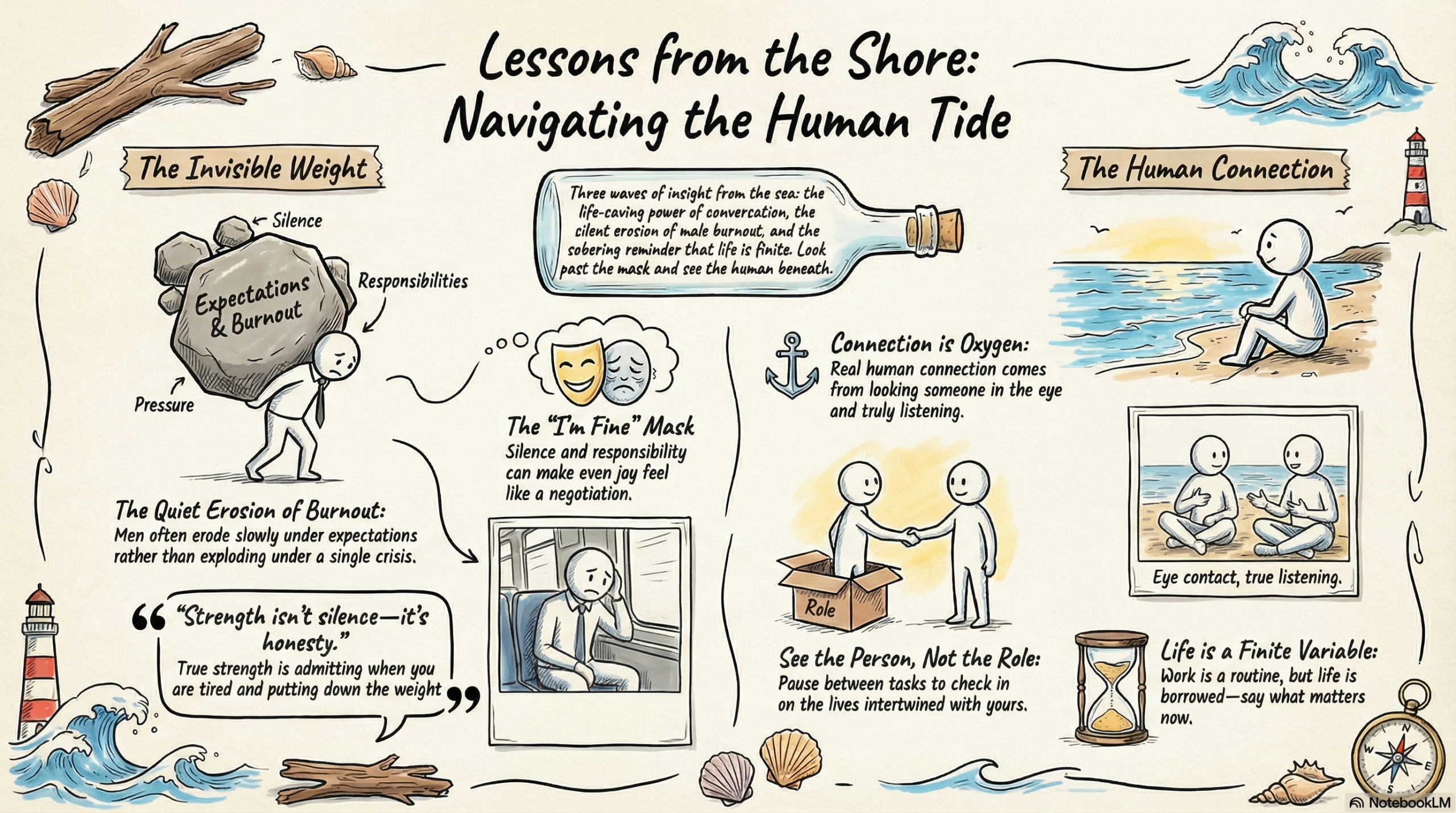
We’re more connected than ever. Social media, WhatsApp groups, endless notifications. Yet we’ve forgotten how vital real human connection is. The kind that comes from looking someone in the eye and listening—really listening.
This brief interaction reminded us that you don’t need to be a therapist or expert to make a difference. Sometimes, just being present and open is enough.
So here’s a small request from a crew that almost missed the point: if someone—anyone—reaches out to talk, especially someone who might be different or struggling, please don’t turn away. You might be the only person who listens that day. And that can mean everything.
Bring empathy back. Choose kindness. Choose connection.
The sea doesn’t choose which waves to welcome. Neither should we.
2. The Quiet Burn — The Pier at 3 AM
You can’t always see it—but it’s there.
Behind the jokes, the work calls, the “I’m fine.” Behind the WhatsApp ticks turning blue, behind the beer after a long week, behind the nod that says “I’ve got this.”
There’s a kind of burnout that builds quietly in men.
Not from one bad week. Not from a single crisis. But from years of carrying too much and feeling like putting it down would make them weak.
He doesn’t explode. He erodes. Piece by piece—under the weight of expectations, responsibility, and silence.
And because society still applauds the “strong, steady one,” he keeps going. Until one day, even joy feels like effort. Even getting out of bed feels like a negotiation.
We came across a message recently—shared around on social apps, author unknown. It captures this perfectly, and it’s been sitting in our collective mind like a pebble we can’t stop turning over in our palm.
It said something like this:
“The strongest men are often the ones quietly burning out. They don’t ask for help because they’ve been taught not to. They don’t complain because they think no one’s listening. But they are there. In your office. In your friend circle. In your mirror.”
We’re paraphrasing, but you get the point.
If this hits close to home—for you, your brother, your partner, your colleague—maybe check in. Not with a “How are you?” that expects a “Fine.” But with a “We’re here. You don’t have to carry it alone.”
Sometimes, the strongest thing a man can do is admit he’s tired.
The sea doesn’t hide its storms. Why should we?
3. The Wake‑Up Call — At the Straits of Remembrance
Life has a way of reminding us of its fragility.
A few days ago, we were made aware that a trusted peer in the industry—someone we had collaborated with regularly—had passed away during an incident while at work.
The news struck deeply, as we were not far from the location when it happened. It’s one of those moments that stop you mid‑stride. Suddenly, what felt like routine work doesn’t feel so routine anymore.
In our line of work, risk is something we assess, quantify, and report. We fill out forms, attend briefings, follow protocols. But this… this is a different kind of risk. The human one. The reality that every day we step into uncertainty, often without realising how close it lives beside us.
This loss has been a quiet wake‑up call. A reminder that:
- Our work matters—not because it’s perfect, but because it’s finite.
- The people behind the reports and plans give meaning to it all.
- We may manage contingencies, but life remains the ultimate variable.
We’ll carry on as usual—but with a little more awareness. To pause between tasks. To check in with a colleague. To listen more than we speak.
Because in our world, risk isn’t only about systems or operations—it’s about the people behind them, and the lives intertwined with ours.
Here’s to valuing both: the work, and those who make it worth doing.
Reflections from the Shore — Where the Tide Turns
So we gather here again, the water cold around our ankles, and we think about these three encounters. Three waves, each different, each leaving something behind.
The first taught us that connection isn’t a luxury—it’s oxygen.
The second taught us that strength isn’t silence—it’s honesty.
The third taught us that tomorrow isn’t guaranteed—it’s borrowed.
We spend so much time building personas, managing expectations, scrolling through lives that aren’t ours, that we forget to look up. To see the person on the train. To hear what isn’t being said. To hold what we have before it slips away.
Say the thing. Not tomorrow. Not when you have time. Now.
See the person. Not the role. Not the mask. The human behind it.
Hold what matters. Work will always be there. Deadlines will always multiply. But the people? They’re here, and then they’re not.
*So here’s to the strangers who remind us we’re human. *
Here’s to the quiet ones carrying more than they show.
Here’s to the colleagues who become more than colleagues—who become the reason the work means something.
And here’s to the sea, which keeps coming back, wave after wave, reminding us that time moves whether we’re paying attention or not.
Pay attention….
The tide is waiting.
— The Sarcastic Mariner(s)
Somewhere between the North‑Bound Train and the Straits of Remembrance
Related reading: The Quiet Defiance of Staying Afloat