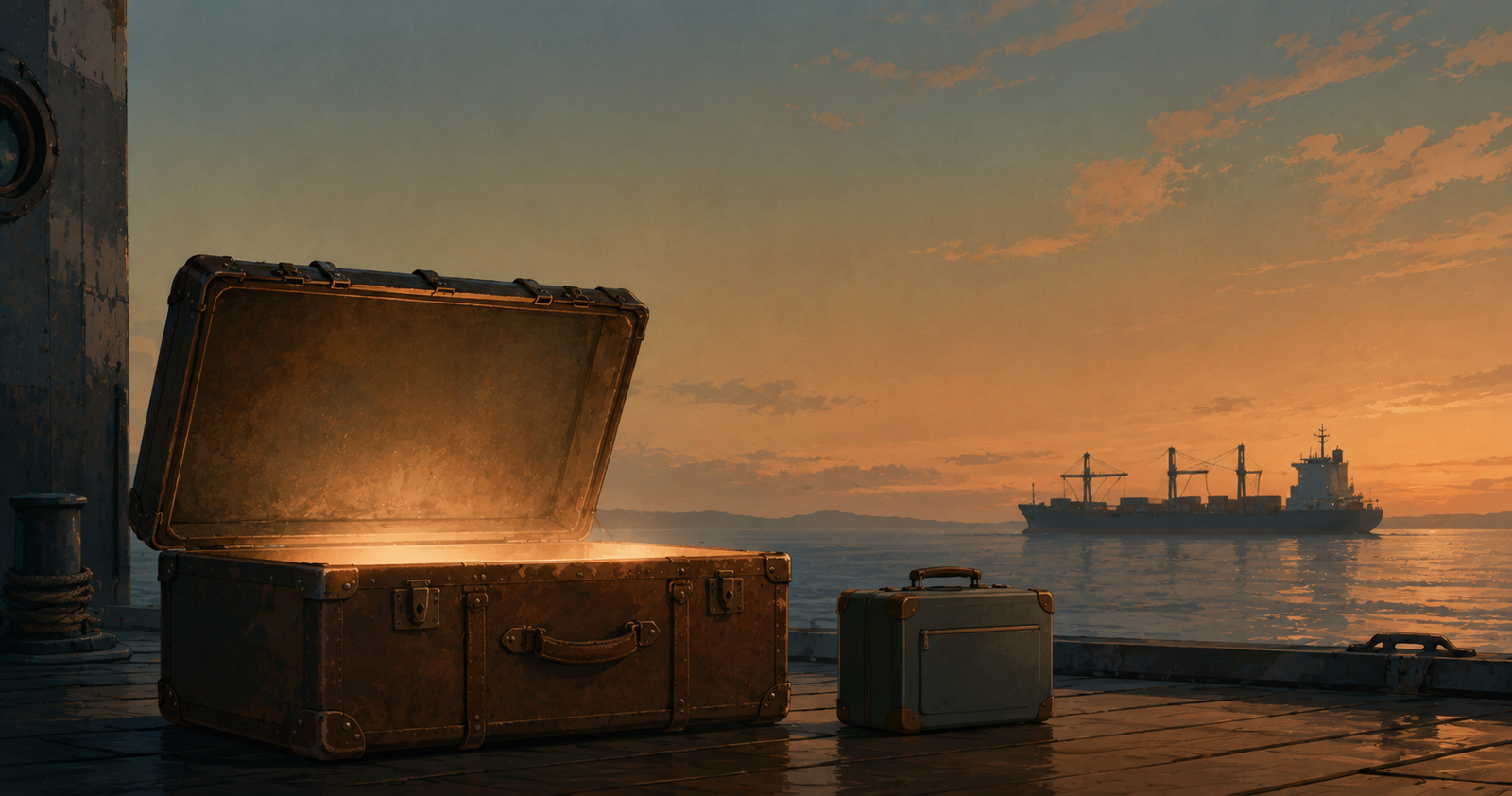

The baggage we carry starts small. We have a theory. Every person is born with an invisible suitcase.
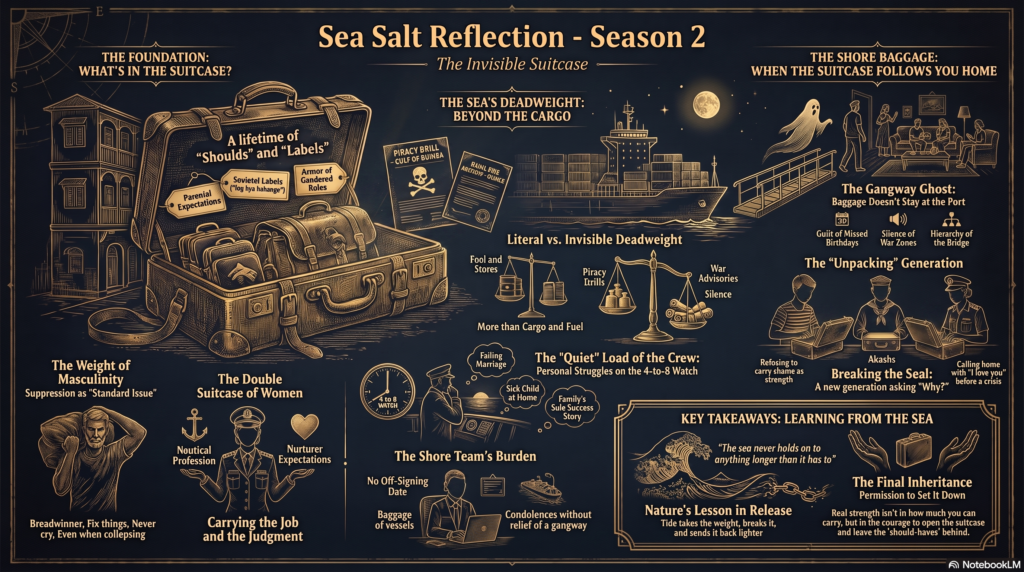
At first it’s empty—light enough to kick across the floor. Then the world starts filling it. Expectations from parents. Labels from teachers. The weight of “log kya kahenge.” The armour of masculinity. The quiet negotiations of femininity. The trauma of wars we didn’t start. The sweat of piracy we didn’t ask for.
We spoke about this before—the suitcase full of personalities we picked up along the way. Turns out, that wasn’t the only thing we packed.
Some of us carry that suitcase for a lifetime. Others learn to unpack it.
This volume is about baggage. The kind you check in at the airport, and the kind that checks into your soul. It’s about men and women, old rules and new cracks, and the sea—which never holds on to anything longer than it has to.
🧳 Part I: The baggage we carry – Gender, Generations, and the Weight of “Should”
The Old Suitcase – Men
A generation ago, a man’s suitcase was simple. Be the breadwinner. Don’t cry. Fix things. Provide.
If you couldn’t, you were less than. If you tried to open the suitcase and take something out—say, the need for tenderness—the world would laugh.
Therapy was optional. Suppression was standard issue.
We’ve carried that suitcase up gangways, down corridors, into engine rooms that smelled of diesel and quiet resignation. We’ve seen men in their fifties collapse under the weight of “I’m fine,” because no one told them the suitcase has zippers on both sides.
The Old Suitcase – Women
For women, the suitcase was different—but no lighter. Be the nurturer. Don’t be too loud. Don’t be too quiet. Manage the home, the children, the in-laws—and if you must have a career, carry it lightly. Don’t let it show that you’re tired.
And if you did everything right, the reward was simple: more responsibility.
The sea didn’t welcome women when we started sailing. Some decks still don’t.
We’ve seen female officers carry two suitcases—one for the job, one for the judgment. Both heavy. Neither optional.
The New Generation – Lighter, but Not Empty
The kids today—and we say this with the affectionate sarcasm of old uncles—are doing something different.
They’re opening the suitcase.
A young deck cadet told us, “Why should I be the only one providing? She can earn too.”
A female third officer laughed when we asked about marriage pressure. “I’ll get married when I find someone who doesn’t need my suitcase to be smaller than his.”
The world is shifting. Not fast. Not without resistance. But the newer generation is finally asking:
Do I have to carry all this?
And for the first time in a long time, the answer is starting to sound like:
No.
🌊 Part II: The Sea’s Baggage – Pirates, Wars, and the Cargo We Didn’t Choose
Literal Baggage – The Ship
A ship’s baggage has a proper name—deadweight tonnage. Very official. Very measurable. Cargo, fuel, stores, crew. Everything that makes the vessel heavy enough to matter.
Unlike the rest of what we carry.
Then there’s the baggage that doesn’t appear on any stability calculation.
Piracy.
The transit past Somalia. The Gulf of Guinea. Extra lookouts. Citadel drills. That quiet understanding that a radar blip might not just be another vessel.
It shows up in your sleep before it shows up on your radar.
And then, war.
Missiles near choke points. Naval advisories. Rerouted passages that stretch voyages and nerves. Briefings that sound calm on paper and feel very different at sea.
We don’t discuss it over dinner. But it sits there anyway. In the captain’s pause before departure. In the way the news gets checked more often than the weather.
Emotional Baggage – The Crew
A ship’s crew carries a different kind of deadweight.
The AB whose marriage is quietly ending between port calls.
The engineer refreshing his phone for updates on a sick child.
The cook who hasn’t been home long enough to notice his parents getting older.
The cadet carrying a sentence: “Don’t come back unless you make something of yourself.”
There’s no formula for this. No conversion table. No checklist.
What we have is chai.
Shared silence on the 4-to-8 watch.
The understanding that everyone on board is carrying something—and the only real kindness is not adding to it.
🏠 Part III: Shore Baggage – The Baggage We Leave Behind (And the One Waiting for Us)
Ashore
When we sign off, we imagine leaving the suitcase at the gangway.
It follows us anyway.
The guilt of missed birthdays.
The quiet resentment of a partner who managed alone.
The realisation that your children have grown—but not with you.
Piracy comes home as interrupted sleep.
War comes home as silence.
Hierarchy comes home to the living room—and we wonder why no one salutes.
For the Shore Team
And then there are the ones who never sail—but carry just as much.
The superintendent holding together vessels, budgets, and expectations.
The crewing manager writing condolence emails and then calling the next candidate.
The HR officer listening to stories that don’t belong in office hours—but show up anyway.
Different uniform. Same baggage allowance. No off-signing date.
Their load doesn’t show. But it stays.
🔄 Part IV: Unpacking – What the New Generation Is Teaching Us
The younger sailors—the Akashs of the world—aren’t afraid to open the suitcase.
They ask questions we were trained not to ask.
They challenge roles we were told to accept.
They refuse to carry shame disguised as strength.
They call their fathers and say “I love you”—without waiting for a crisis.
They’re not perfect. Their baggage just looks different.
Social media anxiety. The pressure to always be visible. The quiet fear of missing out on a life that mostly exists on screens.
But they’re unpacking.
Slowly. Messily. Honestly.
Maybe that’s the real inheritance—not the cargo, not the routes, but the permission to leave some weight behind.
🌊 Reflections from the Shore – The Suitcase That Never Quite Closes
We stand at the railing, the water cold around our ankles.
The ship is loaded.
The crew is on board.
Piracy drills are checked.
War briefings are filed.
And in the corners of cabins, the old suitcases sit—bulging with decades of “should have” and “if only.”
But here’s the thing.
The sea doesn’t carry baggage the way we do.
It takes it, breaks it, and sends it back lighter.
The wave comes, takes the weight, and retreats.
The tide doesn’t ask about your past.
The storm doesn’t care about your title.
Maybe that’s what we’re learning.
That the only baggage we truly need is the knot we tie when we’re eight.
The rest?
We can set it down. One item at a time.
The new generation is right.
The old generation is not wrong.
The difference is… one is still unpacking.
Here’s to the pirates we’ve faced.
The wars we’ve sailed through.
The expectations we’ve carried.
And the day we finally look at the suitcase and say:
Not today.
— The Sarcastic Mariner(s)
Somewhere between a dowry negotiation and a pirate skiff
If this made you pause, question, or smirk — you’ve been reading Sea, Salt & Reflections.
Start from the beginning →
Related reading: Season 2 Episode 3 – The Great Isolation · Season 2 Episode 1 -The Big Bang and the Tiny Boat