
How COVID Changed the Shore, the Ship, and the Silence Between Us
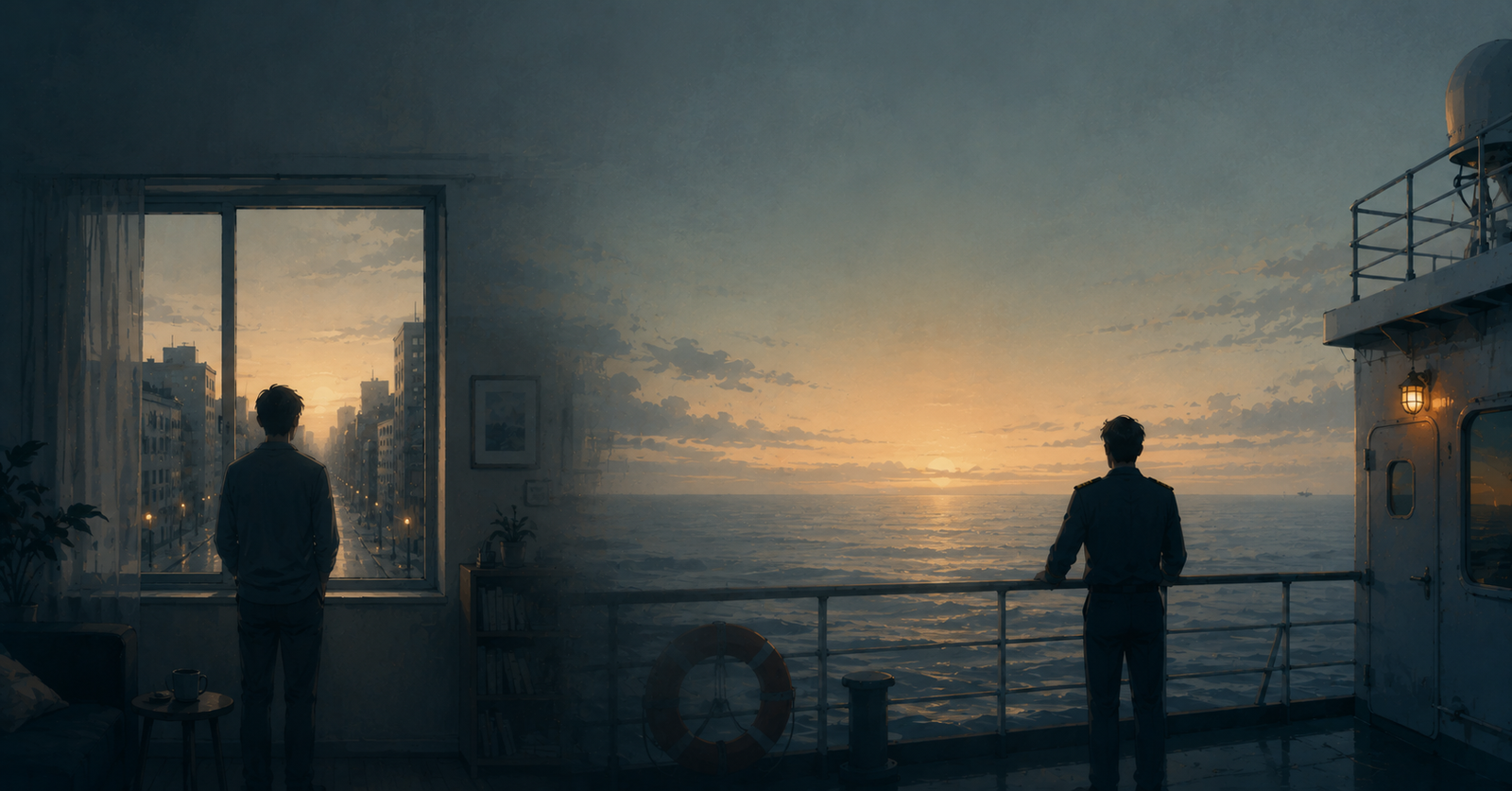
This is the story of the Great Isolation — the one that started long before COVID, and the one COVID forced the rest of the world to finally feel. There are moments in history that divide life into two parts.
Not just because of the virus. Not because of the masks, the lockdowns, or the endless sanitiser stations that appeared like small altars outside every supermarket.
But because, for the first time in generations, the entire world experienced isolation at the same time.
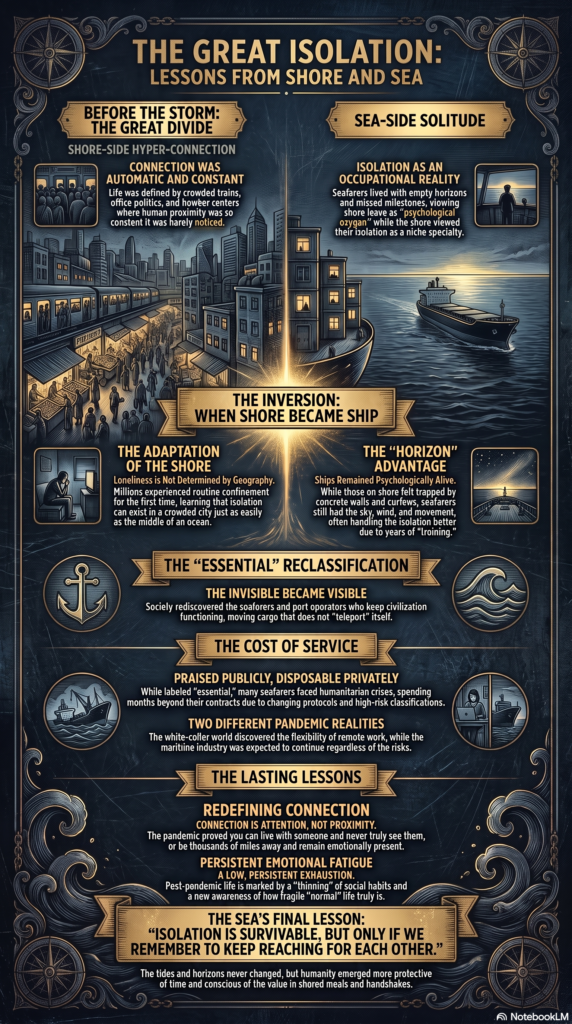
Before the pandemic, the shore represented connection. Crowded trains. Office politics. Coffee shops full of noise and unfinished conversations. Human proximity was so constant we barely noticed it.
The ship was different. The ship was distance. Long watches. Empty horizons. Birthdays missed by oceans and time zones. Seafarers knew solitude long before the world learned the word “lockdown.”
Then COVID arrived.
And suddenly the shore understood.
Apartments became cabins. Zoom calls became watchkeeping. Days blurred together. People discovered that loneliness could exist even with perfect Wi-Fi and grocery delivery.
Meanwhile, ships kept moving.
Not normally. Not easily. But moving.
This volume is not about the pandemic itself. Enough has already been written about infection curves, restrictions, and press conferences.
This is about what remained afterwards.
The silence.
The fatigue.
The strange inversion where the world ashore briefly resembled life at sea.
And the uncomfortable truth that isolation was never really a maritime problem.
It was always a human one.
🏠 Part I: Before the Pandemic – The World We Thought Was Permanent
Before COVID, most people complained about being too busy.
Traffic. Meetings. Crowded calendars. Endless notifications. The exhaustion of modern life.
Connection was automatic. You didn’t have to plan human interaction. It simply happened around you. Elevators. Offices. Hawker centres. Family gatherings you secretly wanted to avoid until they disappeared completely.
On ships, the complaints were different.
The repetition. The distance. The same faces every day. The strange feeling of watching life happen elsewhere while your own existed on pause between ports.
Shore leave wasn’t luxury. It was psychological oxygen.
Back then, many ashore viewed seafarer isolation as something niche. Occupational. Temporary.
Then the world shut down.
And suddenly everyone understood what routine confinement does to the human mind.
🦠 Part II: The Great Isolation When the Shore Became the Ship
The strangest thing about lockdowns was not the silence.
It was how quickly humans adapted to it.
Dining tables became offices. Bedrooms became classrooms. Relationships became compressed into square footage and bandwidth.
People learned new phrases:
“Muted.”
“You’re frozen.”
“Can everyone hear me?”
Entire lives moved onto screens.
And for the first time, millions experienced something seafarers already knew well:
Loneliness is not determined by geography.
You can feel isolated in the middle of a city just as easily as in the middle of an ocean.
But there was one important difference.
On shore, many people felt physically trapped. Concrete walls. Recycled air. Curfews. Endless repetition.
At sea, even during COVID restrictions, there was still horizon.
Sky. Wind. Movement. Open deck at 2 AM with nothing but engine vibration and stars overhead.
The sea remained psychologically alive in a way many cities suddenly were not.
Ironically, the people long associated with isolation sometimes handled it better than those experiencing it for the first time.
Not because seafarers are stronger.
Because they had already spent years learning how to survive distance.
😷 Part III: Essential Workers and the Great Reclassification
One of the strangest outcomes of COVID was the sudden rediscovery of who keeps civilisation functioning.
During the pandemic, society created a new category:
“Essential workers.”
Doctors. Nurses. Truck drivers. Supermarket staff. Delivery riders. Port operators. Seafarers.
People whose jobs could not be performed from a laptop in sweatpants.
For a brief moment, the invisible became visible.
The world remembered that ships still needed crews. Food still needed transport. Fuel still needed movement. Containers did not teleport themselves across oceans because someone scheduled a video meeting about supply chains.
There was pride in that recognition.
But there was also resentment quietly buried underneath it.
Because many essential workers were praised publicly while feeling disposable privately.
Crew changes became humanitarian crises. Seafarers spent months beyond contracts. Some workers were applauded one day and forgotten the next.
Meanwhile, another divide emerged.
The white-collar world discovered remote work flexibility. Maritime and frontline industries discovered they were expected to continue regardless.
Same pandemic.
Different realities.
💔 Part IV: The Loneliness That Stayed Behind
The lockdowns ended.
But some things never fully returned.
The pandemic normalised isolation in ways we still don’t fully discuss.
People became more hesitant socially. Friendships weakened quietly through distance and habit. Offices reopened, but many conversations never truly resumed where they left off.
And beneath it all sat exhaustion.
Not dramatic exhaustion. Not cinematic collapse.
Just a low, persistent emotional fatigue carried by millions who learned how fragile normal life really was.
On ships, the feeling was different but familiar.
Crews lived through repeated restrictions, uncertainty, cancelled leave, changing protocols, and the psychological weight of being constantly classified as “high risk.”
Yet maritime life also exposed something important:
Humans can adapt to difficult conditions surprisingly well — if they still have meaning, structure, and each other.
The real danger was never simply isolation.
It was isolation without connection.
Without purpose.
Without horizon.
🌊 Part V: What the Sea Quietly Taught Us
The sea did not solve loneliness.
But it did teach something the shore had forgotten.
Space matters. Air matters. Silence matters.
Not every moment needs noise. Not every empty moment needs filling.
Many people emerged from the pandemic with a different relationship toward time, work, and presence.
Calls became more intentional. Families spoke more honestly. Some relationships deepened. Others quietly dissolved under pressure that had existed long before lockdowns exposed it.
And perhaps the greatest lesson was this:
Connection is not proximity.
It is attention.
You can live with someone and never truly see them.
You can stand thousands of miles away and still remain emotionally present.
The sea had been teaching that lesson to seafarers for generations.
The world ashore simply joined the class temporarily.
🧭 Reflections from the Shore – After the Storm
So we stand here again, water cold around our ankles, thinking about what changed.
The masks are mostly gone now.
The quarantine hotels are memories.
The temperature scanners disappeared almost overnight.
But something shifted permanently beneath the surface.
The world became more digital. More remote. More efficient.
And somehow, at the same time, more emotionally tired.
We learned that modern life was far more fragile than we imagined.
We learned that essential workers were essential long before the headlines discovered them.
We learned that isolation could exist anywhere — in studio apartments, crowded cities, family homes, or on the bridge of a vessel crossing an empty sea at midnight.
And maybe we learned something else too.
That human beings are more resilient than we give ourselves credit for.
Not unbreakable.
Not fearless.
Just capable of continuing.
The sea never changed during COVID.
The tides kept arriving. The horizon stayed where it always was.
But we changed.
We became more aware of distance. More protective of time. More conscious that ordinary moments — shared meals, open borders, handshakes, crowded laughter — were never ordinary at all.
Here’s to the ones who sailed through it.
Here’s to the ones who stayed ashore and held everything together.
Here’s to the workers who kept the world moving while most of it stopped.
And here’s to the sea, which quietly watched humanity rediscover something sailors already knew:
Isolation is survivable.
But only if we remember to keep reaching for each other.
— The Sarcastic Mariner(s)
Somewhere between the final lockdown and the first real reunion
If this made you pause, question, or smirk — you’ve been reading Sea, Salt & Reflections.
Start from the beginning →
Related reading: Season 2 Episode 2 -The Baggage We Carry · Season 2 Episode 1 -The Big Bang and the Tiny Boat