
Dr. Kumud R. Jha · Singapore · Doctorate in AI · US Patent Holder View LinkedIn Profile
The Real Numbers Behind AI Carbon Footprint
AI carbon footprint is the part of this conversation we talk about least — in the most literal, physical sense.
Every time you run a large language model query, something happens in the physical world. Electricity flows. Cooling systems run. Water evaporates. In a data centre somewhere — Virginia, Singapore, Dublin, Osaka — racks of specialised hardware consume power at a scale that would have been unimaginable a decade ago.
The intelligence feels weightless. The infrastructure is anything but.
Here are the numbers that should be in the conversation.
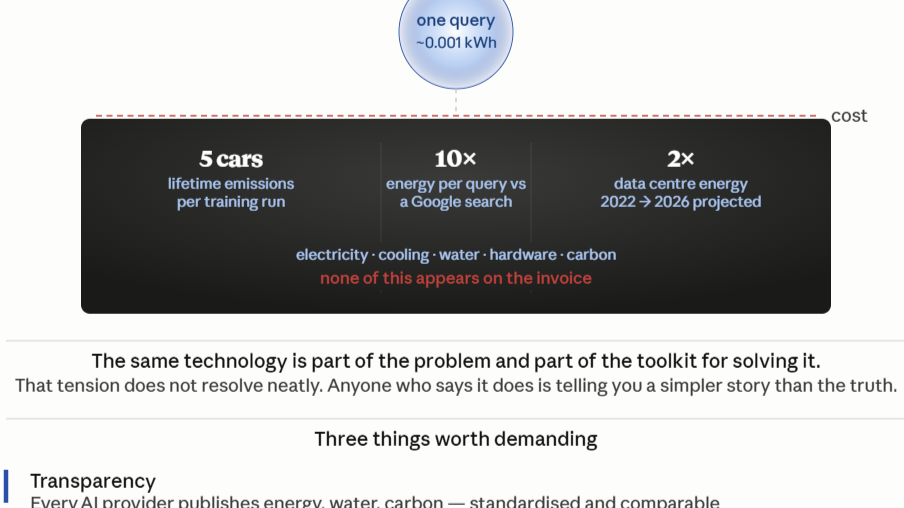
Training a single large AI model produces roughly the equivalent carbon emissions of five average cars over their entire lifetimes. That is one training run — before a single user has asked a single question.
The International Energy Agency estimated that data centres consumed around 460 terawatt-hours of electricity globally in 2022. By 2026 that figure is projected to more than double — driven substantially by AI workloads. To put that in context: that is roughly equivalent to the entire electricity consumption of Japan.
A single ChatGPT query uses approximately ten times the energy of a Google search. Multiply that by hundreds of millions of queries per day.
Microsoft’s water consumption — used primarily to cool data centres — increased by 34 percent between 2021 and 2022. The year GPT-4 was trained.
These numbers are not an argument against AI. They are an argument for honesty about the full carbon footprint of the technology we are deploying at scale.
The Complexity Nobody Wants to Sit With
Here is where it gets genuinely difficult. Because AI is simultaneously one of the most energy-hungry technologies ever deployed — and one of the most promising tools for addressing the very climate crisis its energy consumption is contributing to.
AI is optimising power grids in real time — reducing waste, balancing renewable intermittency, cutting transmission losses. AI is accelerating materials discovery for next-generation batteries and solar cells — compressing decade-long research cycles into years. AI is modelling climate systems at resolutions that were computationally impossible five years ago, giving climate scientists tools they have never had.
The technology that is part of the problem is also, genuinely, part of the toolkit for solving it. That tension does not resolve neatly. And anyone who tells you it does — in either direction — is selling you a simpler story than the truth.
What Responsible AI Development Looks Like on This Dimension
The leading AI labs are making commitments on renewable energy — Microsoft, Google, and Amazon have all announced significant clean energy procurement. The question is whether the commitments keep pace with the growth. So far, in most cases, they are not.
The efficiency story is more encouraging. The energy cost per unit of AI computation has been falling rapidly — models are getting dramatically more capable per watt as research matures. The trajectory is in the right direction.
But efficiency gains historically get consumed by scale. More efficient models mean cheaper inference — which means more queries — which means more total energy consumed. The rebound effect is real and it is happening now.
Three things worth demanding, if we are serious about AI carbon footprint:
Transparency first. Every major AI provider should publish energy consumption, water usage, and carbon footprint per model — in a standardised, comparable format. None currently do this comprehensively.
Locationally matched renewables. Procurement of renewable energy certificates that match actual consumption by hour and location — not annual averages that allow dirty grid power to run the data centres.
Efficiency as a first-class metric. Model leaderboards currently rank on capability. Adding energy efficiency as a ranked dimension would change what the field optimises for.
As we covered in Day 23, who AI serves is never just a technical question — it’s a design choice. The same is true of AI carbon footprint: it belongs on the invoice, not buried in a sustainability report nobody reads.