
Why We Stopped Seeing Each Other
An old article resurfaced in our feed recently. A New York Times piece from the early 2000s. The headline landed like a dull anchor in fog:
“Died at His Desk, Unnoticed for Five Days.”
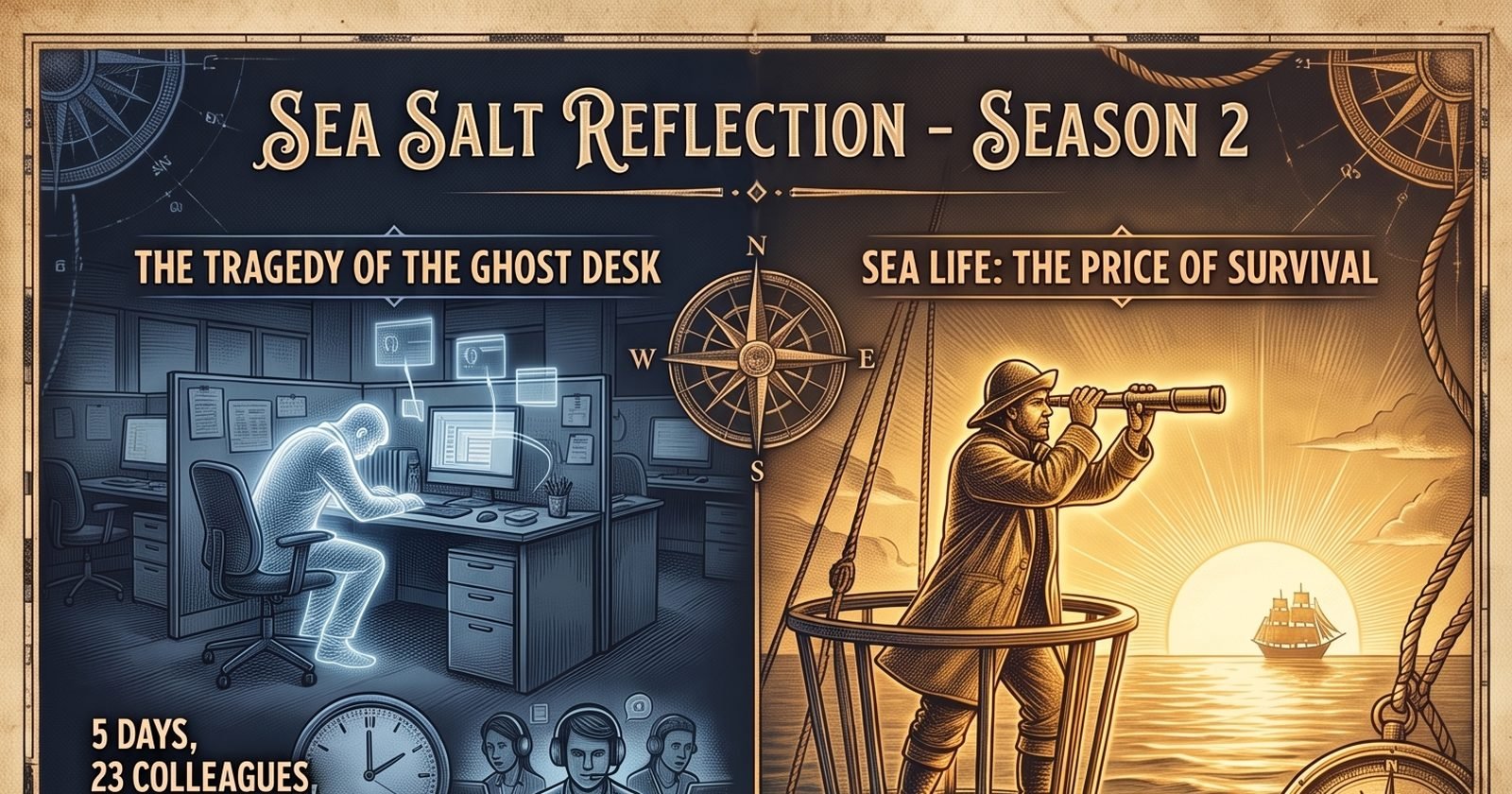
The details are sparse now – as they should be, for privacy. But the core remains: a man in an open-plan office, surrounded by colleagues, collapsed on a Monday. No one checked on him. No one noticed he had stopped moving. A cleaner found him on Saturday.
Twenty-three people. Five days. A whole workweek.
We read it twice. Then we sat in silence, cold water lapping at our ankles, thinking about masks, loneliness, and the strange way modern life allows people to disappear quietly while standing in plain sight.
At sea, silence is information. The crewman who suddenly skips chai. The officer who stops joking on watch. The steward eating alone three nights in a row. People notice. Not because sailors are saints – because isolation at sea can turn dangerous very quickly.
Shore life forgot that somewhere along the way.
👥 Part I: The Open-Plan Ghost Ship
Offices were designed to bring people together. No walls. No cubicles. Just rows of desks like oars on a galley. The theory was collaboration. The reality was headphones, calendar invites, and the quiet erosion of human attention.
That old article revealed something darker.
You can be surrounded by people and still become invisible. Not because people are cruel. Because they stopped looking.
Back in Season One, we talked about being alone in a crowded room. The old generation feared “log kya kahenge” (what will people say). The new generation fears “log kya like karenge” (what will people like). Same fear. Different mask.
But that desk revealed the final stage of modern isolation: when nobody is looking at all.
The office was never perfect. Neither is a ship’s mess room. Someone always steals the good biscuits. Someone talks too loudly before coffee. But proximity forces recognition. You notice when a chair stays empty too long.
Ships learned this lesson centuries ago. Shared meals. Rotations. Watch systems. Muster checks. Not because humans are naturally attentive – because people drift when left alone too long.
The sea is dangerous precisely because indifference is fatal.
🧑🎓 Part II: The COVID Graduate – Learning Everything Except How to Belong
We know a young man. Let’s call him a friend’s son. He came to Singapore from Mumbai for university during COVID.
What was supposed to be four years of lecture halls, canteen tables, accidental friendships, and late-night conversations became four years inside a rented room with a laptop and a muted microphone.
He graduated without ever really knowing his classmates.
No shared meals.
No group-study chaos.
No random “bro, you free later?” conversations that slowly become lifelong friendships.
Just usernames. Screens. Digital presence without physical memory.
Now, two years into a respectable job in Singapore, he asked us a question that stopped us cold:
“How do people actually make friends?”
Not where.
Not which app.
Not networking advice.
He meant the mechanics of it.
How do you walk up to another human being and begin? How do you ask someone for coffee without sounding awkward? How do you build trust without hiding behind a screen?
He said something else that stayed with us:
“Everyone already seems busy with their own life. I don’t know how to enter it.”
Two years in a city of millions.
A degree.
A stable job.
Hundreds of digital connections.
And nobody he could call at 3 AM.
At sea, we sometimes joke that ships force friendships the way storms force prayer. You eat together. Stand watch together. Survive rough weather together. Even silence becomes shared company.
On shore, people can live ten floors apart and remain strangers for years.
That young man isn’t unusual anymore. He’s simply one of the first generations taught how to connect digitally before learning how to connect physically.
He’s what happens when an entire generation is told to stay home, then told to go build relationships without ever being shown how.
📉 Part III: The Great Un-Bonding
The pandemic didn’t create loneliness. It accelerated a drift already underway.
The handshake retired.
The chai break became a Zoom link.
The canteen table became a mute button.
For a while, it even felt efficient.
No commute.
No awkward office politics.
No forced small talk.
But something important quietly disappeared: informal human surveillance. The tiny social rituals where people unconsciously check if each other are okay.
A vessel depends on this instinct. Not formal procedures alone. Informal noticing.
The engineer who looks exhausted.
The cadet unusually quiet during dinner.
The captain lingering too long alone on the bridge wing after watch.
Ships survive because people keep watch long before emergencies begin.
Shore life outsourced that role to notifications and status indicators.
Now we see names in Teams meetings instead of faces. We type “I’m fine” and hit send. We’ve become the lookout who never looks up.
The man in that office died in a room full of people.
Today, many risk something quieter: living in cities of millions while emotionally unmoored from everyone around them.
🎮 Part IV: The Kids Aren’t Alright – Closed Doors & Open Servers
We see the same drift in younger kids too.
Crucial years of playground arguments, birthday parties, awkward introductions, and accidental friendships were replaced by lockdowns, screens, and online classrooms.
Now many are comfortable only within tiny familiar circles. Same school friends. Same Discord server. Same WhatsApp group.
Not because they dislike people.
Because they lost the social muscle.
The simple childhood sentence:
“Hey, can I play too?”
…now feels strangely difficult.
So they go online instead.
Gaming servers.
TikTok comments.
Anonymous group chats.
And to be fair, real friendships absolutely form there. We shouldn’t dismiss that.
But the digital sea has predators too.
Fake profiles.
Scams.
Manipulation dressed as friendship.
“Free rewards” that empty bank accounts faster than rough weather empties unsecured containers.
This generation grew up with screens, not strangers. They know privacy settings better than street instincts.
We don’t blame them for that.
The old safeguards disappeared quietly:
The overheard conversation.
The neighbour who noticed something was wrong.
The shoulder tap saying:
“Careful, something feels off here.”
At sea, even the youngest cadet eventually learns a hard truth:
Not every light on the horizon is friendly.
🚢 Part V: The Ship Still Has a Lookout
Let’s not romanticise ships too much. The sea can be brutally lonely too. Some vessels carry silence heavier than cargo.
But ships force acknowledgement.
You cannot quietly disappear for five days aboard a vessel. Someone knocks. Someone notices. The system depends on it.
The cabin is small.
The mess is shared.
The watch is a contract:
I’ve got your back. You’ve got mine.
No one sends a reaction emoji to a mayday.
On shore, we built invisible bulkheads instead. The open-plan office became isolated screens. The neighbourhood became a swipe. The family dinner became background noise beneath notifications.
We are more connected than ever – and more alone.
That old office story wasn’t just a tragedy. It was a forecast.
And the young graduate in Singapore – the one wondering how to make friends – he isn’t a cautionary tale either.
He’s a mirror.
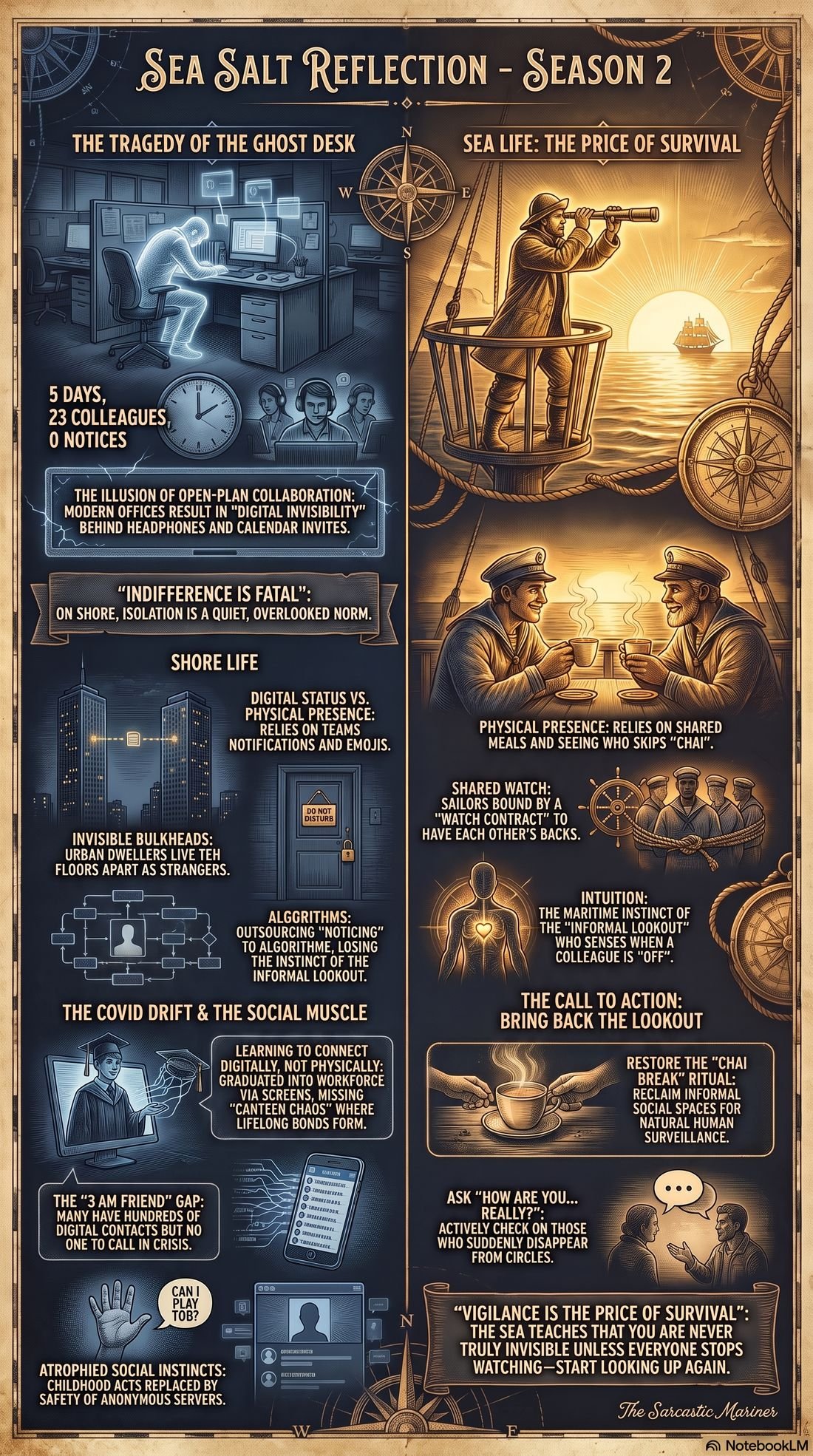
🌊 Reflections from the Shore – Bring Back the Lookout
So we sit here again, water cold around our ankles, thinking about the cleaner who finally opened the door. About the twenty-three people who walked past. About the young man scrolling through his phone wondering why “Want to grab coffee?” feels harder than a job interview.
We are not here to shame anyone.
We are here to remind ourselves of something the sea figured out long ago:
People drift when nobody is watching.
The sea has a lookout on every watch. One pair of eyes always scanning the horizon. Not because the ocean is evil. Because vigilance is the price of survival.
Somewhere along the way, shore life abandoned the lookout.
We replaced presence with availability.
Conversation with reaction emojis.
Community with algorithms.
And now we ask why people feel alone.
This is not nostalgia for 2019. That tide has already turned.
But maybe it is a call to notice again.
To ask the quiet colleague:
“How are you… really?”
To teach children that friendship is not measured by followers.
To check on the person who suddenly disappears from the group chat.
To knock on the metaphorical cabin door.
That anonymous office worker died alone among twenty-three people.
And somewhere in Singapore, a young professional with a degree, a stable job, and an empty contact list is still wondering how human connection became this difficult.
Let that be the story we refuse to repeat.
Here’s to the chai break.
Here’s to the hand on the shoulder.
Here’s to the lookout who still looks up.
And here’s to the sea, which refuses to let us forget:
You are never truly invisible… unless everyone stops watching.
— The Sarcastic Mariner(s)
Somewhere between a closed-door dorm and a midnight bridge watch
If this made you pause, question, or smirk — you’ve been reading Sea, Salt & Reflections.
Start from the beginning →
The novel behind this series: I See U →