
Stirring the Pot: We Wrote a Series. It’s Still Not Finished.
We at The Sarcastic Mariner have done something arguably worse: we started writing fiction.
Not because we were bored.
Because the industry needed a problem it could not file away.
This series—The Last Watch—is not a finished masterpiece. It is a work in progress.
More than a year of discussions, arguments, retrospection, and uncomfortable realisations have gone into it so far. More will follow.
We are not entirely sure we are proud of it.
We are very sure it was necessary.
We Read Everything. And Then Watched It Happen Again.
We read the incident reports. All of them.
The ones with names.
The ones without.
The ones that recommend, gently and politely, that perhaps something could be done differently next time.
We attended the seminars.
“Lessons learned,” delivered in air-conditioned rooms where everyone silently agrees we will forget them by Tuesday.
We saw the posters.
The circulars.
The loss prevention bulletins nobody reads beyond the executive summary.
The machinery works. The knowledge exists.
And every year, without fail, the same things happen:
Enclosed space deaths
Falls from height
Lifeboat drill fatalities
Collisions built on fatigue and quiet optimism
At some point, you stop asking what we don’t know.
And start asking why what we do know changes so little.
The Gap Is Not Information. It Never Was.
We spent a long time staring at it.
The gap between:
What the industry knows
And what actually happens onboard
It is not an information gap.
It is a human one.
Habit.
Time pressure.
Fatigue.
Familiarity.
The quiet voice that says, this is the same as last time—and last time was fine.
Reports cannot compete with that voice.
Procedures cannot override it consistently.
But a story might.
Why Fiction (Yes, We Asked Ourselves Too)
We could have written another safety guide.
Another booklet. Another video with a sombre soundtrack.
They are useful.
They are also easy to ignore.
Fiction is harder to ignore.
You cannot skim a novel the way you skim a risk assessment.
You cannot detach from a character the way you detach from a statistic.
A story forces you to stay.
To sit with someone who:
Has your job
Your pressures
Your habits
And then watch what happens when one small variable changes.
Stories do not tell you what to do.
They show you what happens when what you always do stops working.
If you feel it, you remember it.
If you remember it, you might act differently.
That is the theory.
We are still testing it.
What We Kept Seeing
Across decades of incidents, different ships, different crews, different flags—the details always changed.
The pattern did not.
Someone doing their job.
In conditions slightly worse than usual.
Using habits that worked yesterday.
Until they didn’t.
The gap between “normal” and “fatal” was often measured in seconds.
Reports document that gap.
They do not let you stand inside it.
That is what we tried to write.
Not the summary.
The moment.
What the bridge looked like at 0400.
What the engineer was thinking when the alarm sounded.
What nobody said out loud.
It is not pleasant work.
It is also the only way we found to make the problem feel real enough to matter.
This Is Still Ongoing (Because the Problem Is)
This is not a completed series handed down from a mountaintop.
It is evolving.
Every discussion, every case study, every uncomfortable conversation adds something. Changes something. Forces a rewrite somewhere.
Because the problem itself is not static.
If anything, that is the point:
There is no final version of safety.
There is only continuous correction.
The books reflect that. Or at least, they try to.
Stirring the Pot (Because It Keeps Boiling Over Anyway)
The Sarcastic Mariner has never been polite about safety.
We have pointed out:
That compliance is often mistaken for understanding
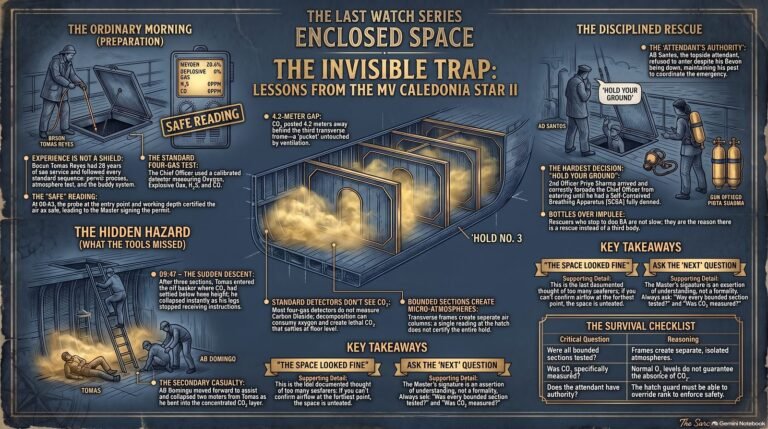
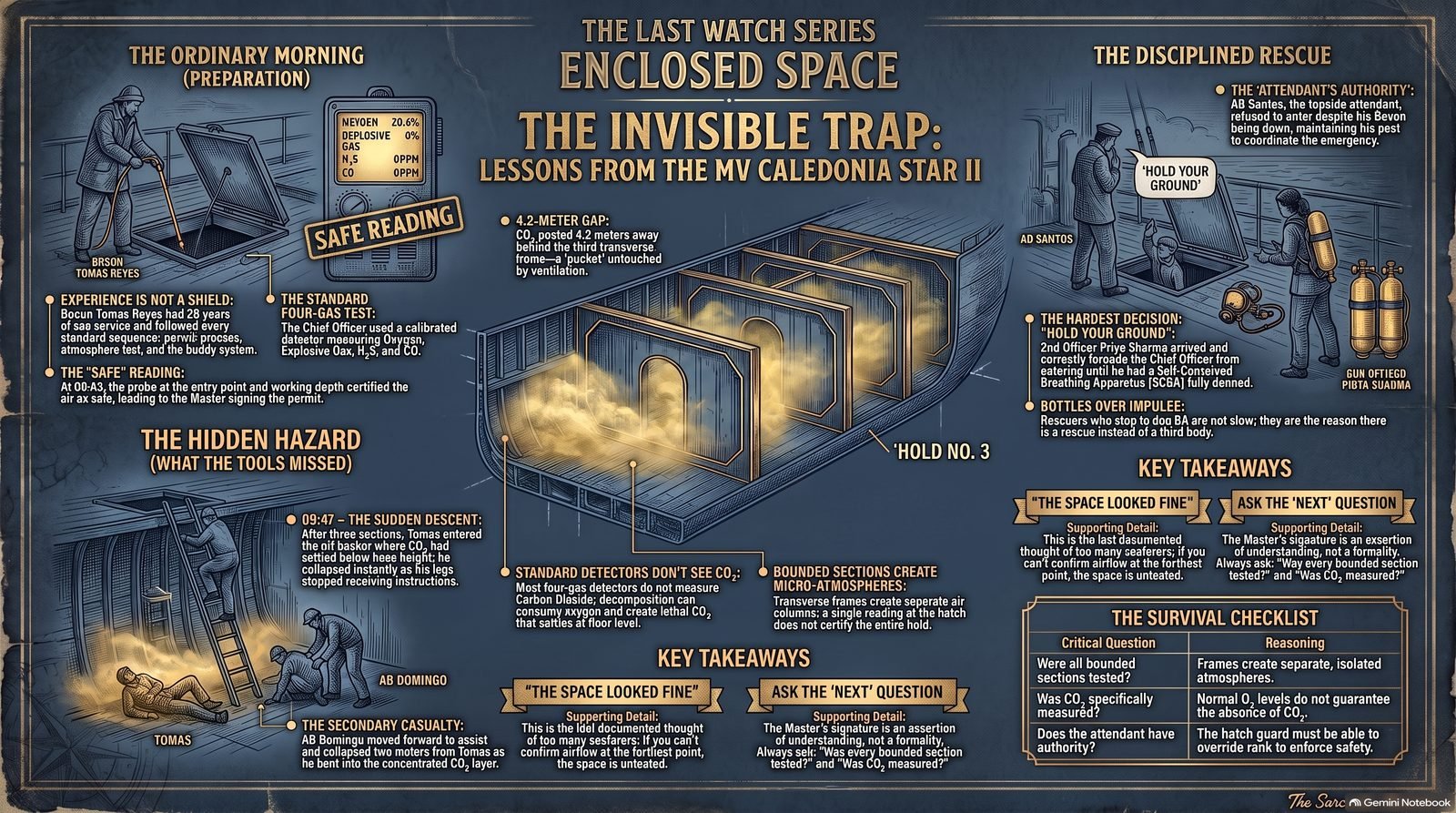
That a four-gas detector does not measure carbon dioxide
That the buddy system can produce two casualties instead of one
Not because it is entertaining—though it is—but because politeness has not been particularly effective.
Decades of well-worded guidance have not eliminated the same recurring fatalities.
So this is not polite.
Fiction is not polite.
It is louder. Messier. Harder to ignore.
What This Is Really Trying to Do
If one person reads one of these books and pauses before an enclosed space entry and asks:
“Did we check the far end?”
“What about CO₂?”
“What are we assuming here?”
Then this entire ongoing, exhausting project is justified.
One question asked at the right time is worth more than a hundred perfect permits signed too early.
What You Will Feel (Probably)
If you work at sea, this will feel familiar.
Uncomfortably so.
You will recognise:
The Chief Officer
The bosun
The superintendent at midnight
The rating who notices something and says nothing
You will think of a watch.
A decision.
A moment where you almost said something.
And if this works the way we hope it does, you will ask:
What would I do differently next time?
Not theoretically.
Practically.
The Point, Without Dressing It Up
Incident reports are necessary.
Seminars are necessary.
Procedures are necessary.
They are not sufficient.
The gap is human.
So the solution has to be human too.
This series is an attempt—still ongoing—to bridge that gap.
Not with answers.
With better questions.
The Last Line
If this has irritated you, good.
If it has made you slightly uncomfortable about your next enclosed space entry, better.
The series is still being written.
The question is whether the industry is still willing to read—and more importantly, to think.
The other half of the outcome, as always, is on you.
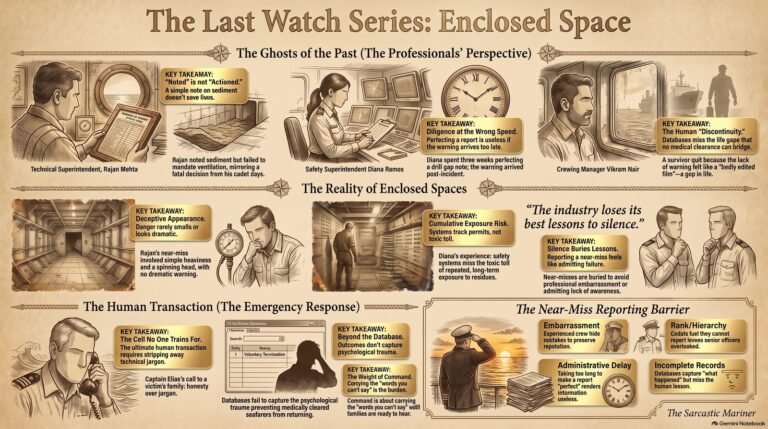
This is part of The Last Watch series: fiction and hard truths about maritime safety from The Sarcastic Mariner(s).
Read the series →
Start from: Article 1: The Fatal Mirage →
The book: The Last Watch, Book 1: Enclosed Space →