
The Buddy System: Because Dying Alone Is Against Procedure
It works beautifully.
Right up until the moment the atmosphere decides two for the price of one is acceptable.
Two people go in. Two people come out.
Someone is always watching. Someone always knows where you are.
It is taught everywhere—basic training, toolbox talks, SMS manuals—written with the confidence of something that sounds unarguably correct.
And for the scenario it was designed for, it is.
The problem is that enclosed spaces rarely follow that scenario.
The Logic Is Sound. The Assumption Is Not.
The buddy system solves a specific problem:
A lone worker collapses unnoticed.
So you send two.
If one goes down, the other raises the alarm.
Simple. Logical. Effective.
But it relies on one critical assumption:
That one person remains functional long enough to help.
That assumption holds in:
Mechanical injury
Heat stress
Gradual exposure
It does not hold in:
Oxygen-deficient atmospheres
Carbon dioxide accumulation
Hydrogen sulphide at high concentration
Inert gas environments
In those conditions, incapacitation is:
Rapid
Simultaneous
Often without warning
The system assumes two atmospheres.
The reality is one shared atmosphere.
And when that atmosphere fails, it tends to fail for everyone in it.
Two In, Two Down
Picture it.
The space has been ventilated.
Tested at the access point.
Declared safe.
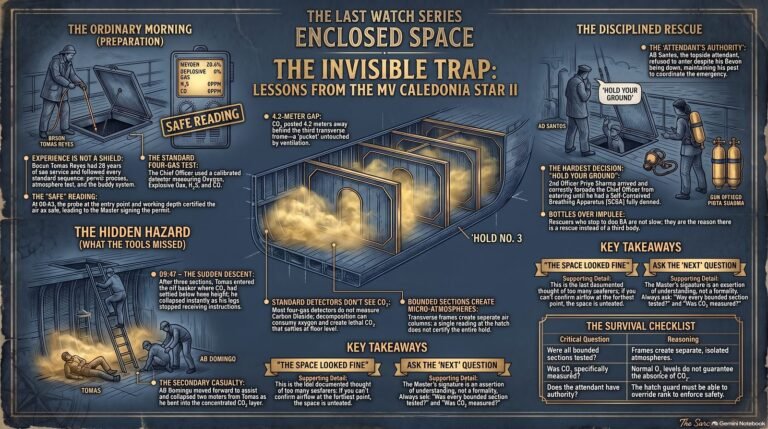
The AB and bosun enter together. That is what procedure requires.
They move deeper into the space—away from the hatch, away from the test point, into an area ventilation does not effectively reach.
A pocket exists. Localised. Undetected.
Not because procedures were ignored.
Because procedures are spatially limited.
They enter it together.
Because they are together.
Within seconds:
Oxygen drops below survivable levels, or
CO₂ displaces breathable air, or
H₂S overwhelms sensory warning
There is no staggered collapse.
No warning shout.
No dramatic rescue attempt.
Just two people losing consciousness in the same atmosphere.
The buddy system has now produced two casualties instead of one.
Not because it failed.
Because it worked exactly as designed—just against the wrong hazard model.
The Topside Attendant: Witness to the Timeline
The attendant is the control point.
Maintain communication.
Monitor entry.
Raise the alarm.
And critically—do not enter.
That last instruction is correct.
History is full of fatalities where would-be rescuers became additional casualties.
So the attendant stays out. Calls for help. Activates response.
Procedure followed.
But the timeline is unforgiving.
Loss of consciousness in oxygen-deficient atmospheres can occur within seconds.
Irreversible injury follows within minutes.
The attendant may respond immediately—and still be too late.
Not due to failure.
Due to physics.
The system assumes time exists for intervention.
In many enclosed space incidents, it does not.
The Part We Don’t Drill Properly
Enclosed space drills are conducted regularly.
But they tend to follow a predictable script:
Casualty near access
Known atmosphere
Controlled response
What is rarely practiced is the actual decision point:
The moment the rescue team arrives, sees the readings, and understands:
The atmosphere inside has already incapacitated two people
Entering without full protection guarantees additional casualties
Entering with protection may still be too late
That hesitation—the calculation between urgency and survivability—is the real scenario.
And it is almost never trained under realistic pressure.
We rehearse recovery.
We do not rehearse uncertainty.
What the Buddy System Can’t Do
The buddy system:
Prevents unnoticed collapse
Improves accountability
Enables early alarm
It does not:
Protect against shared atmospheric hazards
Guarantee intervention time
Replace atmospheric control measures
Used alone, it becomes a psychological safety net.
One that assumes the hazard will behave in a way that allows rescue.
Enclosed space atmospheres rarely cooperate.
What Actually Matters
If the hazard is atmospheric, survival depends on controlling the atmosphere—not just observing each other.
That means:
Testing beyond the access point, including remote areas
Recognising stratification and dead zones
Continuous monitoring, not single-point checks
Understanding detector limitations (e.g. CO₂ not measured on standard four-gas units)
Using breathing apparatus where uncertainty exists—not only for rescue
And most importantly:
Acknowledging, openly, that:
“If we both enter the same pocket, the buddy system will not save us.”
That is not pessimism.
That is accurate hazard modelling.
The Last Line
The buddy system was designed to stop people dying alone.
It does that.
It was never designed to stop two people dying together.
And enclosed spaces, with their complete indifference to procedure, have been exploiting that distinction for years.
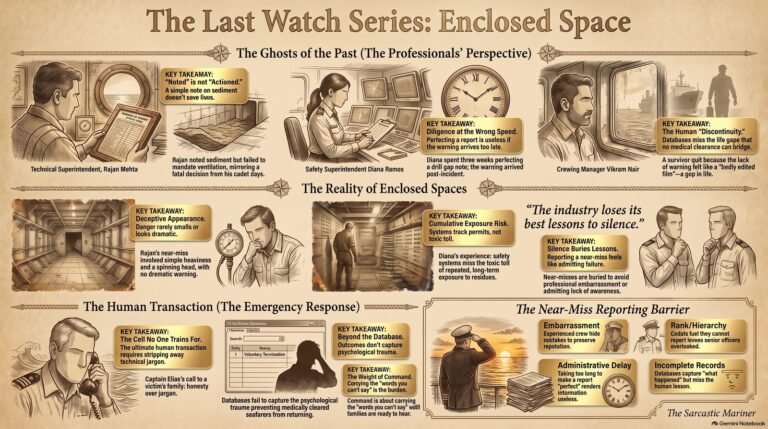
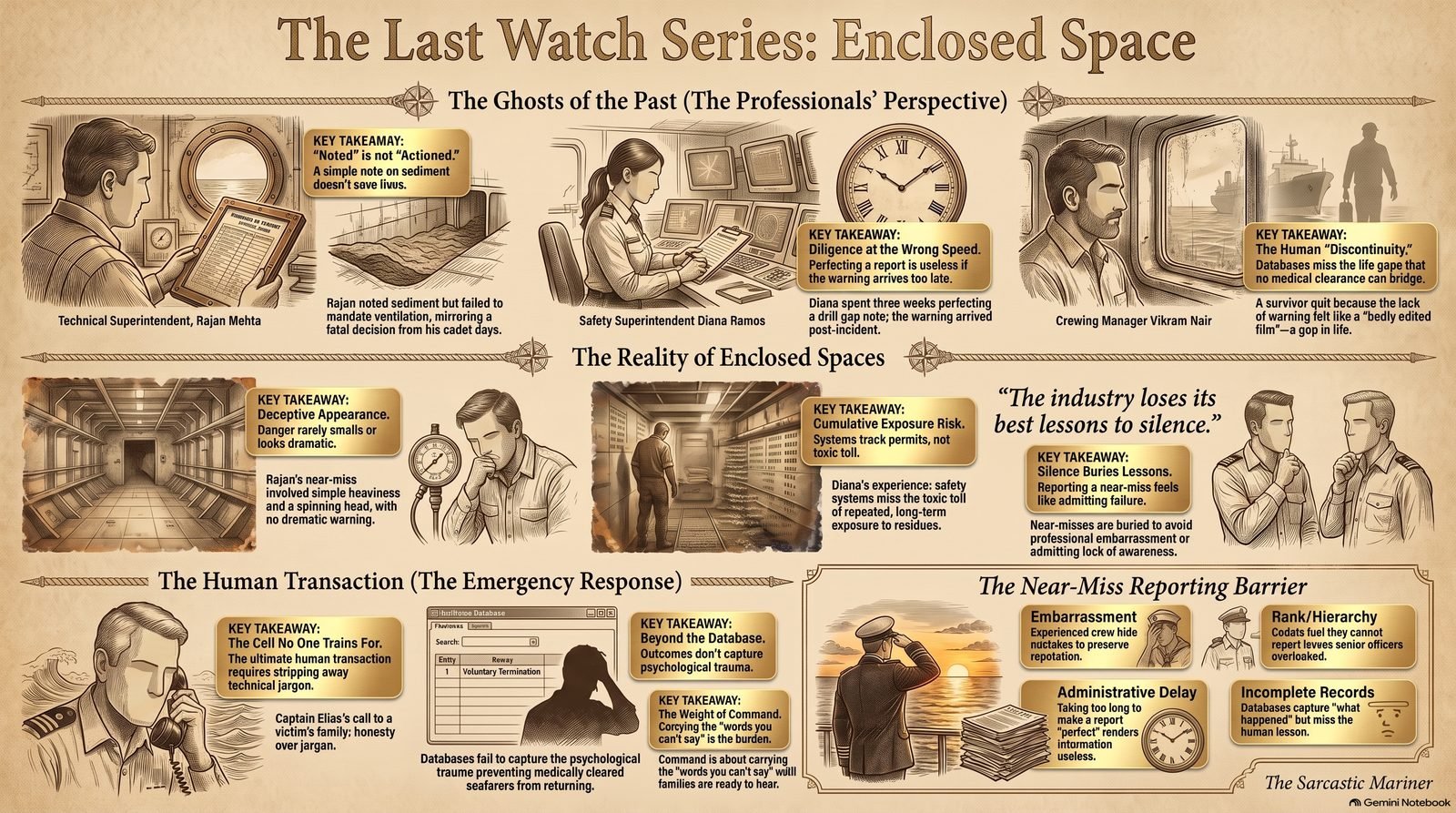
This is part of The Last Watch series: fiction and hard truths about maritime safety from The Sarcastic Mariner(s).
Read the series →
Next: Article 4: The Procedure Illusion →
The book: The Last Watch, Book 1: Enclosed Space →