
Experience Reduces Fear. Not Risk.
Your years at sea will tell you everything is fine.
Your years at sea have been wrong before.
You just were not around to remember it.
The Able Seaman with seventeen years on deck can strip a Wilden pump in his sleep.
The bosun has scrubbed ballast tanks since before the third mate was born.
The fitter knows that generator crankcase better than he knows his own house.
And the oiler can navigate the engine room blindfolded—at least well enough to find the coffee.
These are not reckless men. Not careless. Not incompetent.
They are experienced. And that is precisely the problem.
Because experience builds certainty.
And certainty kills quietly.
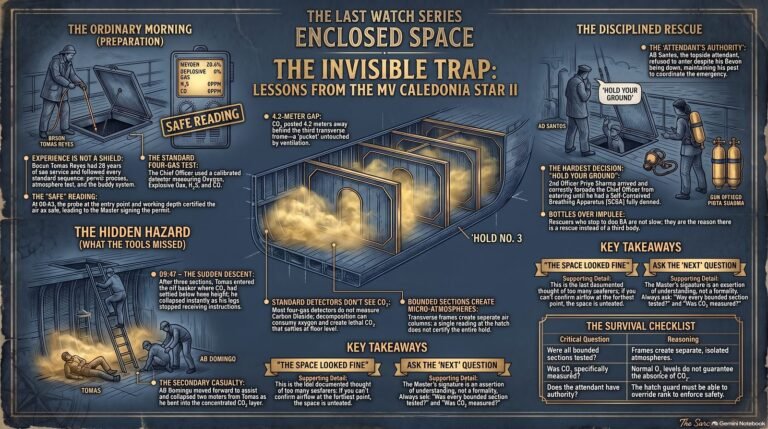
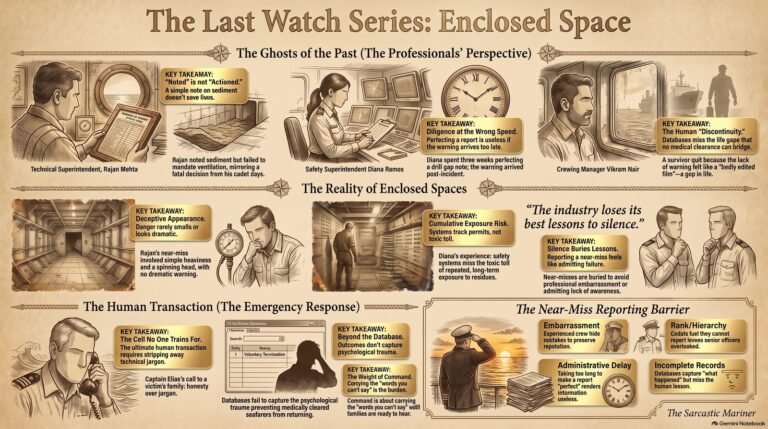
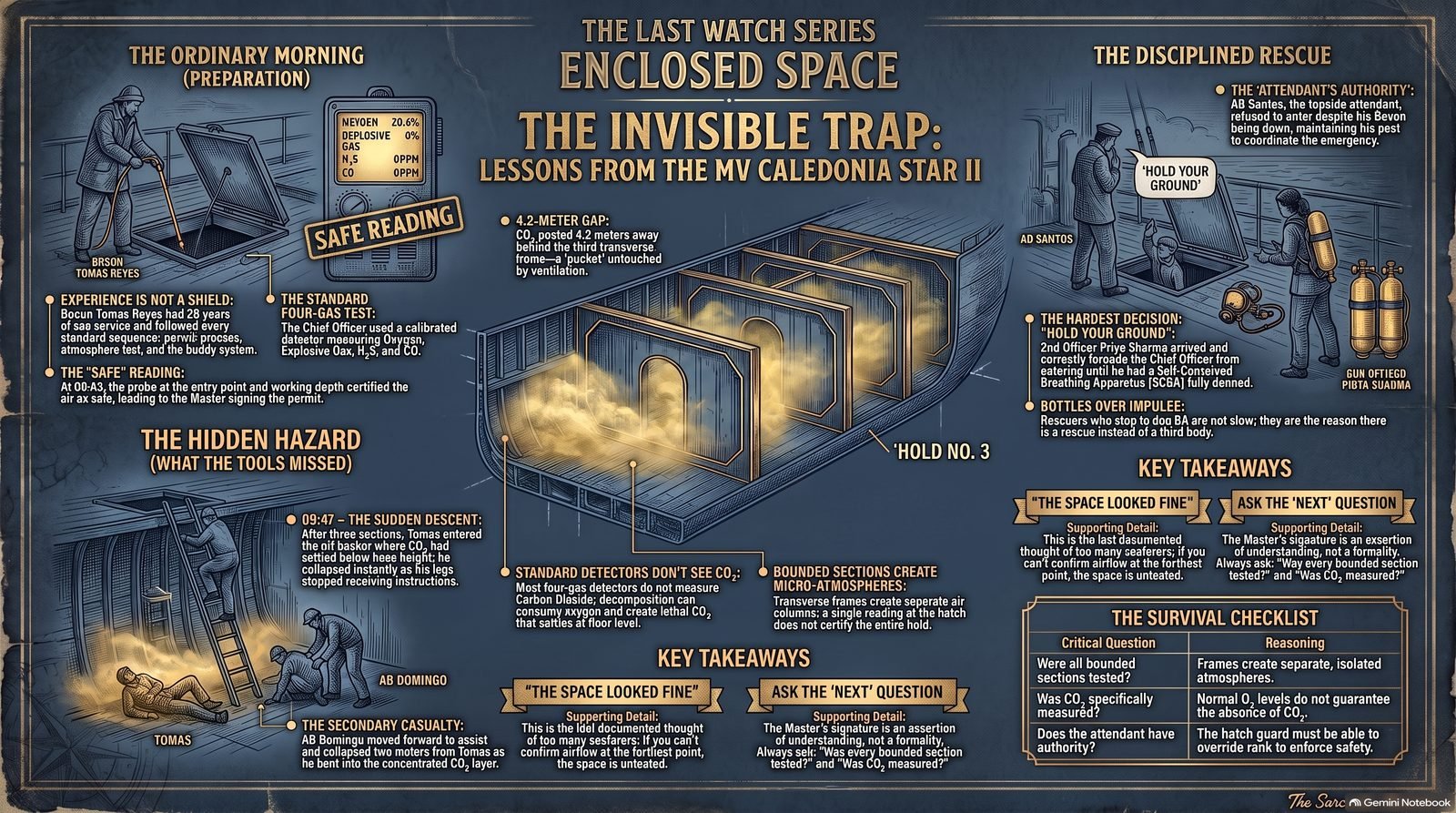
Industry data does not bother with opinions. Between 2000 and 2024, at least 1,010 crew and shore personnel died in enclosed spaces. A significant proportion were not green hands. They were the people who “knew better.”
They did know better.
That was the problem.
Experience reduces fear. It does not reduce risk.
The difference between those two things is a body bag.
The AB and the Ballast Tank: Confidence Meets Chemistry
He has done it a hundred times.
Open. Ventilate. Test. Enter. Chip. Paint. Exit. Eat. Sleep. Repeat.
Routine is a powerful drug.
Until the moment he dislodges sediment and releases a pocket of hydrogen sulphide that has been quietly fermenting at the bottom of the tank.
At low concentrations, it smells like rotten eggs.
At high concentrations, it removes your ability to smell anything at all.
Which is a remarkably efficient design flaw.
The tank was ventilated. The atmosphere was tested. The checklist was followed.
None of that changes the fact that gas pockets do not read checklists.
In one real case, a crew member worked a full day inside a ballast tank, felt dizzy, blamed dehydration, and later collapsed outside. Suspected H₂S exposure. Everything had been “done right.”
Experience told him he knew what a ballast tank smells like.
The gas disagreed.
The Fitter and the Crankcase: When “It’s Not a Space” Becomes One
To the fitter, a crankcase is not an enclosed space.
It is a machine.
A familiar one. Open, inspect, close. Repeat for twenty years.
That is exactly the trap.
Crankcases. Scavenge spaces. Boiler drums.
They do not feel like enclosed spaces. Which is why they kill like them.
The pattern has always been safe.
Until the day it isn’t.
Oxygen depletion. Carbon monoxide. Residual fumes. Something that was never there before.
Something experience has never seen.
And experience can only warn you about what it has seen.
Experience is the most convincing liar in maritime safety.
It has never been wrong.
It just has not been killed yet.
The Bosun and the Fuel Oil Tank: Trust, Signed and Stamped
The bosun signs the permit.
Steady hand. No hesitation.
This is his world.
The tank has been ventilated. Tested. Declared safe.
But “safe” means tested at a point, at a time, with an instrument.
It does not mean the space is uniformly safe.
It does not mean there isn’t a pocket of vapour sitting behind a frame, waiting.
The bosun trusts the process.
The process is not wrong.
It is just not omniscient.
The Oiler and the CO₂ Room: The One That Doesn’t Warn You
The CO₂ room is just another stop on the round.
Check gauges. Log readings. Move on.
It does not feel like an enclosed space.
Which is exactly why it is one.
A minor leak. Odourless. Invisible. Heavier than air.
No smell. No warning. No second chance.
The room had always been safe.
Until it wasn’t.
Experience had never taught him what danger looked like here.
Because here, danger does not look like anything.
The Irony We Don’t Put on Posters
We assign the most experienced person to the riskiest job.
It sounds logical. It feels responsible.
And yet—those most familiar with enclosed spaces are often the ones who underestimate them.
Familiarity reduces perceived risk.
Not actual risk.
Data reflects it. Senior crew and seasoned ratings form a significant portion of casualties.
Among crew fatalities, more than half are lower ranks—and among them, bosuns and ABs dominate.
The people who “know.”
The irony would be funny if it wasn’t fatal.
So What Do We Do With Experience?
Get rid of it? Of course not.
Replace it with procedure? Not enough.
The answer is simpler, and more uncomfortable:
Stop treating experience like protection.
Experience is data.
Partial. Biased. Historical.
It tells you what has happened.
It tells you nothing about what is about to happen.
When someone says, “I’ve done this a hundred times,” they are telling the truth.
They are also making a prediction.
And predictions, in an environment you cannot see, smell, or feel properly, are just well-informed guesses.
Guesses do not belong on enclosed space permits.
But they are written all over them.
The Last Line
The sea teaches you to trust what you know.
An enclosed space teaches you something else entirely:
What you know is never the whole story.
Some lessons are only learned once.
This is part of The Last Watch series: fiction and hard truths about maritime safety from The Sarcastic Mariner(s).
Read the series →
Next: Article 2: The Permit Illusion →
The book: The Last Watch, Book 1: Enclosed Space →