
Compliance Is Not Comprehension. We Keep Confusing the Two.
You ticked every box.
You followed the SMS to the letter.
The permit is a work of art.
And the hold still has no idea it was supposed to be safe.
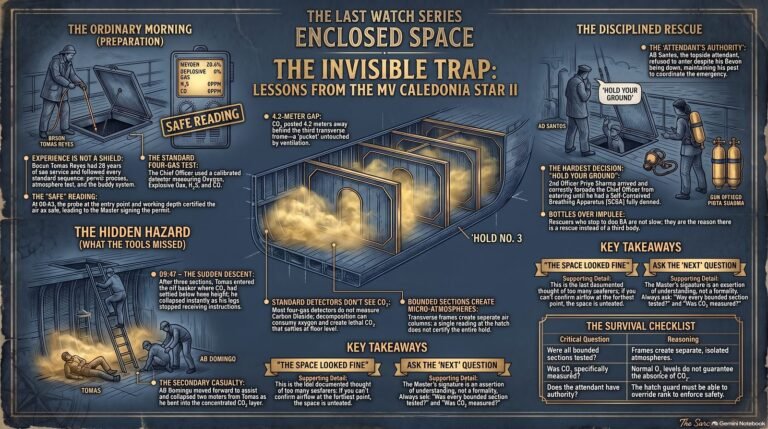
The Chief Officer used a ruler. The atmosphere readings are in clean block capitals. Time recorded to the minute. Names legible. Signatures witnessed. Toolbox talk done. Rescue plan discussed. Ventilation verified.
If an auditor had walked in at that exact moment, they would have framed the document.
Twenty minutes later, two men are dead.
The paperwork survives them. It always does.
The industry has elevated the permit to something close to sacred. As if its existence bends physics to our will.
It doesn’t.
A permit is not a contract with the atmosphere.
The atmosphere does not read English.
It does not care what box you ticked.
It only cares whether the gas you didn’t test for is sitting in the corner you didn’t check.
Compliance is doing what you were told.
Comprehension is knowing what you are actually dealing with.
The gap between those two things is where people die.
The Permit Does Exactly What It Says (Which Is Not Much)
Let’s be fair.
A permit does exactly what it is designed to do.
It records that:
At a specific time
In a specific location
With a specific instrument
Certain parameters were tested
That is all.
It does not freeze those conditions.
It does not guarantee uniformity across the space.
It does not promise that what was true at 08:45 is still true at 09:15.
A signature proves the process was followed.
It does not prove the space is safe.
But we behave as if it does.
We hold up a signed permit like a shield against enclosed space hazards, and then act surprised when reality ignores it.
The problem is not the permit.
The problem is the meaning we assign to it.
A completed checklist feels like control.
It creates the illusion that the risk has been dealt with.
It hasn’t.
A permit is a snapshot.
And a snapshot has blind spots.
Procedure Is Not Thinking (But It Often Replaces It)
Picture the scene.
The Chief Officer completes the permit with absolute precision. Risk assessment attached. Gas meter calibration verified. Everything in order.
The team looks at the document and relaxes.
Not because they are careless.
Because the system looks thorough.
And humans trust thoroughness.
That’s the trap.
A fully completed permit signals: the thinking has already been done.
So nobody asks the next question.
What’s not covered?
What wasn’t tested?
What could change?
Because asking those questions feels unnecessary. Even disruptive.
In practice, it can feel like questioning the competence of the person who signed it.
And in a hierarchy, that hesitation is enough.
So the question stays unasked.
And whatever sits outside the scope of the checklist—CO₂, localised vapour pockets, oxygen depletion in an untested section—remains exactly where it is.
Undisturbed.
Unrecorded.
Unforgiving.
“The Permit Met the Standard” Is Not a Defence
After an incident, the phrase appears almost automatically:
“The permit met all requirements.”
It is usually presented as reassurance.
It shouldn’t be.
A standard defines a minimum.
A minimum is not safety.
It is the lowest level of agreement.
If the outcome is fatal and the defence is compliance, what that actually tells you is simple:
The standard was not enough.
Consider the typical four-gas detector:
Oxygen
Flammable gases
Hydrogen sulphide
Carbon monoxide
Carbon dioxide is not included.
Which means a perfectly compliant permit can show “all clear” while CO₂ accumulates unnoticed.
Compliance scores 100%.
The space remains hazardous.
That is not a procedural failure.
That is a limitation of the system.
And limitations do not announce themselves on checklists.
We Confuse the Map With the Space
A permit is a map.
The space is not.
The space is a steel structure with geometry, residues, blind spots, and conditions that evolve over time.
Ventilation is not uniform.
Gases do not distribute evenly.
Conditions do not remain static.
A reading at one point does not represent the entire space.
A reading at one time does not represent the next.
A perfect map of a minefield is still a minefield.
What Permits Should Be (But Rarely Are)
This is not an argument against permits.
It is an argument against what we think they are.
A permit should start a conversation, not end one.
What is actually in the space?
What could be generated?
Where might gas accumulate?
What has not been tested?
These are not complex questions.
They are just not written down.
And what is not written down is often not asked.
Adding another checkbox will not fix that.
Changing how people use the checklist might.
The Real Problem
We have trained people to comply.
We have not trained them enough to question.
Compliance creates accountability after the fact.
Comprehension creates survival before it.
Right now, we are better at producing perfect paperwork than we are at producing doubt.
And doubt—properly applied—is what keeps people alive in enclosed spaces.
The Last Line
The permit tells you what was checked.
It does not tell you what was missed.
The sea has always been very efficient at exploiting that difference.
This is part of The Last Watch series: fiction and hard truths about maritime safety from The Sarcastic Mariner(s).
Read the series →
Next: Article 3: The Fatal Illusion →
The book: The Last Watch, Book 1: Enclosed Space →