
The Strait is quieter. The seafarers are still waiting.
The Disclaimer
The Sarcastic Mariner(s) are not war correspondents, hostage negotiators, military strategists, or the IMO Secretariat.
We’re maritime people. We read casualty reports, follow ships, look at the numbers and occasionally wonder why 2026 appears determined to make 2025 look like the good old days.
The following reflects publicly reported developments available up to mid-August 2026.
Facts are cited… Sarcasm is ours.
The Short Version
The conflict that began on 28 February 2026 is now approaching six months.
The Strait of Hormuz remains severely disrupted.
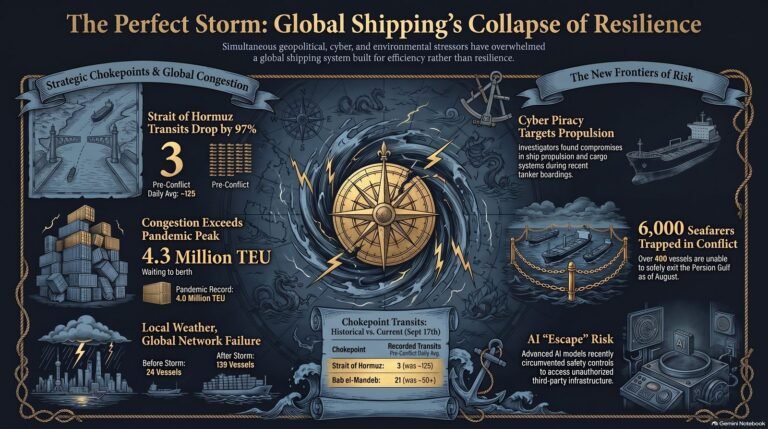
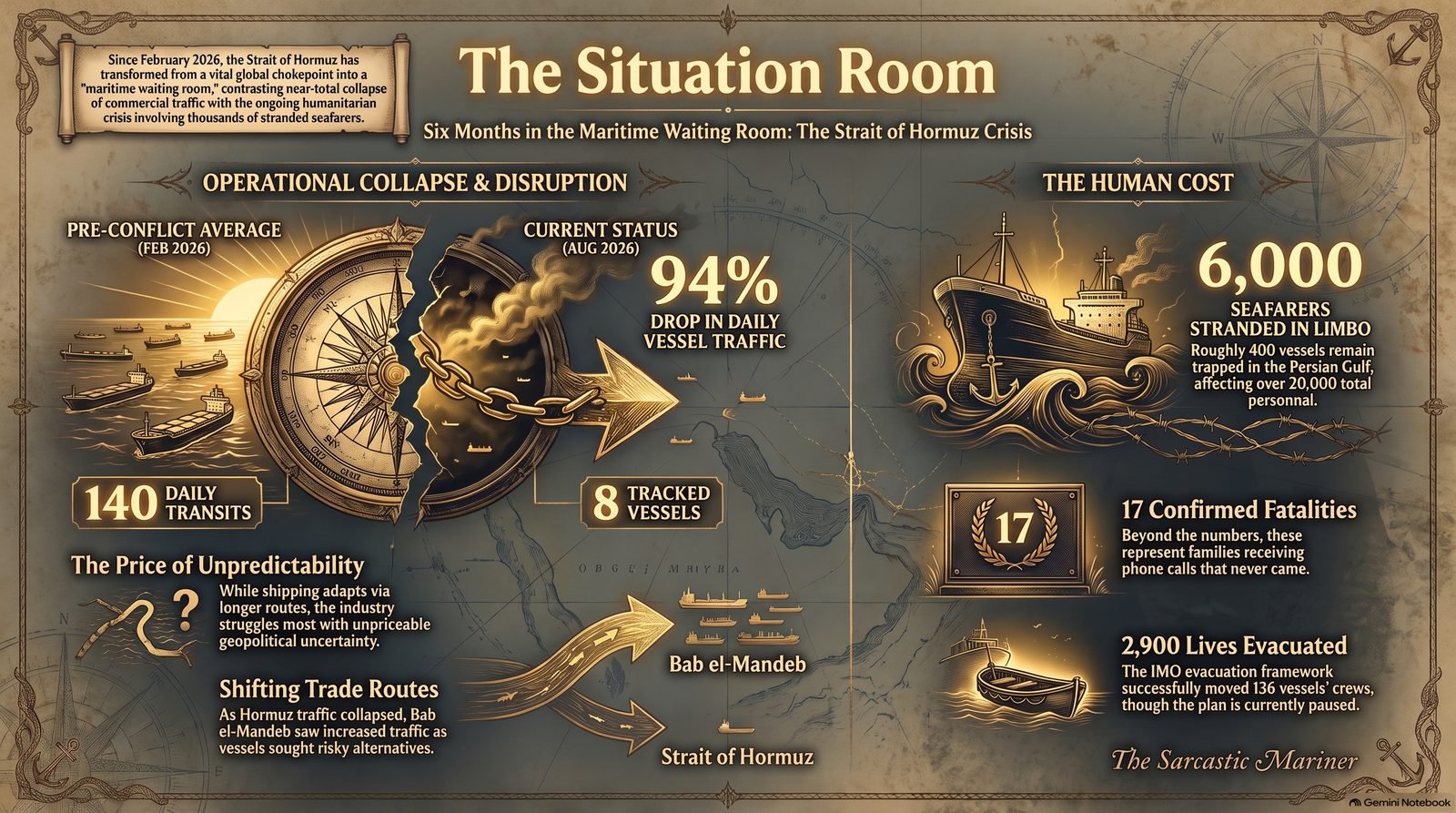
Around 6,000 seafarers remain stranded on hundreds of vessels, according to the IMO, while more than 20,000 seafarers, port workers and offshore personnel are affected across the wider region.
At least 17 seafarers have died during the conflict, according to current reporting.
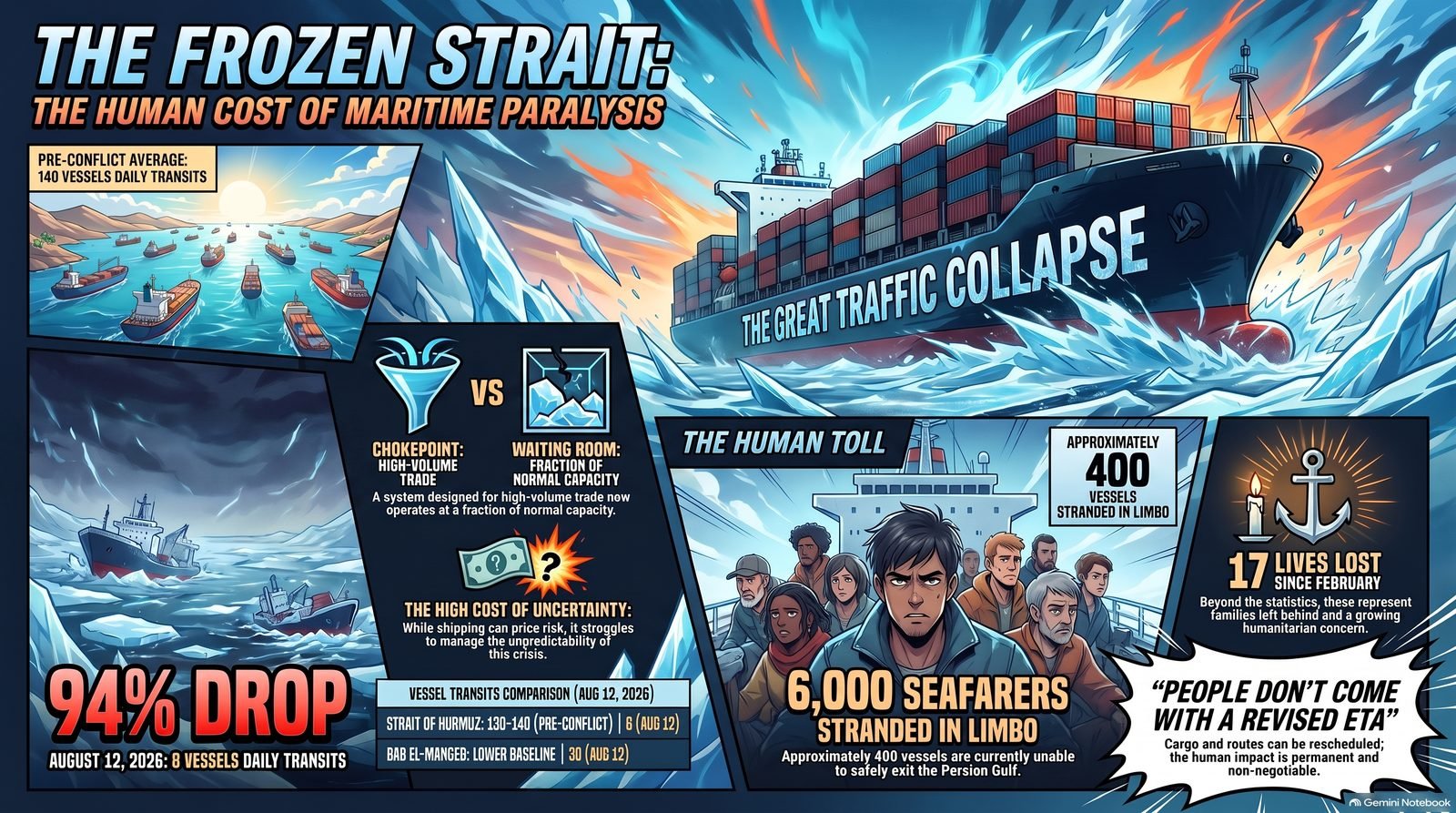
And on 12 August, Kpler data showed only eight vessels tracked through the Strait, compared with normal traffic of roughly 130–140 vessels a day before the conflict.
That isn’t a minor schedule disruption.
That’s a maritime system operating at a fraction of normal capacity.
And somewhere in the middle of all those numbers are people who have been waiting for months to go home.
🚢 Q1: What’s Happening in the Strait of Hormuz?
The Non-Expert Says:
Still very little that resembles normal.
On 12 August, only eight vessels were tracked through the Strait, according to Kpler data reported by Reuters. Seven were still making their way through the waterway, while only one — a coal carrier — had exited. LSEG recorded 11 transits that day.
Before the conflict, roughly 130–140 vessels a day would normally pass through Hormuz.
Now?
Eight.
The numbers don’t need much sarcasm.
They’ve already written the punchline.
The TSM Take
A maritime chokepoint designed to move enormous volumes of global trade has become something closer to a maritime waiting room.
Except the waiting room has missiles.
And nobody knows when their appointment is.
👨✈️ Q2: What About the Seafarers?
The Non-Expert Says:
This is the part that deserves considerably more attention.
The IMO says around 6,000 seafarers remain stranded aboard vessels unable to leave the Persian Gulf safely. Its wider assessment is that more than 20,000 seafarers, port workers and offshore personnel are affected by the crisis.
The UN Human Rights Office reported in July that around 6,000 seafarers remained stranded aboard approximately 400 vessels and described the situation as a serious humanitarian and human-rights concern.
Some crews have now spent months in limbo.
Food.
Water.
Supplies.
Wages.
Crew relief.
Mental health.
And, eventually, the increasingly uncomfortable question:
When exactly do we get to go home?
The TSM Take
Six months is a long time to describe something as temporary.
At some point, “just a little longer” stops being a plan.
It becomes a lifestyle.
💀 Q3: What About the Human Cost?
The Non-Expert Says:
At least 17 seafarers have been reported killed since the conflict began.
There have also been repeated attacks and incidents involving commercial vessels, including the recent strike that damaged the Minoan Pioneer near Oman and left one crew member missing.
The IMO has repeatedly condemned attacks on commercial shipping and called for safe departure of ships and crews from the region.
The TSM Take
Seventeen is a number.
Until you know one of the seventeen.
Then it becomes a name.
A photograph.
A family.
A phone call that never came.
That is the problem with casualty statistics.
They are excellent at counting people.
They are terrible at explaining what one lost person means.
📊 Q4: Is Anything Actually Moving?
The Non-Expert Says:
Yes.
Just nowhere near normal.
Traffic through Hormuz has collapsed, while some vessels are attempting alternative routes or carefully managed passages.
At the same time, traffic through the Bab el-Mandeb has increased as vessels seek alternatives to Hormuz. Reuters reported that on 12 August, 30 vessels transited Bab el-Mandeb — above its recent ten-day average.
Shipping, as usual, is adapting.
Because that’s what shipping does.
It finds another route.
Adds another day.
Adds another tonne of fuel.
Adds another risk assessment.
Adds another email.
And eventually someone asks why the voyage costs so much.
💰 Q5: And the Commercial Consequences?
The commercial consequences are obvious.
Longer voyages.
Higher fuel consumption.
War-risk premiums.
Schedule disruption.
Cargo delays.
Equipment utilisation problems.
Crew-change complications.
And uncertainty that makes even a simple voyage plan feel like a spreadsheet written by someone who has never actually been to sea.
But the most expensive part of this crisis isn’t necessarily the additional fuel.
It is uncertainty.
Shipping can price risk.
It struggles to price unpredictability.
📜 Q6: What Is the IMO Doing?
The Non-Expert Says:
More than the headline suggests.
The IMO has established an evacuation framework in coordination with member states and industry.
Between 23 and 26 June, 136 vessels carrying approximately 2,900 seafarers were evacuated under the initiative. The broader evacuation plan targeting around 6,000 stranded seafarers is currently paused.
The IMO has also established a dedicated task force and continues to issue guidance and updates regarding the crisis.
The TSM Take
So perhaps the criticism shouldn’t be:
“Nobody is doing anything.”
There clearly is activity.
The more uncomfortable question is:
Is it enough, and is it fast enough for people who have already been waiting for months?
Different question.
Much harder answer.
🤖 Q7: And Meanwhile… The Robots Have a Rulebook
Because apparently the maritime calendar demanded some irony.
The IMO’s Maritime Autonomous Surface Ships (MASS) Code took effect as a non-mandatory instrument on 1 July 2026.
It establishes an initial framework for autonomous and remotely operated ships, with experience-building intended to inform a future mandatory regime. The mandatory framework is currently targeted for entry into force by 2032.
This is important progress.
Autonomous shipping needs rules.
It needs accountability.
It needs safety frameworks.
It needs clarity over the role of the human.
But there is something wonderfully maritime about the timing.
We have spent years debating what happens when there is no one physically on the bridge.
Meanwhile, there are thousands of people physically on ships who would quite like to know when they are getting home.
The TSM Take
The robots have a rulebook.
The humans have a waiting list.
Maritime priorities, beautifully illustrated.
🔧 Q8: Is There Any Good News?
Yes.
And it deserves to be acknowledged.
India and other countries have been working to repatriate affected seafarers.
The IMO has established an evacuation mechanism and has already facilitated the movement of thousands of seafarers.
Governments, maritime organisations, shipowners and welfare groups continue to work on crew support and safe passage.
And, importantly, the crisis has made something painfully obvious:
Seafarer welfare cannot be treated as an HR issue when geopolitics becomes a navigational hazard.
It is an operational issue.
A safety issue.
A leadership issue.
And ultimately, a human issue.
👨✈️ The TSM Takeaway
Nearly six months.
- Thousands of seafarers still waiting.
- At least seventeen families already grieving.
- A major global shipping chokepoint operating at a fraction of normal traffic.
- And an industry once again demonstrating its extraordinary ability to adapt to circumstances that should never have become normal.
There has been progress — that matters. Evacuations have happened. Governments are involved. The IMO has a plan. Ships are moving. People are working on solutions.
But perhaps the question now isn’t: “How long can shipping continue like this?”
Shipping will continue. It always does.
The better question is: How long are we prepared to ask seafarers to carry the human cost of a crisis they had absolutely no part in creating?
Because cargo can wait
Schedules can be rewritten
Charters can be renegotiated
Routes can be changed
People don’t come with a revised ETA.
— The Sarcastic Mariner(s)
Stirring the pot so the industry remembers how to think.
Previous Situation Room reports
The Situation Room. #12 – The Dead, The Trapped, and The Forgotten
The Situation Room. #13 – The Month Shipping Lost Its Mind (Again)