
Dr. Kumud R. Jha · Singapore · Doctorate in AI · US Patent Holder View LinkedIn Profile
The Myth Behind Most AI Adoption Strategy
AI adoption strategy in most boardrooms right now rests on a myth. It goes like this: the companies that will win the AI era are the ones moving fastest. First to deploy. First to automate. First to cut costs through AI substitution.
I want to challenge that directly.
The companies I have seen get lasting value from AI are not the fastest movers. They are the most deliberate ones. And the distinction matters enormously — because the gap between fast and deliberate is where most AI transformations quietly fail.
Here is what I mean.
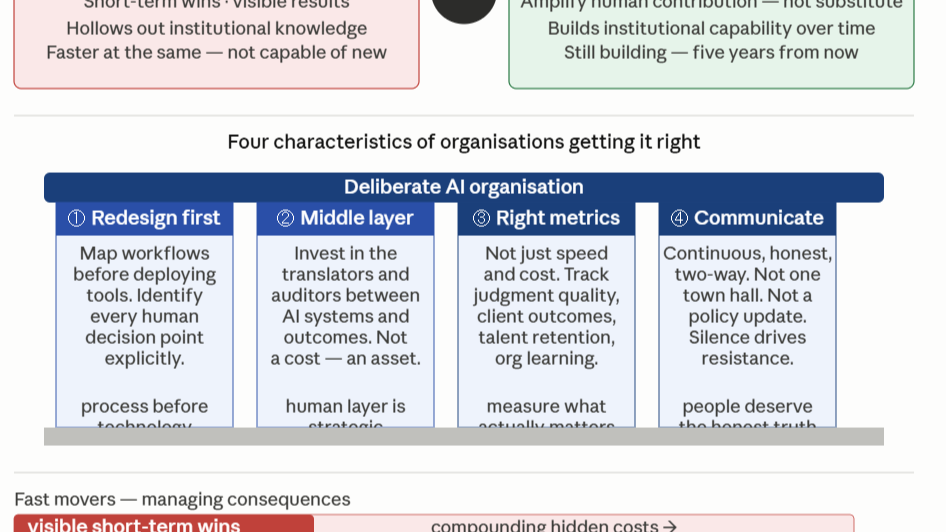
Fast AI adoption looks like this: identify the most automatable processes, deploy tools that reduce headcount or turnaround time, measure the cost saving, declare success. This produces visible short-term results. It also tends to produce something less visible: the hollowing out of institutional knowledge, the disappearance of the junior roles that develop senior talent, and an organisation that is faster at doing what it already does — but less capable of doing anything new.
A deliberate AI adoption strategy looks different. It starts not with the technology but with a question: what does this organisation exist to do that only humans can ultimately be accountable for? And then: how do we design around that, using AI to amplify the human contribution rather than substitute for it?
Four Traits of Organisations Getting AI Adoption Strategy Right
One — They redesign workflows before they deploy tools. They do not drop AI into existing processes and expect transformation. They step back, map the process end to end, identify the decision points that require genuine human judgment, and then design the human-AI handoff explicitly. Who does what, when, and why — before the first tool is switched on.
Two — They invest in the middle layer. The people who sit between the AI systems and the business outcomes — translating, auditing, contextualising, escalating — are treated as a strategic asset, not a transitional cost. These are the AI translators and workflow designers from Day 18. The organisations that cut this layer to save money tend to regret it within eighteen months.
Three — They measure the right things. Not just speed and cost — but quality of judgment, client satisfaction, talent retention, and organisational learning. An AI deployment that cuts turnaround time by forty percent but reduces the quality of senior decision-making is not a success. It is a slow disaster being measured by the wrong instruments.
Four — They communicate relentlessly. The organisations where AI adoption goes well are the ones where people understand what is changing, why, and what it means for them — not through a single town hall, but through continuous, honest, two-way conversation. The silence that surrounds most AI deployments — the decisions made in strategy teams and communicated through policy updates — is one of the primary drivers of resistance and failure.
The Question Every Leader Should Bring to Their Next Strategy Session
None of this is complicated. All of it is slow. And slow, in this context, is not a weakness. It is a feature.
The organisations that build deliberately will still be building five years from now. The ones that moved fast will be managing the consequences.
Are we designing AI into our organisation — or just deploying it?
The difference between those two things is the difference between transformation and turbulence. It is also, in the end, the whole point of a genuine AI adoption strategy.