
Dr. Kumud R. Jha · Singapore · Doctorate in AI · US Patent Holder View LinkedIn Profile
Why You Need a Personal Learning Architecture
Learning architecture is the thing most professionals skip — and it’s the reason so many otherwise capable people find themselves scrambling every time the market shifts.
Yesterday we buried the cheese metaphor for good. The jobs your children will hold don’t have names yet. The skills that will matter most in five years are being shaped right now by forces nobody fully understands. And the traditional career model — learn once, apply for decades — is not just outdated. It is a liability.
So the question is not whether you need to keep learning. That is settled.
The question is: how do you build a learning architecture that actually works — not in a sabbatical, not in a six-month bootcamp, but in the twenty-three minutes between your 9am and your 10am, and the forty minutes on the train home? Because that is the only time most of us actually have.
The Problem With How Most Professionals Approach Learning
Most professionals learn reactively. A new tool appears. A client asks about something they don’t know. A performance review surfaces a gap. Then they scramble — consume a course, read some articles, attend a conference — and return to the same pattern until the next scramble.
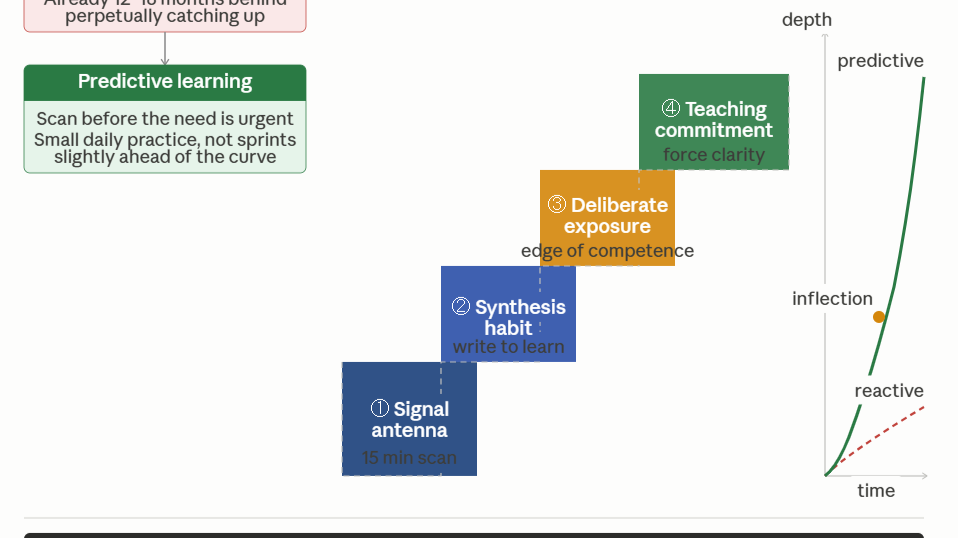
Reactive learning keeps you perpetually behind. By the time a skill gap is visible to you, it has usually been visible to the market for twelve to eighteen months already.
The professionals who stay ahead do something different. They learn predictively. They scan for signals before the need is urgent. They maintain a small, deliberate practice — not a sprint, a practice — that keeps them slightly ahead of the curve rather than catching up to it.
Four Components of a Personal Learning Architecture
One — A signal antenna. A small, curated set of sources you trust to surface what is emerging before it becomes mainstream. Not the news. Not LinkedIn trending posts. Primary sources — research publications, regulator announcements, the quiet conversations happening at the edges of your industry. Fifteen minutes a day of intentional scanning beats three hours of reactive scrolling every time.
Two — A synthesis habit. Reading is not learning. Learning happens when you connect what you just encountered to something you already know — and articulate the connection. The professionals who learn fastest are not the ones who consume the most. They are the ones who write the most. A weekly two-hundred-word note to yourself — what did I learn, what does it change, what do I want to explore next — compounds faster than any course.
Three — Deliberate exposure. Actively seek the conversations, projects, and rooms you are not yet qualified for. Not recklessly — but intentionally. The learning curve is steepest at the edge of your competence. If every meeting you attend is one where you already know the answers, you are not learning. You are performing.
Four — A teaching commitment. Teach what you are learning — to a colleague, a mentee, in a post, in a client conversation. Teaching forces clarity. It surfaces the gaps you did not know you had. And it builds the reputation of someone who is always growing, which is its own form of career insurance.
The Compounding Effect Nobody Talks About
A thirty-minute daily learning practice, maintained consistently over two years, does not produce sixty hours of knowledge. It produces a transformed mental model — because the connections accumulate, the patterns become visible, and the speed of new learning accelerates as the foundation deepens.
This is the part AI cannot replicate. AI can deliver information instantly. It cannot do the slow work of integration — connecting new signals to the specific, lived, contextual knowledge you have built over a career. That integration is yours alone.
As we covered in Day 20, the meta-skills that survive automation all depend on this kind of ongoing renewal — a learning architecture you protect deliberately rather than one you assemble in a panic.
The question is whether you protect the time to do it. Not a lot of time. Just enough. Consistently.