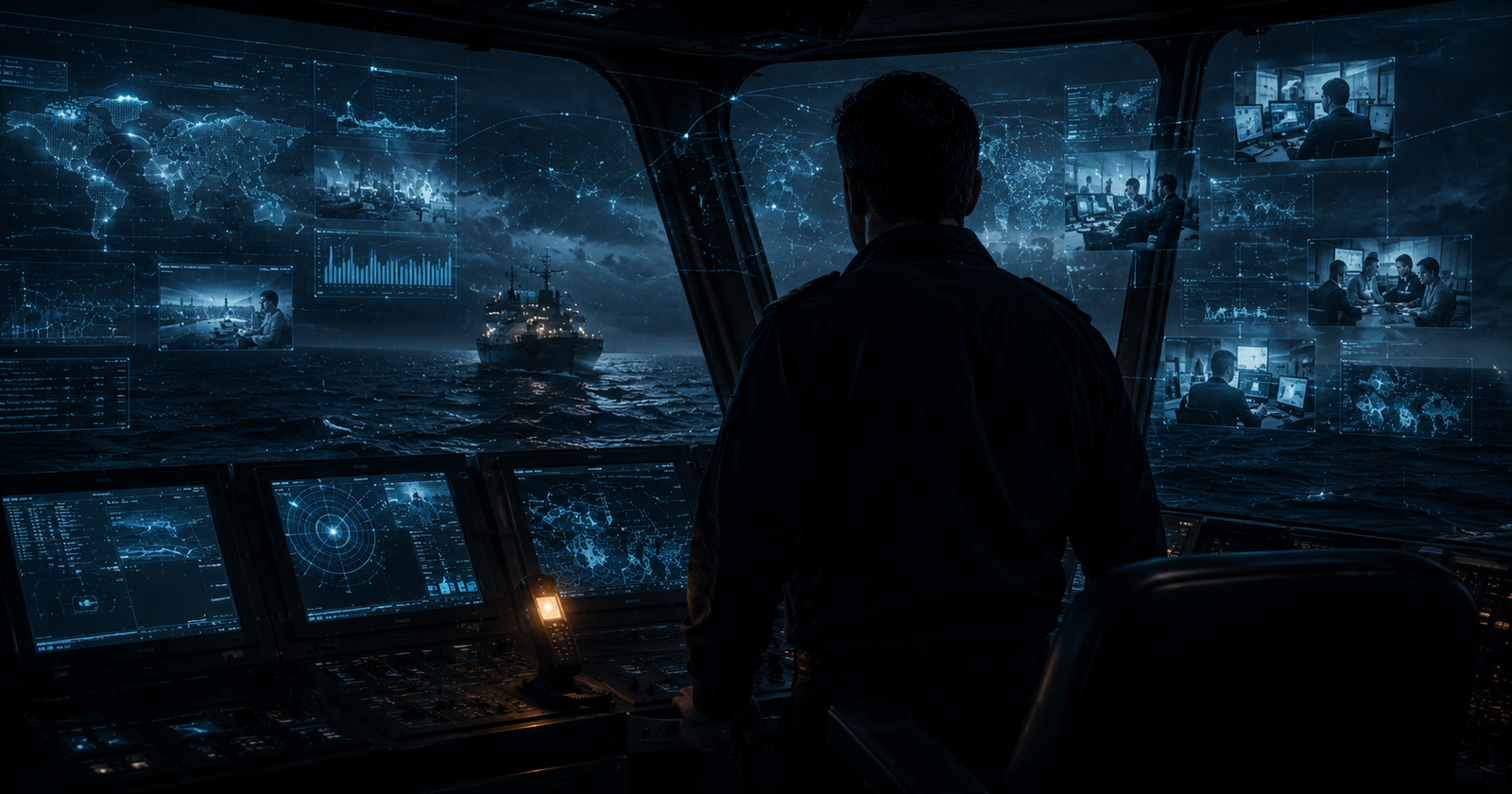

Remember when we begged for internet at sea?
Like, really begged. This is the story of trust and connectivity in shipping — and how getting everything we asked for didn’t fix what we thought it would
Emails home that took 20 minutes to send. Phone calls that cost more than dinner. Crew welfare reports that basically said: “They’re fine. Probably. We’ll know in three weeks.”
Shore wanted connectivity for efficiency. Real-time data. No more waiting for port reports like it’s 1995.
Crew wanted connectivity for sanity. Video calls. Netflix that doesn’t buffer. The ability to remember what their kids look like without squinting at a six‑month‑old photo.
Everyone got what they wanted. And now we’re all wondering what the hell happened.
From the Shore: “This Is Called Responsibility”
Let’s start in the office. Nice chair. Stable coffee. Air conditioning that doesn’t occasionally sound like it’s dying.
From here, constant connectivity doesn’t feel like micromanagement.
It feels like:
- Doing your job
- Covering your bases
- Making sure you’re not the one explaining at an investigation why nobody asked
Here’s what changed:
When something goes wrong today—delays, weather, cargo drama—the first question isn’t “What happened?”
It’s: “Who knew? When did they know? And why wasn’t it in my inbox before I had to find out from the charterer?”
Charterers want updates. Insurers want visibility. Regulators want proof.
In this environment, not knowing isn’t quaint. It’s a risk.
So shore teams call at 2 AM. Not because they enjoy it. Not because they forgot you’re human. Because silence—when data is supposed to flow—now looks like someone dropped the ball.
High‑speed internet created an unspoken rule:
- If the data exists, why wasn’t it shared?
- If the weather model updated, why didn’t you act?
- If speed dropped, where’s the explanation?
- If we can see everything, why wouldn’t we?
From shore, this feels like protection. Of the company. Of the master. Of everyone from the brutal clarity of hindsight.
It’s not control. It’s covering their backs.
Same action. Different view.
From the Bridge: “This Is Called Surveillance”
Now come onboard.
That space—the bridge—used to feel like yours.
Now it feels like a live stream. With commentary. From people who aren’t getting wet.
From the captain’s chair, constant calls don’t feel like support.
They feel like:
- Trust replaced by an audit trail
- Experience overruled by a screen
- Questions that arrive faster than answers
Those dots on someone’s dashboard in Singapore?
They represent:
- Actual wind
- Actual current
- Actual fishing boats with no lights
- Actual fatigue after four months
- Actual humans doing actual work
That helpful weather update from shore? Doesn’t factor in the pilot’s timing. Or the watch change. Or the fact that right now, everyone’s focused on not hitting something—not optimizing fuel by 0.3 knots.
We asked for empowerment.
We got oversight in high definition. That shift is the clearest sign of how trust and connectivity in shipping has quietly changed the job
We wanted better lives at sea. We created permanent reachability.
Trust and Connectivity in Shipping: The Question Nobody Asks Out Loud
Here’s the uncomfortable bit:
Connectivity didn’t destroy trust. It just revealed that trust was… conditional.
Back when you couldn’t call the ship, you had to trust the master. No choice. The vessel left port and became its own world.
Now that you can call any time?
Do you trust them less? Or does the ability to check just become… the obligation to check?
And if you’re checking constantly—what are you actually saying about the person you trusted to sail your ship?
Because actions have a language. And constant check‑ins say something. Even if you don’t mean it.
The Bandwidth Problem Nobody Solved
We built the information superhighway.
We forgot to install:
- Traffic lights
- Speed limits
- A working “Do Not Disturb” button
That’s the real cost of unmanaged trust and connectivity in shipping — nobody installed the traffic lights.
The answer isn’t less data. It’s definitely not more control.
It’s boundaries.
- Clear rules about when shore steps in
- Clear respect for decisions made on scene
- Clear acceptance that leadership at sea involves judgment, context, and experience that doesn’t fit on a dashboard
Because leadership doesn’t disappear over the horizon.
It just gets quieter. cUnless we keep interrupting it.
Some Companies Get This Right
These are the companies quietly getting trust and connectivity in shipping right.
They use connectivity to support, not supervise. They ask before they interrupt.
They treat the bridge as a place of leadership—not a remote workstation with a view.
They understand that the master isn’t “ashore’s agent on board.” The master is the person holding the certificate when something goes wrong at 3 AM with no one else around.
They learned what aviation learned decades ago:
The goal isn’t total visibility. It’s shared understanding.
And you don’t get shared understanding by turning every deviation into an email thread copied to six people.
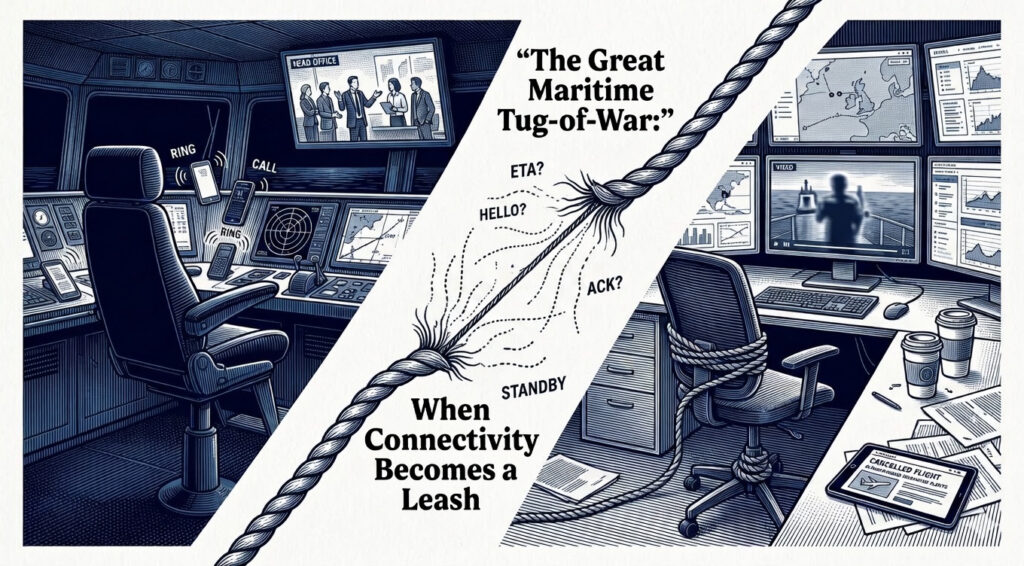
We’ve connected the ocean. Now we need to reconnect the trust.
That’s the paradox sitting at the heart of trust and connectivity in shipping today
Not with more systems. Not with another app. Not with a wellness webinar about “work‑life balance” delivered by someone who’s never been east of Suez.
With boundaries. With respect for the fact that command is still a thing. With the courage to let competent people do the jobs they were hired to do.
Connectivity shrank the ocean.
It shouldn’t shrink the master.
Remember when internet at sea was supposed to fix everything?
Shore got efficiency. Crew got sanity. Everyone won.
Except now the bridge feels like a live stream. With commentary. From people who aren’t getting wet.
We wanted empowerment. We got oversight in HD.
We wanted connection. We got permanent reachability.
Here’s the thing:
Connectivity didn’t destroy trust. It just revealed how much of it was conditional on not being able to check.
Somewhere right now, a master is getting a weather update from someone who can’t feel the wind.
And somewhere else, a shore team is covering their backs because silence looks like risk.
Same technology. Different worlds.
The ocean got smaller. But the gap? Still there.
This is the real story of trust and connectivity in shipping today — not a technology problem, but a boundaries problem
To everyone onboard right now: When does connectivity feel like support—and when does it feel like something else? 👇
To everyone ashore: Before that next call… ask yourself: Am I helping, or just checking?
“Read the other half of this story in The Human Factor #3 – The Dashboard Never Sleeps, where the superintendent explains what it looks like from the other end of the phone.
Fiction from the same sea: The Measurable Horizon, Book 2: Same Sea, Different View →