
Dr. Kumud R. Jha · Singapore · Doctorate in AI · US Patent Holder View LinkedIn Profile
This is Day 1 of the #AIWithoutFear 30-day challenge. Dr. Kumud R. Jha opens the series with the question everyone is afraid to ask honestly: what does AI and job loss actually mean for your future — and your children’s?
AI and Job Loss: Destroyer or Liberation Technology?
Let me say something uncomfortable right at the start of this challenge: yes, AI will eliminate jobs. I’m not going to argue against that.
Electricity made candlemakers redundant — and then created electricians, engineers, and an entire industrial economy that candlemakers could never have imagined. The calculator rendered rooms full of human “computers” obsolete — and freed mathematicians to do mathematics instead of arithmetic. The PC reshaped entire industries overnight — and spawned software development, digital design, and knowledge work at a scale no previous generation had access to. In every case, the disruption was real. The jobs that disappeared were real. And yet — humanity didn’t run out of work. It found better work. Work that was more creative, more complex, more distinctly human.
AI will do the same. The question is not whether jobs will change. It’s what kind of work we will be freed up to do.
Here is the deeper question I want to sit with today:
If money were not a constraint — if survival were not the reason you showed up — would you still be doing what you do?
Think about how many Picassos never picked up a brush. How many Mozarts never touched a piano. How many Sachins never found a cricket bat. Not because the talent wasn’t there — but because the economics of survival demanded something else of them entirely. They became accountants, factory workers, farmers — competent, perhaps even content — but always at some distance from what they were actually capable of. The world received their labour. It never received their genius.
That loss is not abstract. It is the sum of every painting never painted, every symphony never written, every innings never played.
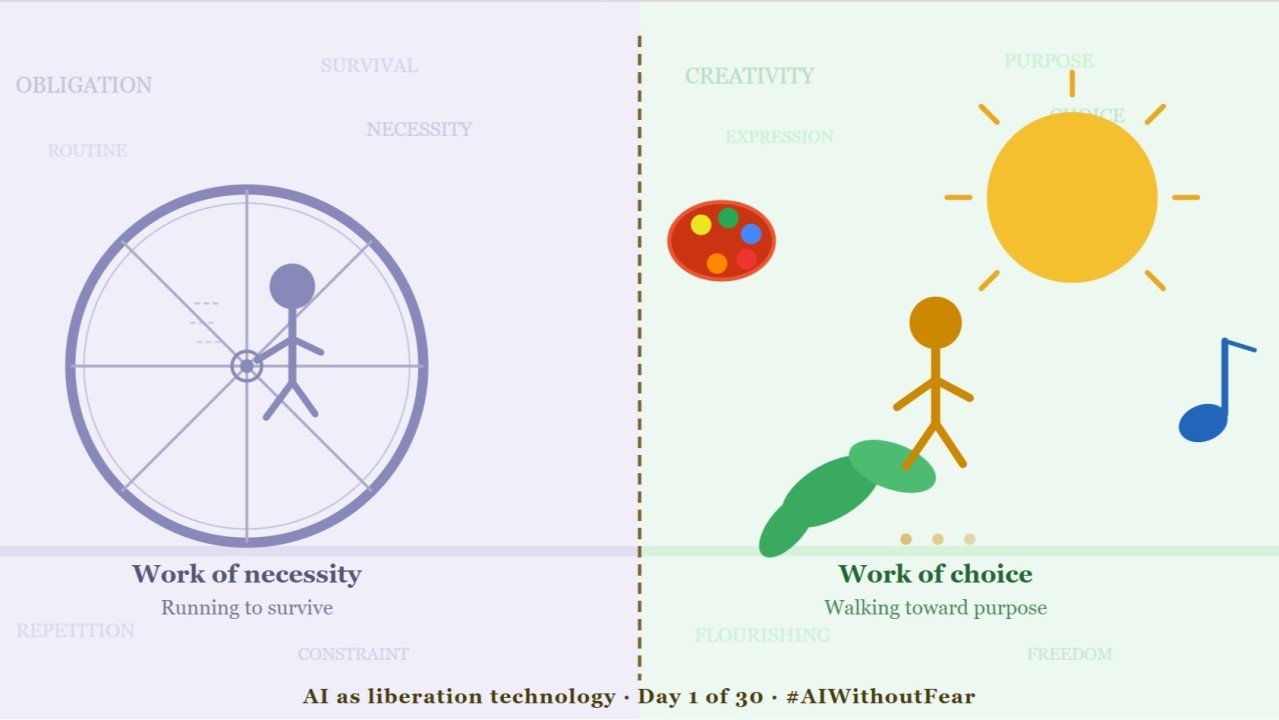
We have built a civilisation where the majority of human beings spend the majority of their waking hours doing work they would not freely choose. Not because humans lack imagination or passion — but because the treadmill of economic necessity has left little room for anything else.
AI, at its highest potential, is not a job-destroyer. It is a liberation technology — one capable of generating enough productive value that humanity might, for the first time, have a genuine choice about how it spends its time and energy.
How that economic surplus gets distributed is a profound and urgent question — one I’ll return to in this series. But that is a conversation about policy and governance, not about the technology itself.
The technology, if we govern it wisely, holds out this possibility: that your children and grandchildren may get to run toward their purpose rather than away from financial precarity. That the next Picasso actually picks up the brush. That the next Mozart finds the piano before the mortgage finds him first.
If not for AI — what would it take for the next generation to achieve the creative, intellectual, and spiritual actualisation that human beings are genuinely capable of?
I’d love to hear your answer.