
In shipping, leadership is structured. Clear roles. Clear authority. Clear accountability. Self-leadership at sea works the same way — until you step off the bridge and into the rest of your life, where it’s far less defined. We lead through habit. Through momentum. Through obligation. We don’t design systems — we inherit them. This is part of the same thinking we explored in human factors in shipping — the gap between formal systems and the informal ones we actually run on.
All competing for attention. All demanding decisions.
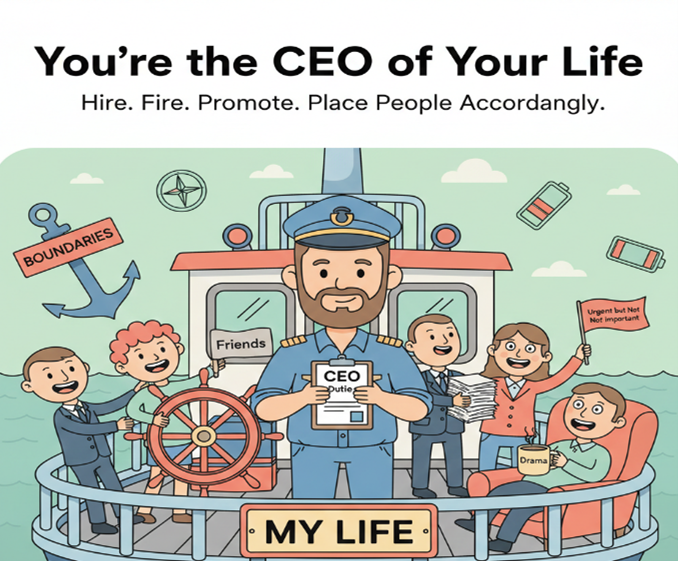
Congratulations. You are the CEO of your life.
Whether you’re leading it well… is a separate discussion.
Most of us are accidental CEOs
In shipping, leadership is structured. Clear roles. Clear authority. Clear accountability. Self-leadership at sea works the same way — until you step off the bridge and into the rest of your life, where it’s far less defined.
We lead through habit. Through momentum. Through obligation.
Occasionally through mild panic.
We don’t design systems—we inherit them. We don’t review performance—we cope with outcomes.
And then we wonder why the organisation feels inefficient.
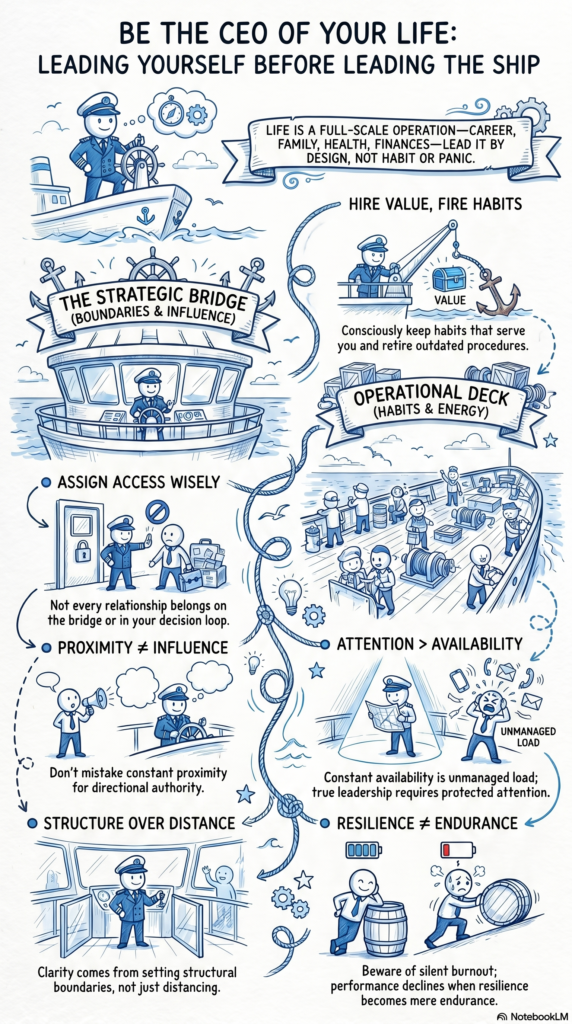
Make connections—but assign access wisely
Every ship has controlled zones. So does a well-run life.
Not everyone needs:
- Full access
- Decision-making influence
- Emergency-call privileges
Some people are great in your life—but not in your decision loop.
Not every relationship belongs on the bridge.
Some are perfectly placed in the background—valuable, but not directional.
Problems begin when boundaries blur.
When proximity is mistaken for influence.
When good intentions turn into constant noise.
Clarity isn’t distance. It’s structure.
Hire carefully—especially your habits
In organisations, hiring decisions are deliberate. In personal life, they are often accidental.
We keep:
- Commitments that drain more than they deliver
- Relationships that have run their course
- Habits that once worked—but no longer serve
Mostly because: “It’s always been this way.”
That’s how outdated procedures survive on ships too—until something breaks. Because systems that don’t evolve don’t stay stable — they slowly degrade, the same pattern we’ve seen play out in maritime safety culture.
Good leadership requires:
- Hiring what adds value
- Promoting what works
- Letting go of what doesn’t
Not emotionally.
Structurally.
Because systems that don’t evolve don’t stay stable—they slowly degrade.
Availability is not leadership
Shipping doesn’t reward the officer who is available 24/7.
It rewards the one who understands timing, prioritisation, and intervention.
Yet many of us operate as if constant availability equals responsibility.
Every message answered.
Every request accepted.
Every issue absorbed.
That’s not leadership.
That’s unmanaged load.
Good leaders protect their attention. They decide where to engage—and where not to.
Because attention, not time, is the real constraint.
You’re allowed to let things go
This is where it becomes uncomfortable.
Because “letting go” sounds harsh.
But in reality, it’s often necessary.
It may mean stepping back from:
- Roles that no longer fit
- Expectations that no longer apply
- Patterns that no longer work
Not out of frustration.
But out of alignment.
Strong leadership decisions are rarely emotional.
They are considered, measured, and timed.
And they recognise one simple truth:
Not everything is meant to scale with you.
Why this matters (especially in high-pressure industries)
Industries like shipping train people to be:
- Resilient
- Available
- Reliable under pressure
All valuable traits.
But self-leadership at sea rarely gets the same attention as technical training — and without it, those same traits come with a cost.
Resilience becomes endurance. Availability becomes overload. Reliability becomes silent burnout.
And burnout rarely arrives dramatically.
It shows up as:
- Reduced clarity
- Lower engagement
- Quiet detachment
The system keeps running. But performance declines.
Final Thought
You don’t need to become harder.
You don’t need to become distant.
You just need to become intentional.
Because whether you planned it or not— you are already leading your life. The only real question is: Are you designing it…or simply reacting to it?
📌 What’s one thing you’re choosing to step back from this year?
(Clarity counts. Even if it’s not shared publicly.)
Fiction from the same sea: The Measurable Horizon, Book 4: The Master’s Log →