
What We Learned from The Human Factor Series
Just culture in shipping is the thread running through everything you’re about to read.
Six acts. Seventeen articles. One uncomfortable truth:
If shipping is adapting so fast, why are we still fighting the same battles?
The answer, I’ve learned, has nothing to do with technology.
The Paradox We Refuse to Name
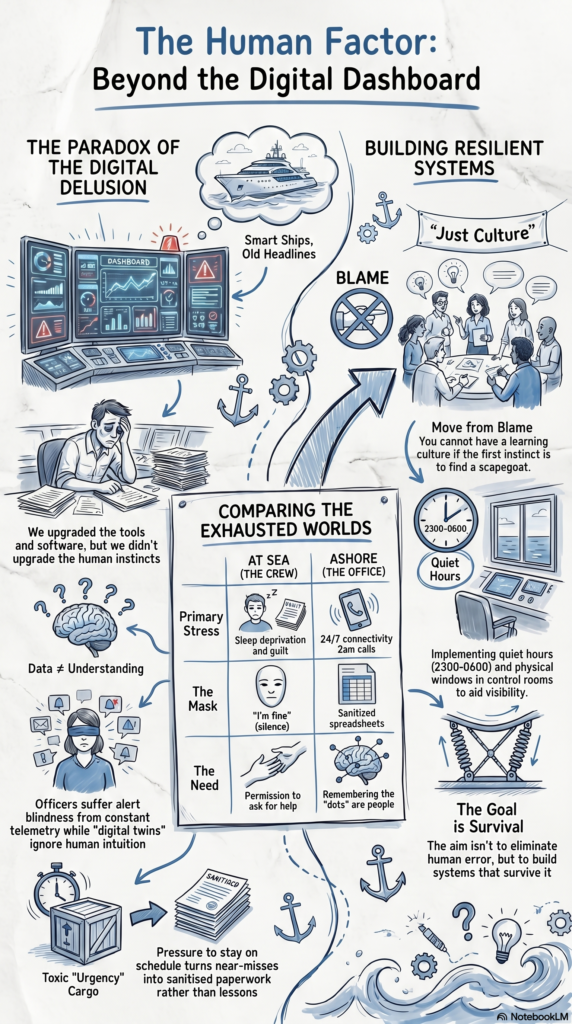
We built smart ships. AI route optimisation. Digital twins that mirror every pipe and bulkhead. Emissions dashboards that would impress NASA.
And yet, every few weeks, the same headline: Crew member lost. Vessel grounded. Cargo on fire. Ship detained. Another investigation underway.
We upgraded the tools. We didn’t upgrade the instincts.
The sea hasn’t read the software manuals. It never will.
That was Act 1. The paradox. The gap between what we measure and what matters.
Two Worlds, One Exhaustion
We spent Act 2 walking both sides of the radio.
At sea: the chief engineer who hasn’t slept properly in months, the second officer who saw something wrong and said nothing, the master who carries thirty‑five years of guilt from a grounding that wasn’t really his fault.
Ashore: the superintendent whose phone hasn’t been on silent since 2013, the crewing manager who takes calls at 2am from worried mothers, the safety manager who watches her carefully worded policies dissolve into sanitised spreadsheets.
Both sides are tired. Both sides are right. Both sides are holding the same line—just from different ends.
Connectivity was supposed to bring us closer. Instead, it created witnesses.
The Digital Delusion
Act 3 was the hardest to write. Not because the technology is bad—it isn’t. But because we’ve convinced ourselves that more data equals better decisions.
It doesn’t.
Ships now produce so much telemetry that officers suffer alert blindness. They silence alarms because if everything is urgent, nothing is. They trust AI recommendations that have never been seasick. They build digital twins that nobody onboard uses—because the twin shows what the sensors report, not what the chief engineer feels.
Ancient mariners crossed oceans with less data and more understanding. They felt the wind, read the swell, trusted their instincts.
We measure everything. We understand less.
The Cultural Disease
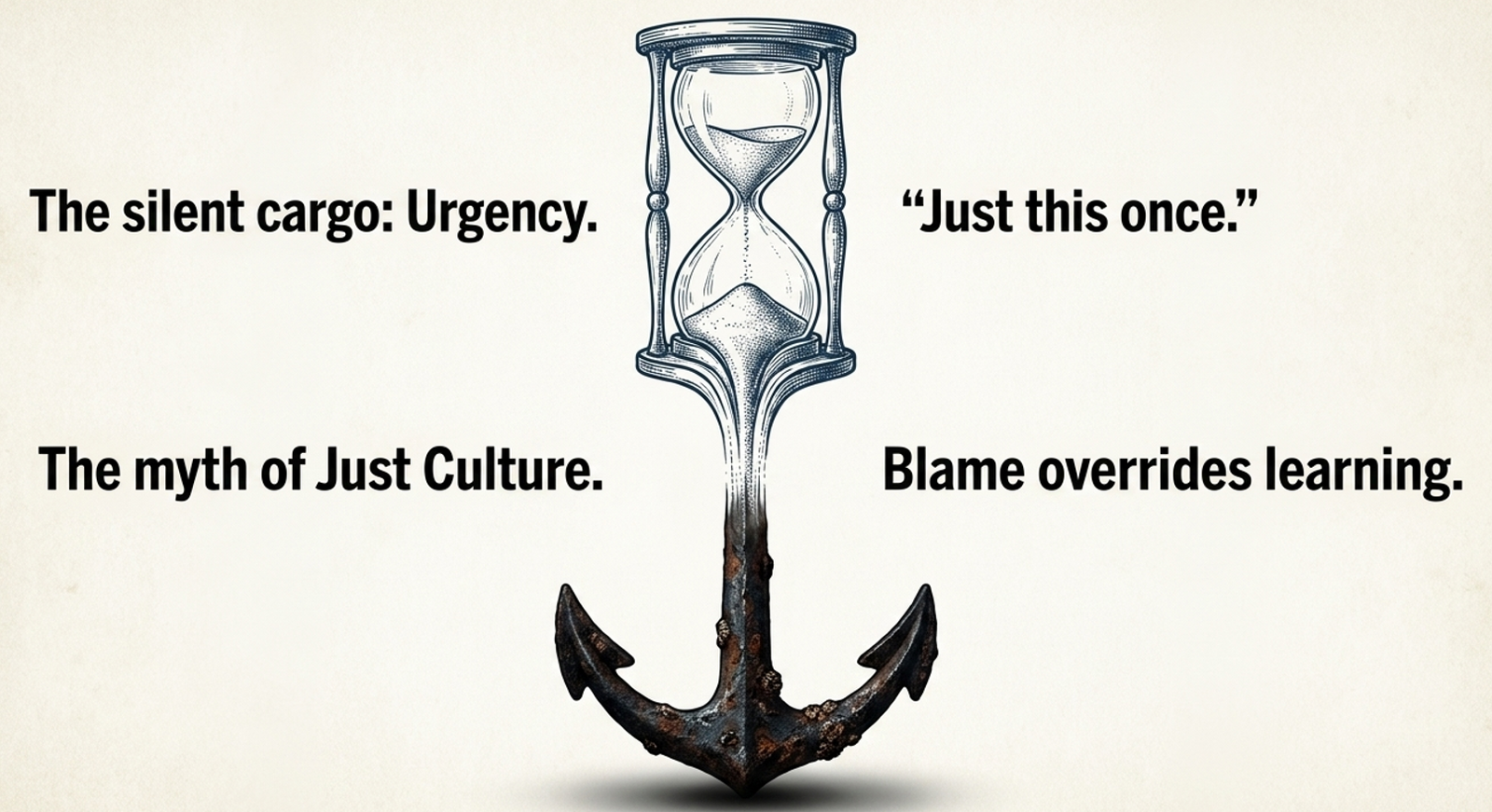
Act 4 named the real cargo: urgency. Not the healthy kind. The whispered kind. “Just this once.” “We’re already late.” “The charterers are watching.”
Urgency bends judgment until the rules barely matter. It turns near misses into paperwork we’d rather not file.
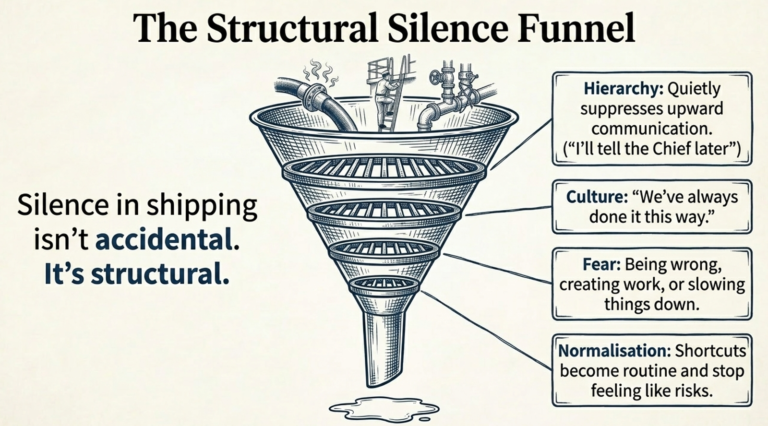
And then there’s the unicorn: just culture in shipping — the idea that people should be able to report honestly without fear of blame.
We say we want it. Until the deductible kicks in.
Until the lawyers ask for names. SKYbrary’s maritime safety resources lay out the regulatory framework behind this shift, but frameworks don’t change behavior on their own — culture does. You cannot have a learning culture if your first instinct is to find someone to blame.
The Messy Reality
Act 5 was the spill. Five minutes to cause. Five years to explain.
A blackout during anchoring approach. A rushed bunkering. An exhausted crew. A miscalibrated sensor. A thousand small compromises that seemed reasonable at the time.
The investigation concluded that every system functioned as designed.
Which, unfortunately, was exactly the problem.
The Way Forward
Act 6 didn’t offer grand solutions. It offered small ones: a quiet hours policy, a window in the engine control room, a five minute conversation between a captain and an officer who finally felt safe to speak.
This is what just culture in shipping actually looks like in practice — not a poster in the crew mess, but small, repeatable permission to be honest.
DNV’s research on safety culture makes the same point: effective leadership fosters a just culture rather than a blame culture, where people don’t fear making mistakes or concealing them.
What I Hope You Take Away
I didn’t write this series to depress you. I wrote it because silence has a cost, and we’ve been paying it for too long.
If you work at sea, I hope you remember that the mask you wear—the “I’m fine”—doesn’t have to be permanent. You’re allowed to be tired. You’re allowed to ask for help.
If you work ashore, I hope you remember that every dot on your dashboard is a person. A father. A mother. Someone who answered the phone when they should have been sleeping.
If you lead teams, I hope you ask yourself: What kind of culture am I creating? Because the Master Effect is real. Your bridge, your office, your ship—the tone you set is the one they follow.
And if you’re just someone who cares about the people who move 90% of the world’s goods, thank you. Keep caring. Keep talking.
One Last Field Note
Shipping has never been safer. Ships are smarter. Systems are better. But none of that replaces just culture in shipping — someone still has to be awake, and honest, when something feels wrong. The rest is up to you.Shipping has never been safer. Ships are smarter. Systems are better. Technology improves every year.
But the ocean doesn’t care about our dashboards. It only cares that someone is still awake to notice when something feels wrong.
The investigation concluded that every system functioned as designed.
Which, unfortunately, was exactly the problem.
If you’ve read this far, you already knew most of it. The question was whether anyone would say it out loud. Now someone has. The rest is up to you.
Keep talking.
The Sarcastic Mariner(s)….. Stirring the pot so the industry remembers how to think. If this made you pause, question, or smirk… there’s more where this came from:
⚓ The Human Factor Series:
- #0 – Because What Gets Measured Is Not Always What Matters
- #1 – Smart Ships, Same Headlines
- #2 – The Quiet Cost of Competence: Crew Welfare and the Persona at Sea
- #3 – The Dashboard Never Sleeps: Why Shore Life Isn’t the Soft Option
- #4 – Connectivity Didn’t Kill Trust, It Just Revealed It
- #5 – Maritime Technology Overreliance
- #6 – Digital Delusion in Shipping
- #7 – Ancient Seamanship vs. Wearable Technology
- #8 – Normalization of Deviance in Shipping (The Cultural Disease)
- #9 – The Unicorn of Shipping
- #10 – Auditing Steel Instead of Souls
- #11 – Ballast Water 2.0
- #12 – Digital Pirates, Patchy WiFi, and Paperless Promises
- #13 – The 5-Minute Spill and the 3-Year Investigation
- #14 – The A.P.E.M. Framework
- #15 – Designed for Superhumans
- #16 – The 5-Minute Conversation That Saves Millions
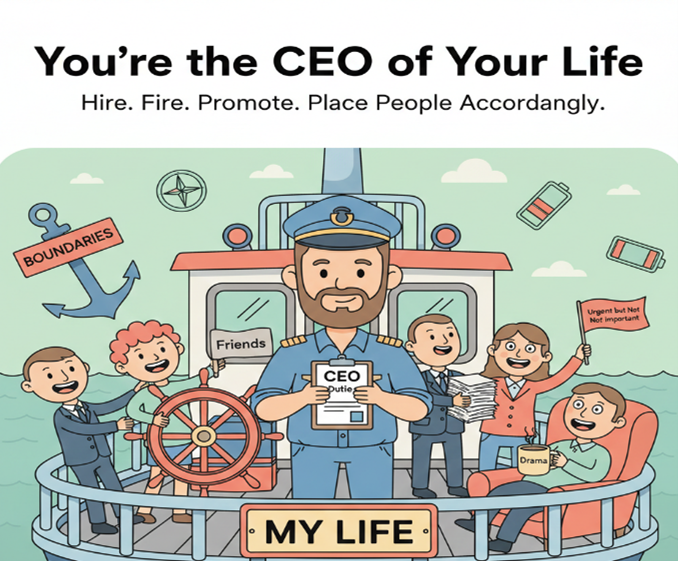
- #17 – Be the CEO of Your Life
- FINALE – The Other End of the Same Conversation
Fiction from the same sea: The Measurable Horizon, Book 5: Accountability in the Age of Visibility →