
Dr. Kumud R. Jha · Singapore · Doctorate in AI · US Patent Holder View LinkedIn Profile
Why AI Prompting Matters More Than Technical Skill
Yesterday we crossed the halfway point. The first fifteen days were about understanding what AI is, what it isn’t, and why the loudest voices on both sides are missing most of the picture.
Now we get practical. Because here is what I have noticed watching hundreds of people interact with AI tools over the past two years: the real skill gap isn’t technical — it’s AI prompting.
The gap between people who get extraordinary value from AI and people who get mediocre results has almost nothing to do with technical skill. It has everything to do with how they think about the interaction.
The people who get the most from AI treat it like a brilliant, well-read colleague who just joined the team.
Not a search engine. Not an oracle. Not a magic button.
A colleague. Brilliant, yes. Extraordinarily well-read. But new. Without context. Without knowledge of your specific situation, your constraints, your history, your standards.
What do you do with a brilliant new colleague?
You brief them properly. You give them context. You tell them what good looks like in your world. You push back when their first answer misses the mark. You iterate. You build shared understanding over time.
That is exactly how great AI users work.
Here is what separates them concretely:
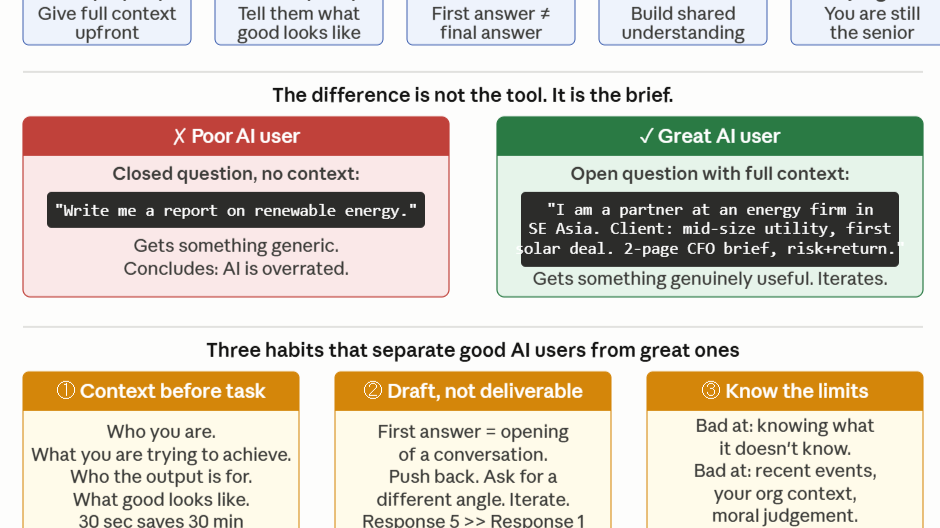
Poor AI users ask closed questions and accept the first answer. “Write me a report on renewable energy.” They get something generic. They conclude AI is overrated.
Good AI users ask open questions with context. “I am a partner at an energy consulting firm in Southeast Asia. My client is a mid-size utility considering its first solar investment. Write me an executive briefing — two pages, no jargon, focused on risk and return — for a CFO audience.” They get something genuinely useful. They iterate from there.
The difference is not the tool. It is the brief.
Three habits that separate good AI users from great ones:
First — give context before you give the task. Who you are, what you are trying to achieve, who the output is for, what good looks like. Thirty seconds of context saves thirty minutes of iteration.
Second — treat the first response as a draft, not a deliverable. The first answer is the opening of a conversation, not the end of one. Push back. Ask for a different angle. Tell it what it got wrong. The quality of the fifth response is almost always dramatically better than the first.
Third — know what AI is bad at and route around it. AI is bad at knowing what it doesn’t know. It is bad at very recent events. It is bad at your specific organisational context unless you provide it. It is bad at tasks requiring genuine moral judgement. Know the limits. Work with them, not against them.
The people who say AI is useless have usually only tried the first response.
The people who say AI can do everything have usually not pushed it hard enough to find the edges.
The truth, as usual, is in the practice.