
Dr. Kumud R. Jha · Singapore · Doctorate in AI · US Patent Holder View LinkedIn Profile
Let me begin with a confession that might surprise you coming from an AI researcher: the fear of AI taking over is not irrational. It is ancient. It is wired into us. And history has given it every reason to persist.
Here is the pattern that repeats across human civilisation, without exception:
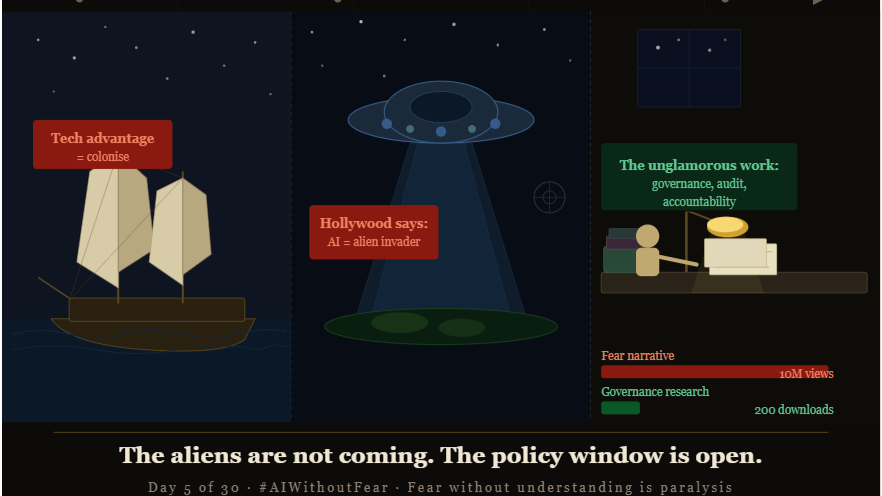
Every time a society achieved a decisive technological advantage over its neighbours — the stirrup, the cannon, the steam engine, the industrial factory, the nuclear weapon — it did not sit quietly with that advantage. It expanded. It extracted. It dominated. The civilisations that mastered iron subjugated those who had not. The Europeans who built ocean-going ships and gunpowder weapons colonised vast portions of the planet. The nations that industrialised first wrote the economic rules for everyone else.
Technological superiority, in human hands, has historically meant the licence to impose. This is the same instinct that fuels fears about AI replacing human workers — an old anxiety about displacement, now aimed at a new technology.
So it is entirely rational — rooted in thousands of years of lived civilisational memory — that when people hear “a new technology of unprecedented power is arriving,” their nervous system reaches for a very old question: who is going to use this to take what is mine?
How Hollywood Turned AI Taking Over Into a Cinematic Template
Think about every major science fiction film involving technologically superior aliens. They do not come to trade. They do not come to learn. They come with weapons of mass destruction and the intention to colonise, extract, or exterminate. Independence Day. War of the Worlds. Oblivion. Avatar — where for once the colonial script is flipped, and we are the technologically superior invaders.
The template is always the same because it is drawn from the only model of “advanced civilisation meets less advanced civilisation” that human history has ever produced. We projected our own colonial instinct onto the stars — and then, when AI arrived, we projected it onto the machine.
The fear is not invented. It is inherited.
But here is where the analogy breaks down — decisively.
Colonial powers wanted land, labour, resources, and markets. They had desires, rivalries, fear of rivals, and survival instincts. A Portuguese navigator of the 16th century was operating within a zero-sum competition for global dominance. His motivations were comprehensible — and dangerous — because they were human.
Current AI systems have none of this. They have no territorial ambition. No survival instinct. No fear of a rival AI seizing their resources. No desire to subjugate anyone. They are, at their core, extraordinarily sophisticated optimisation engines — systems that are very good at the specific task they were designed for, with zero interest in anything beyond it.
The AI that recommends your next Netflix series does not secretly want to take over your television. The AI that reads radiology scans does not harbour ambitions beyond the image in front of it. The gap between “very capable tool” and “colonising intelligence” is not a matter of degree. It is a categorical difference that current AI does not remotely approach.
So why does the fear dominate the conversation?
Because bad news travels at the speed of fire and governance travels at the speed of bureaucracy.
A researcher publishing a careful, nuanced paper on AI alignment frameworks gets 200 downloads and a polite audience at an academic conference. A podcaster who says “AI will end humanity within a decade” gets ten million views, three book deals, and a Netflix documentary.
The governance conversation — the one happening right now between AI safety researchers, regulators, ethicists, and policymakers — is genuinely important. It is also, by any honest measure, deeply unsexy. It involves technical standards, liability frameworks, audit requirements, international coordination mechanisms, and the grinding work of institutional design. None of that trends on social media.
The result is a profound asymmetry in public perception. The fearmongers are not necessarily wrong that risks exist — some of them are serious researchers raising legitimate long-term concerns. But the volume and drama of the catastrophist narrative vastly outweighs the signal. And in that noise, the people doing the quiet, essential work of actually making AI safer and more accountable become nearly invisible.
The most dangerous outcome is not a rogue AI. It is a public so frightened by fictional scenarios that it cannot engage with the real governance decisions being made right now — decisions that will shape how this technology develops for decades.
Fear without understanding leads to paralysis. And paralysis, in a moment that requires active, informed democratic engagement with AI governance, is the one outcome we genuinely cannot afford.
The aliens are not coming. But the policy window is open — and it will not stay open forever.